
St. Martin Island Lighthouse: A remote relic of Great Lakes maritime history
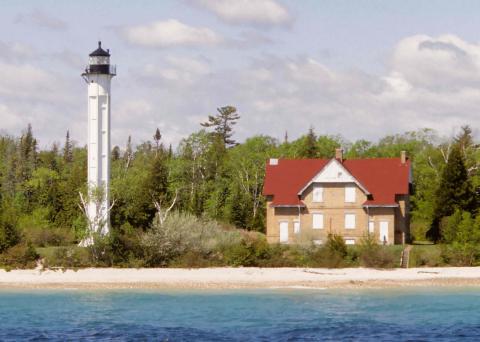
The St. Martin Island Lighthouse continues to aid mariners on Lake Michigan. (Photo courtesy of the United States Lighthouse Society)
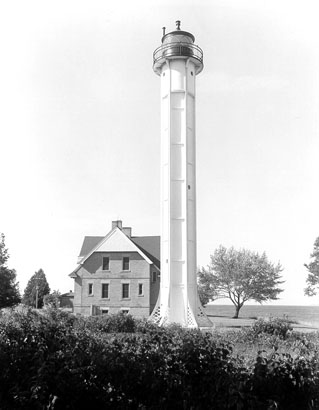
The St. Martin Lighthouse, located in Lake Michigan nearly halfway between the tip of Michigan's Garden Peninsula and Wisconsin's Door Peninsula, was first lit in 1905. (Photo courtesy of the United States Coast Guard)
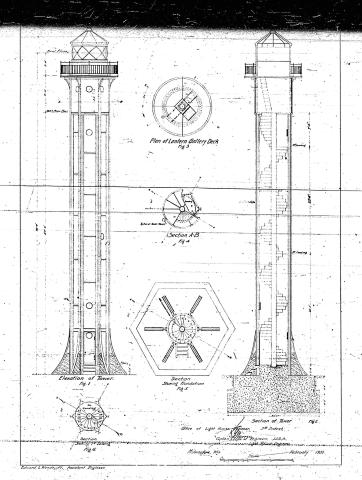
St. Martin Island Lighthouse architectural plan from around 1900 (Photo courtesy of the National Archives)
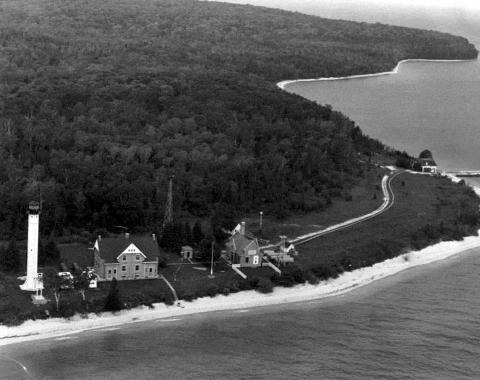
An aerial shot of St. Martin Island and its lighthouse (Photo courtesy of the United States Lighthouse Society)
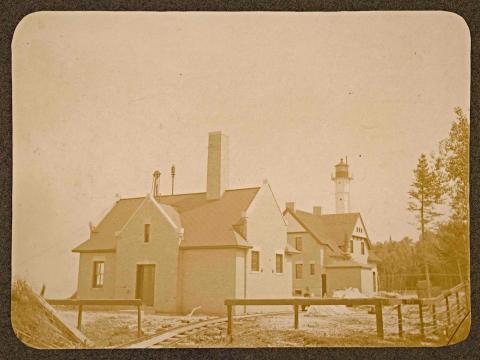
This 1904 photo shows the tramway, fog house, keeper's dwelling and lighthouse on St. Martin Island. (Photo courtesy of the National Archives)
The St. Martin Island Lighthouse continues to aid mariners on Lake Michigan. (Photo courtesy of the United States Lighthouse Society)
The St. Martin Lighthouse, located in Lake Michigan nearly halfway between the tip of Michigan's Garden Peninsula and Wisconsin's Door Peninsula, was first lit in 1905. (Photo courtesy of the United States Coast Guard)
St. Martin Island Lighthouse architectural plan from around 1900 (Photo courtesy of the National Archives)
An aerial shot of St. Martin Island and its lighthouse (Photo courtesy of the United States Lighthouse Society)
This 1904 photo shows the tramway, fog house, keeper's dwelling and lighthouse on St. Martin Island. (Photo courtesy of the National Archives)
Trending
Editor’s note: This story on the St. Martin Island Lighthouse is the fifth in a series on the area’s lighthouses and lightships.
FAIRBANKS TOWNSHIP -- Remote, rugged and largely inaccessible to the public, St. Martin Island is home to one of the Great Lakes’ most distinctive navigational landmarks -- the St. Martin Island Lighthouse. Although automated like many other lighthouses in the region, it remains an active aid to navigation for mariners on Lake Michigan.
The completion of the Peninsula Railroad in 1864, linking Escanaba with the Negaunee iron mines, brought a steady stream of ore vessels to the Port of Escanaba. Ships traveling south had to navigate the hazardous shoals and islands surrounding the St. Martin Passage.
As maritime traffic increased, so did the need for a lighthouse on St. Martin Island, located in Lake Michigan nearly halfway between the tip of Michigan’s Garden Peninsula and Wisconsin’s Door Peninsula.
The island, settled well before the founding of Escanaba, was once home to several fishing villages. Historical accounts indicate it was inhabited by a small band of Native Americans who traded beaver with the French for beads, metal axes, firearms and brandy.
The island also contains an old schoolhouse, a cemetery and remnants of other historic structures. Peter Strom, former president of the Delta County Historical Society, described the buildings as resembling those at Fayette Historic State Park before restoration efforts were completed.
According to the U.S. Coast Guard, the U.S. Lighthouse Board -- the federal agency established by Congress in 1852 to oversee the nation’s lighthouses -- appealed to Congress for funding to construct a lighthouse on St. Martin Island.
Congress initially rejected the request, and the Lighthouse Board renewed its request for the next seven years. Funding was finally approved in 1898, but construction was delayed while the government worked to obtain title to the property.
Because the property owners were unwilling to sell, the title was not cleared until 1901, allowing construction to begin.
The Coast Guard reported that the lengthy delay between the original appropriation and the start of construction required an additional $14,000 to be appropriated for the project. Although Congress denied that request, it instead appropriated another $10,000, bringing the total project funding to $25,000. Construction was scheduled to begin in 1902.
Another setback came when an iron shortage halted work until September 1903.
By the end of that construction season, work was underway on a two-story duplex keeper’s house. Construction resumed in 1904, and the “Cream City brick” keeper’s dwelling was completed using the same plans as the Plum Island Light, built in 1897.
The lighthouse itself was completed in 1904 but was not illuminated until the opening of the 1905 navigation season, as funding was unavailable to hire lighthouse keepers.
The 75-foot tower is considered one of the most unusual lighthouse designs on the Great Lakes. Hexagonal in shape, it features an iron exoskeleton, with its steel support framework mounted on the exterior of the tower.
According to past Escanaba Daily Press reports, it is believed to be the only example of exoskeletal lighthouse construction on the Great Lakes.
The curved lantern room originally housed a Fourth Order Fresnel lens manufactured by Barbier, Benard & Turenne of Paris, France. Today, the lens is displayed in the keeper’s quarters at Point Iroquois Light Station in Chippewa County.
The station’s fog signal building followed designs used at earlier Great Lakes lighthouses, including Old Mackinac Light in 1890 and Beaver Island Light in 1891, according to the Coast Guard.
Historical records indicate that sometime before 1939, the station’s 10-inch steam whistles at the fog signal building were removed and replaced with a diaphone fog signal.
Also at the light station, the radio beacon became one of its most important navigational features, transmitting a precise signal that allowed mariners to determine the lighthouse’s location. The beacon was controlled by two Seth Thomas weight-driven clocks.
According to the United States Lighthouse Society, eight principal keepers served at St. Martin Island during its years of manned operation, along with numerous first and second assistant keepers.
Local folklore tells of a ghost said to haunt the island -- the spirit of a lighthouse keeper who endlessly searches for children believed to have drowned in a storm off the island.
The Coast Guard automated the lighthouse in 1980, after which the Fred Luber family of Milwaukee purchased the island for private use.
The Little Traverse Bay Bands of Odawa Indians acquired the lighthouse property in 1999.
In 2002, Strom wrote to the U.S. Department of the Interior’s Bureau of Indian Affairs regarding an environmental assessment after the tribe requested that an additional 47.8 acres on the island be placed into a trust.
According to Strom’s letter, the assessment stated the lighthouse and surrounding facilities were needed by the tribe to support fisheries research and management, enforce of tribal fish and game laws, regulate tribal fishing harvests and provide safe harbor during storms.
Strom argued that St. Martin Island should remain accessible as a historic property, saying public access to the lighthouse and surrounding grounds was important to the continued research and development of the historic Sand Point Lighthouse report.
“Since the St. Martin Island Lighthouse is listed on the National Historic Register, the Secretary must protect the public’s interest in the historic factors and features that made the site eligible for the National Register,” Strom wrote.
Although the light remains an active navigational aid, public access to both the lighthouse and the island is prohibited. The public can, however, walk the island’s shore, as the Michigan Supreme Court determined in 2005 that the public has a right to walk along the shores of the Great Lakes, even on privately-owned land.
The Nature Conservancy purchased most of St. Martin Island -- approximately 1,244 acres -- from the Luber family in 2013 and acquired another 36 acres from David Uihlein Jr. in 2014.
The remaining 57 acres, including the lighthouse, are owned by the U.S. Bureau of Indian Affairs and managed by the Little Traverse Bay Bands of Odawa Indians.
Time has transformed St. Martin Island from a home to Indigenous communities and lighthouse keepers into one of the Great Lakes’ most secluded landmarks. Yet despite generations of change and shifting ownership, its lighthouse continues the mission it began in 1905 -- guiding mariners safely through the waters of Lake Michigan.
------
Sophie Vogelmann can be reached at 906-786-2021 or svogelmann@dailypress.net.