
Eleven Foot Shoal: Four decades of floating beacons
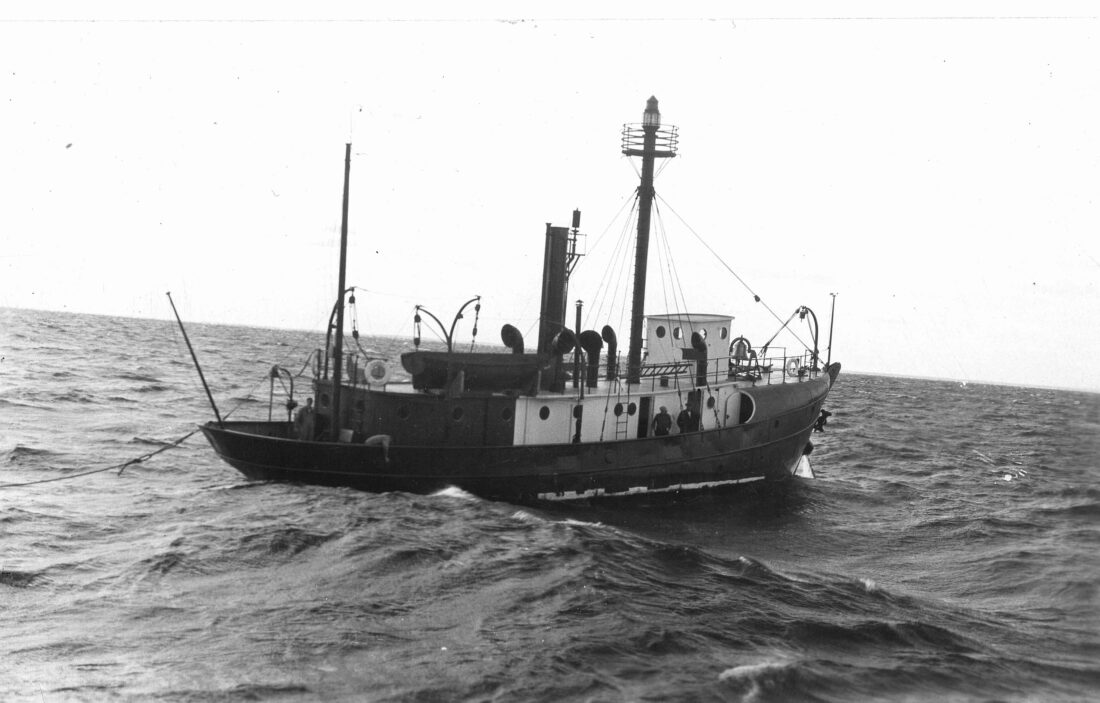
Lightship 82 was the second and last lightship to take position at the Eleven Foot Shoal, approximately two and a half miles off of Peninsula Point. (Photo courtesy of the U.S. Coat Guard Historian's Office)
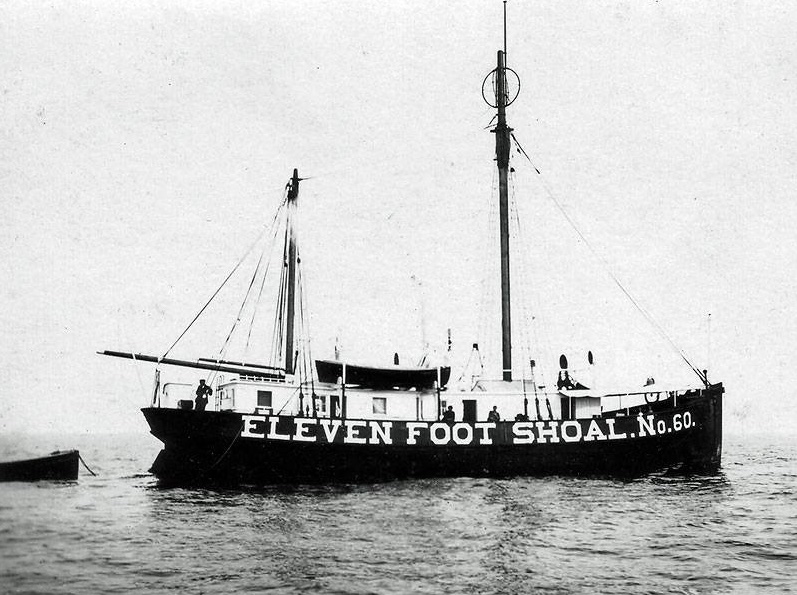
This photo depicts Lightship 60 at the Eleven Foot Shoal. The lightship arrived at the shoal on Oct. 6, 1893, taking up its position at the northern end of Green Bay. (Photo courtesy of the United States Lighthouse Society archives)
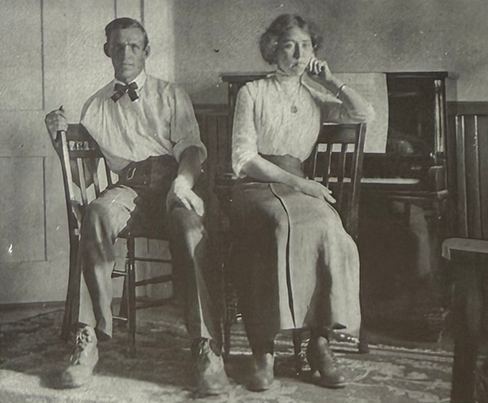
Charles Girard, the man who built the model of Eleven Foot Shoal and served as an engineer on the ship, married Mabel, daughter of Captain Charles Armstrong, Keeper at Peninsula Point Lighthouse. This photo shows both Girard and Armstrong on the day of their engagement. (Photo courtesy of the Delta County Historical Society)
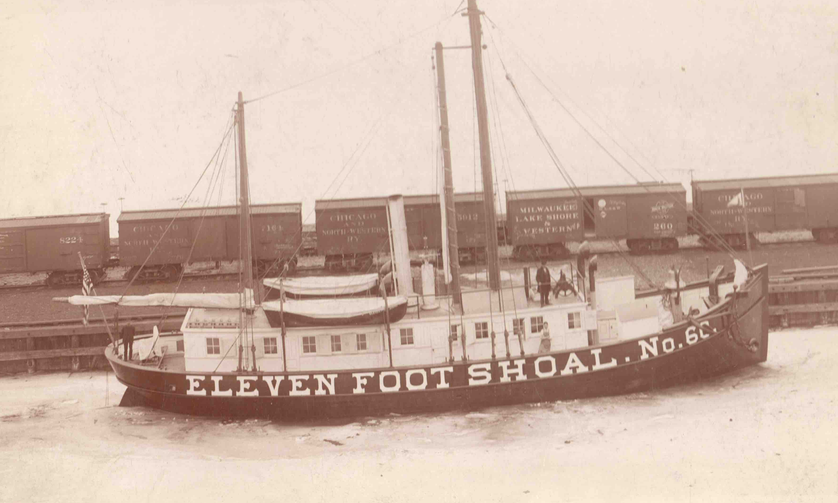
From 1893 to 1935, two lightships anchored at the Eleven Foot Shoal and guided mariners into Little Bay de Noc. (Photo courtesy of the National Archives via the United States Lighthouse Society)
Lightship 82 was the second and last lightship to take position at the Eleven Foot Shoal, approximately two and a half miles off of Peninsula Point. (Photo courtesy of the U.S. Coat Guard Historian's Office)
This photo depicts Lightship 60 at the Eleven Foot Shoal. The lightship arrived at the shoal on Oct. 6, 1893, taking up its position at the northern end of Green Bay. (Photo courtesy of the United States Lighthouse Society archives)
Charles Girard, the man who built the model of Eleven Foot Shoal and served as an engineer on the ship, married Mabel, daughter of Captain Charles Armstrong, Keeper at Peninsula Point Lighthouse. This photo shows both Girard and Armstrong on the day of their engagement. (Photo courtesy of the Delta County Historical Society)
From 1893 to 1935, two lightships anchored at the Eleven Foot Shoal and guided mariners into Little Bay de Noc. (Photo courtesy of the National Archives via the United States Lighthouse Society)
Trending
Editor's note: This story on Eleven Foot Shoal is the third in a series on the area's lighthouses, and in this case, lightships.
ESCANABA -- The history of Eleven Foot Shoal is not defined by a single lightship, but by a succession of vessels that shared the station’s name while guiding vessels into Little Bay de Noc for more than 40 years.
Unlike lighthouses, which stand firmly anchored to the shore or on fixed foundations, lightships were floating beacons stationed where constructing a lighthouse was impractical.
Their crews lived aboard vessels that rolled with the waves, enduring cramped quarters, violent storms and long periods of isolation while providing lifesaving guidance to passing mariners.
When Peninsula Point Lighthouse was built at the southern tip of the Stonington Peninsula in 1865, it helped guide ships traveling to and from the ports of Little Bay de Noc. As larger vessels with deeper drafts became more common on the Great Lakes, however, additional navigational aids were needed to warn mariners of the hidden hazards lying offshore.
According to newspaper clippings preserved by the United States Lighthouse Society, Congress appropriated $60,000 in the early 1890s to establish the Eleven Foot Shoal lightship station .
In 1893, the federal government stationed a lightship approximately two and a half miles off the Stonington Peninsula at Eleven Foot Shoal, named after the depth of the water at its highest point. Two different vessels would go on to anchor the shoal.
Lightship 60 arrived on Oct. 6, 1893, taking up its position at the northern end of Green Bay to guide vessels making the turn into Little Bay de Noc.
Like most Great Lakes lightships, it served only during the navigation season, returning to Escanaba each winter when ice closed the lakes to shipping. The only exception came in 1904, when the vessel wintered at Sturgeon Bay, Wisconsin.
The ship carried three oil-burning lanterns hoisted to the foremast, a steam whistle and an 800-pound brass bell for use during periods of dense fog.
Over the years, it underwent continual improvements, including expanded coal bunkers and the construction of new decking alongside the deckhouse.
Its first master, Capt. Soren Kristiansen, had spent roughly 25 years on the water before assuming command.
In an undated diary entry, Kristiansen recalled:
“On September 15, 1893, I was put in Command of Light Ship No. 60. She was lying at the Government Buoy Depot, Detroit, Michigan. It was an important day for me…. In the evening, the light was hoisted for the first time, and thus my new life had begun, with perfect gentleman for superior officers.”
Historical records indicate that in the early years of the Lighthouse Service, masters hired civilian crews who were required to be American citizens and sign Ship’s Articles. Although incomplete, surviving crew lists of Lightship 60 include men from Garden, Stonington and Escanaba.
“Some adjusted to the cramped quarters and military-like discipline and an equal number resigned or were removed from the strenuous service,” one historical account noted.
Historical accounts describe a brief period of chaos in 1894, when a faulty shackle pin broke, breaking the anchor connection. Kristiansen spent hours attempting to reconnect the two-inch anchor chain from a small rowboat before another lighthouse tender was summoned to return the vessel to its assigned position.
After 22 years as master, Kristiansen became keeper of Sand Point Lighthouse in Escanaba, though he reportedly continued assisting the lightship whenever needed.
Lightship 60 ended its service at Eleven Foot Shoal in 1926 after 33 years. It was sold on Jan. 15, 1926, and was later reportedly used as a floating clubhouse in Chicago.
During its years at the shoal, 12 commanding officers served on Lightship 60.
One man, Charles Girard, built the model of the Eleven Foot Shoal lightship and served aboard the vessel as an engineer. He married Mabel Armstrong, the daughter of Capt. James D. Armstrong, who served as keeper of the Peninsula Point Lighthouse.
At least six men who served aboard Eleven Foot Shoal lightships later became lighthouse keepers themselves: Kristiansen, Girard, Walter Hanson, Dan Garrett, William Ohern and Severin Danielsen.
The following navigation season opened with Lightship 82, which served at Eleven Foot Shoal until 1936.
According to Great Lakes Research, the vessel had previously been stationed off Point Abino, Ontario, where it guided ships approaching Buffalo, New York.
During the Great Lakes Storm of November 1913, the lightship sank in the waters of Lake Erie with the loss of all six crew members.
Debris and life jackets later washed ashore, and the following spring, a Government Lake Survey craft found the wreckage in 62 feet of water almost two miles off from its original station.
The lightship was eventually brought to the surface in September of 1915 before being towed to Detroit where it was repaired and refitted.
After being repaired, it served as a relief vessel on the Great Lakes from 1916 to 1925, at which point it arrived in Delta County to replace the outdated Lightship 60.
Although sources differ on when the lightship station at Eleven Foot Shoal was discontinued -- with newspaper accounts citing 1935 and the U.S. Coast Guard Historian’s Office listing 1936 -- 1935 is generally regarded as the most widely accepted date.
The new Minneapolis Shoal Lighthouse, located 12 miles south of Escanaba, replaced the need for lightships at Eleven Foot Shoal and was reportedly lit for the first time in 1935, bringing an end to more than four decades of floating lightships safeguarding the entrance to Little Bay de Noc.
------
Sophie Vogelmann can be reached at 906-786-2021 or svogelmann@dailypress.net.