
Peninsula Point Lighthouse: A beacon that stands the test of time
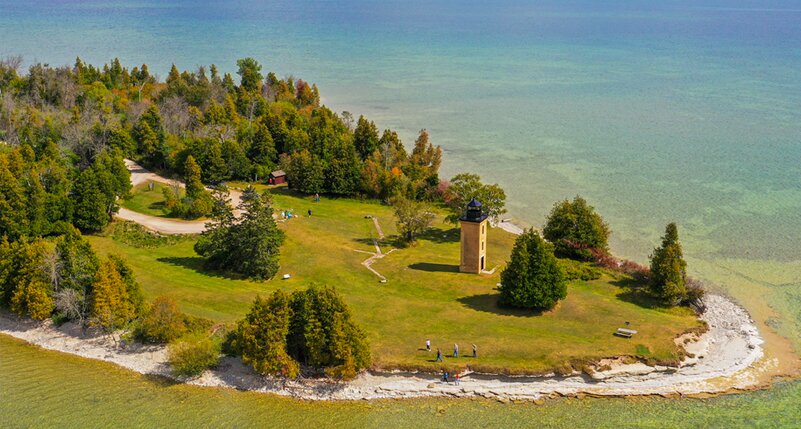
The Peninsula Point Lighthouse has sat at the southern tip of the Stonington Peninsula since 1865. (Photo courtesy of Visit Escanaba)
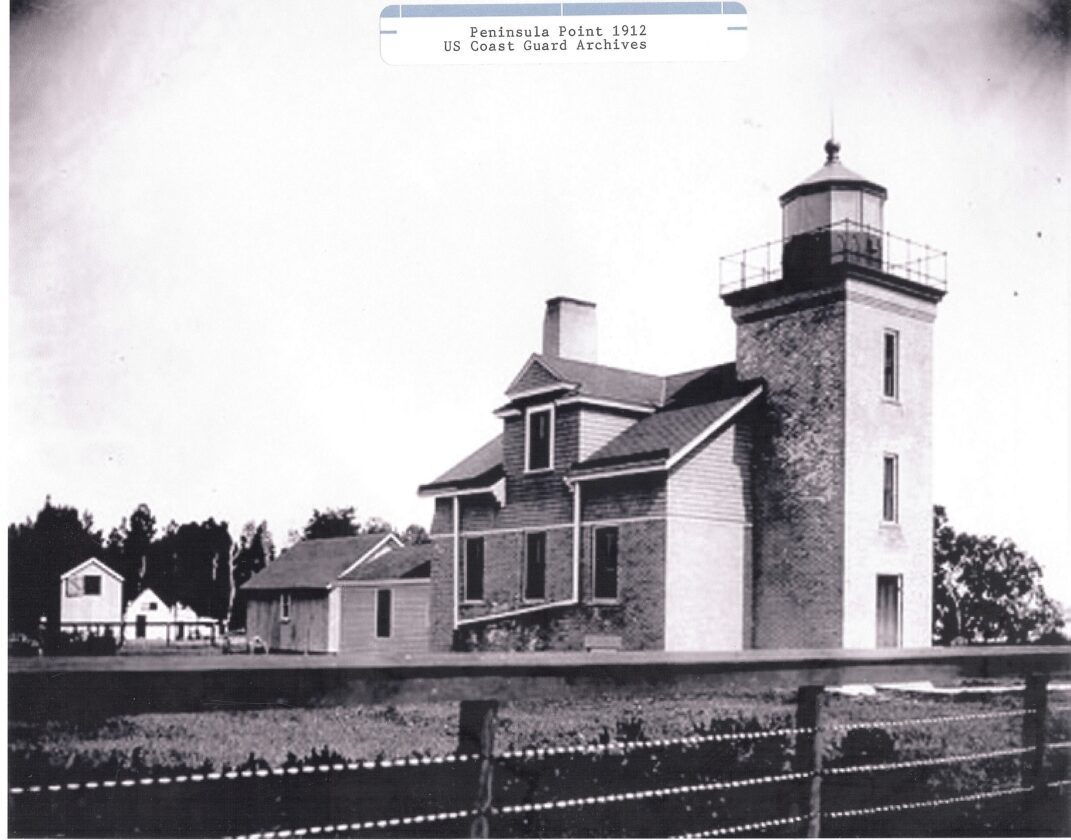
The Peninsula Point Lighthouse, dwelling and outbuildings as they appeared in 1912. (Photo courtesy of the U.S. Coast Guard Archives via the Delta County Historical Society Archives)
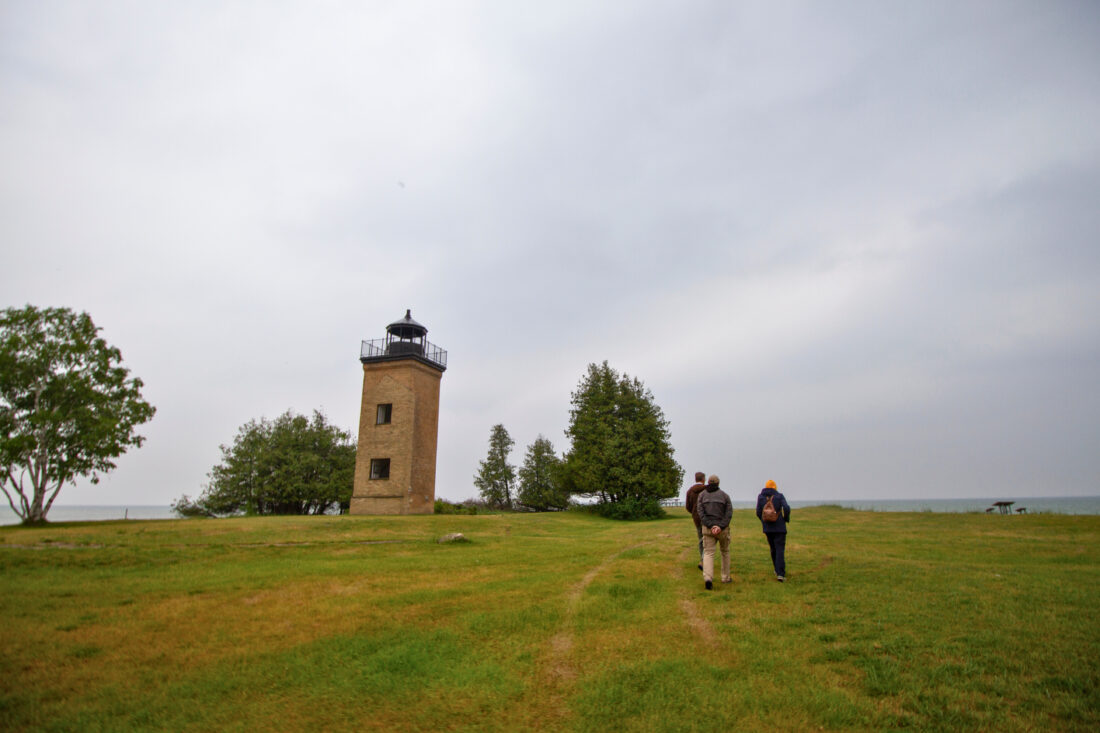
The Peninsula Point Lighthouse in Stonington has stood for just over 160 years, though it has endured many changes over its lifetime. (R. R. Branstrom | Daily Press)
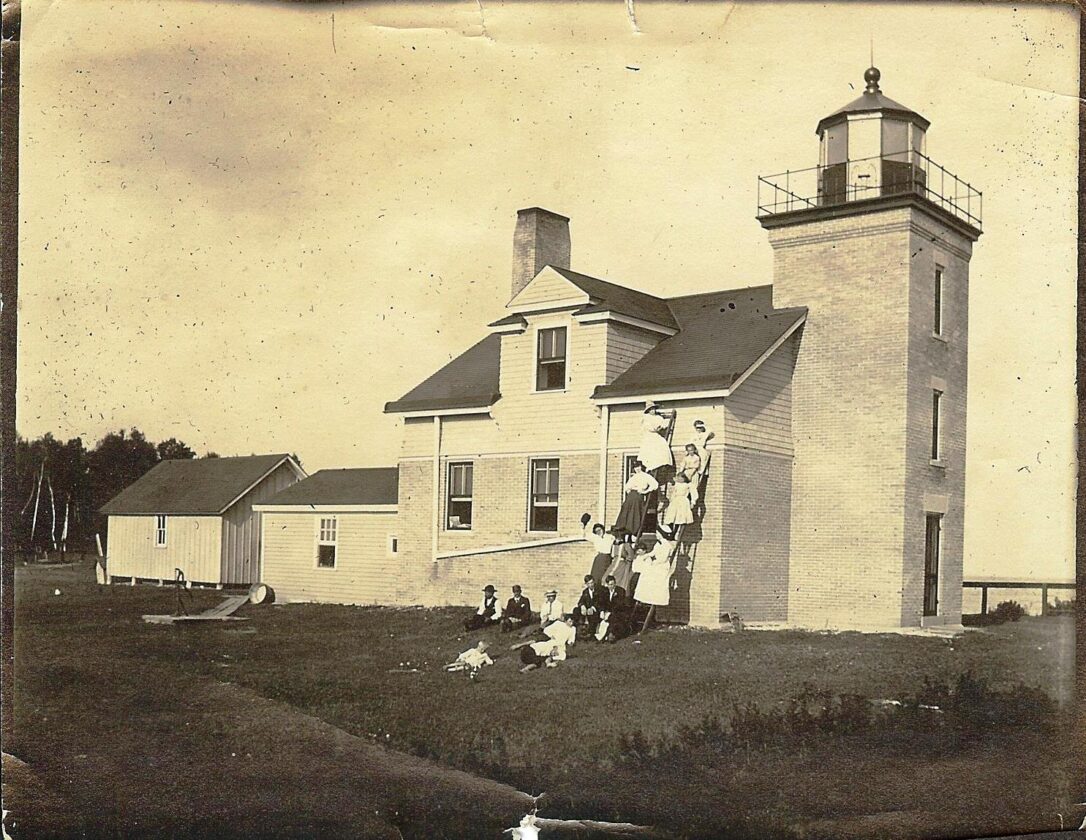
A group of approximately 17 people are posed on two ladders propped up against the side of the Peninsula Point Lighthouse. A donor has dated the photo to 1911. These are most likely members of the Armstrong family, though none are identified. (Photo courtesy of the Delta County Historical Society Archives)
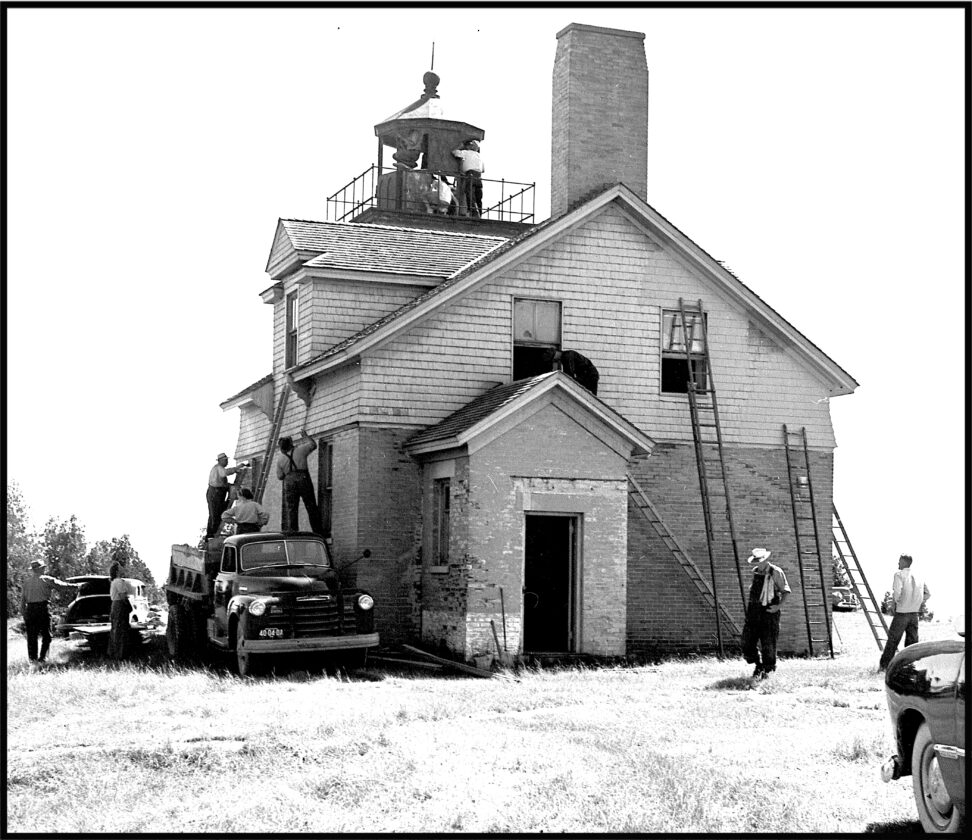
Members of the Stonington Grange can be seen working to restore the Peninsula Point Lighthouse in 1949. (Photo courtesy of the Delta County Historical Society Archives)
The Peninsula Point Lighthouse has sat at the southern tip of the Stonington Peninsula since 1865. (Photo courtesy of Visit Escanaba)
The Peninsula Point Lighthouse, dwelling and outbuildings as they appeared in 1912. (Photo courtesy of the U.S. Coast Guard Archives via the Delta County Historical Society Archives)
The Peninsula Point Lighthouse in Stonington has stood for just over 160 years, though it has endured many changes over its lifetime. (R. R. Branstrom | Daily Press)
A group of approximately 17 people are posed on two ladders propped up against the side of the Peninsula Point Lighthouse. A donor has dated the photo to 1911. These are most likely members of the Armstrong family, though none are identified. (Photo courtesy of the Delta County Historical Society Archives)
Members of the Stonington Grange can be seen working to restore the Peninsula Point Lighthouse in 1949. (Photo courtesy of the Delta County Historical Society Archives)
Trending
Editor’s note: This story on Peninsula Point Lighthouse is the second in a series on the area’s lighthouses.
STONINGTON -- Situated at the southern tip of the Stonington Peninsula, the Peninsula Point Lighthouse has long served as both a historic landmark and a popular destination for visitors seeking local history and outdoor recreation.
The site offers panoramic views of Lake Michigan and is home to over 200 bird species. It also hosts thousands of monarch butterflies each fall as they begin their 1,900-mile migration south.
Visitors can take advantage of picnic tables, grills and restroom facilities located on the grounds. A highlight for many visitors is the limestone shoreline, known for yielding fossils estimated to be 400 million to 500 million years old.
The history of Peninsula Point Lighthouse -- often referred to simply as "the Point" -- dates back to 1864, when the U.S. government recognized the need for a navigational beacon on the Stonington Peninsula.
At the time, shipping traffic was increasing rapidly as area ports transported fish, lumber, iron ore and other products throughout the region.
The lighthouse was needed to guide wooden sailing vessels through the hazardous waters surrounding the peninsula, where shoals such as the Eleven Foot and Minneapolis Shoals posed a constant threat.
Historical accounts describe the reefs as "the watery graves of many wooden-bottom ships."
Congress appropriated funds for the Point on July 20, 1864, and construction of the site was completed the following year.
The 47-acre light station includes a 40-foot-tall brick tower with a spiral iron staircase that led keepers and visitors to the light deck.
Attached to the north side of the tower was a one-and-a-half-story brick residence for the many lighthouse keepers that called the space home during their tenure.
Also located on the site was a compound of buildings, including a frame barn, a frame woodshed, a brick oil house and a privy, according to U.S. government records from 1930. None of those structures remain today.
The first lighthouse keeper at the Point was Charles Beggs. During his time as keeper and thereafter, the dangers of sailing in the area were well documented.
Among the recorded wrecks was one on Dec. 8, 1875: "A heavy gale of wind wrecked the small schooner Jessie Jewell, and all hands were lost."
A report from sometime in 1879 also states, "A small boat was capsized in Little Bay de Noc, containing three persons, all of whom were drowned. The boat was found bottom up with two hats lying alongside."
Beggs died at the Point in February 1887. According to letters preserved by the Delta County Historical Society, Beggs' wife, who had assisted him with lighthouse duties, appealed to the commander of the U.S. Navy's 11th Lighthouse District to appoint her as keeper of the lighthouse after her husband's death.
Her letter, dated Feb. 21, 1887, states, "I am able and competent to discharge the duties in satisfactory manner as I have attended to the Light in sickness of my deceased husband month at the time… I will be obliged to move to Escanaba by ice with teams as we have no dock as it will be utterly impossible to move by boat and houses are not plenty in Escanaba… I am entirely lost don't know what to do if I don't get the Lighthouse."
Instead, Henry Corgan was appointed keeper in April 1887.
In a letter dated May 2, 1887, Corgan described hardships caused by deteriorating docking facilities and inadequate boats. He reported that ice in the bay had carried away the dock, making it impossible to use the station's boat, which he noted was too large to maneuver effectively.
Corgan served until July 1888, when Peter Knudsen was appointed keeper.
During his appointment, Knudsen wrote to lighthouse officials requesting extensive repairs. He described difficult living conditions at the Point, citing insects, cold temperatures, poorly maintained windows and a lack of accommodations.
In October 1889, Captain James D. Armstrong was appointed keeper of the Point after serving as assistant keeper at the South Manitou Lighthouse. Armstrong made the lighthouse his home with his wife and eventually six children -- all but one of whom were born at the Point.
Interview notes from one of Armstrong's children, Ella Jacobsen, state, "Due to the difficult journey and disappointing shape of the facilities, Captain Armstrong told his wife they would not stay there long. Then they commenced to stay for over 40 years."
Additional interview notes indicate the previous keeper had raised chickens upstairs, leaving the residence in poor condition. The site was later remodeled and renovated in 1903.
When World War I began, the Lighthouse Service issued an order prohibiting visitors from entering lighthouses. Only immediate family members were allowed access.
As a result, around 1914 or 1915, the Armstrong family moved to a farmhouse approximately one mile from the lighthouse that their son, Bill, had purchased.
Each evening, Armstrong carried the kerosene lamp to the lighthouse each day and remained there overnight.
In 1922, an automatic acetylene light replaced the hand-operated oil lamp, eliminating the need for personnel to occupy the site. Armstrong subsequently became keeper of the Sand Point Lighthouse in Escanaba.
Although he remained responsible for the Point, he only needed to visit the site a few times each month.
Armstrong retired from the U.S. Lighthouse Service in 1931 after 46 years of continuous duty.
The light at the Point shone for the final time in 1936, when a new light tower was constructed on Minneapolis Shoals. Soon afterward, the USDA Forest Service assumed custodianship of the property and completed repairs to the site.
Public picnic grounds were also established by the Civilian Conservation Corps from the Mormon Creek Camp.
Due to the lack of funds to provide adequate maintenance for the site, the Forest Service considered razing the lighthouse. The Stonington Grange then agreed to assume responsibility for maintaining the lighthouse and grounds and, in 1949, won first prize in a state contest for its preservation efforts.
The preservation campaign helped ensure the lighthouse’s survival, but another challenge soon emerged. In 1959, an uncontrollable roof fire spread rapidly and ultimately destroyed the building's residential extension.
Newspaper reports from the time stated, "All along the west shore of Bay de Noc people watched in the deepening dusk as the light at the tip of Stonington flaired into the sky. The historic old lighthouse was a ruin this morning."
The debris was cleared in 1962, and damage to the north side of the tower caused by intense heat was repaired by the Forest Service through the Federal Operation Outdoor program. Improvements were also made to the access road and parking facilities.
As recreational use of the site increased, vandalism became an ongoing concern, and the site required regular maintenance.
In fact, sometime around 1970, the spire on top of the lighthouse tower and several balls from the handrailing were reportedly stolen. The items were eventually replaced by the Forest Service.
The lighthouse was added to the National Register of Historic Places in October 1975, recognizing its significance to the nation's maritime history. The following year, the Forest Service developed a comprehensive management plan that outlined repairs to the tower and improvements to the surrounding grounds to ensure the site’s long-term preservation and continued public use.
In 1978, restoration work continued with the replacement of deteriorating exterior brickwork. Crews also restored the tower’s ironwork and repainted the spiral iron staircase.
Preservation efforts have continued in the decades since, including significant restoration work completed by HistoriCorps and the Great Lakes Conservation Corps in 2018.
Today, the Peninsula Point Lighthouse remains one of Delta County's most recognizable historic landmarks, drawing visitors who come to explore its history and enjoy the scenic shoreline, often with a packed picnic.
------
Sophie Vogelmann can be reached at 906-786-2021 or svogelmann@dailypress.net.