
Sand Point Lighthouse: A shoreline sentinel of history
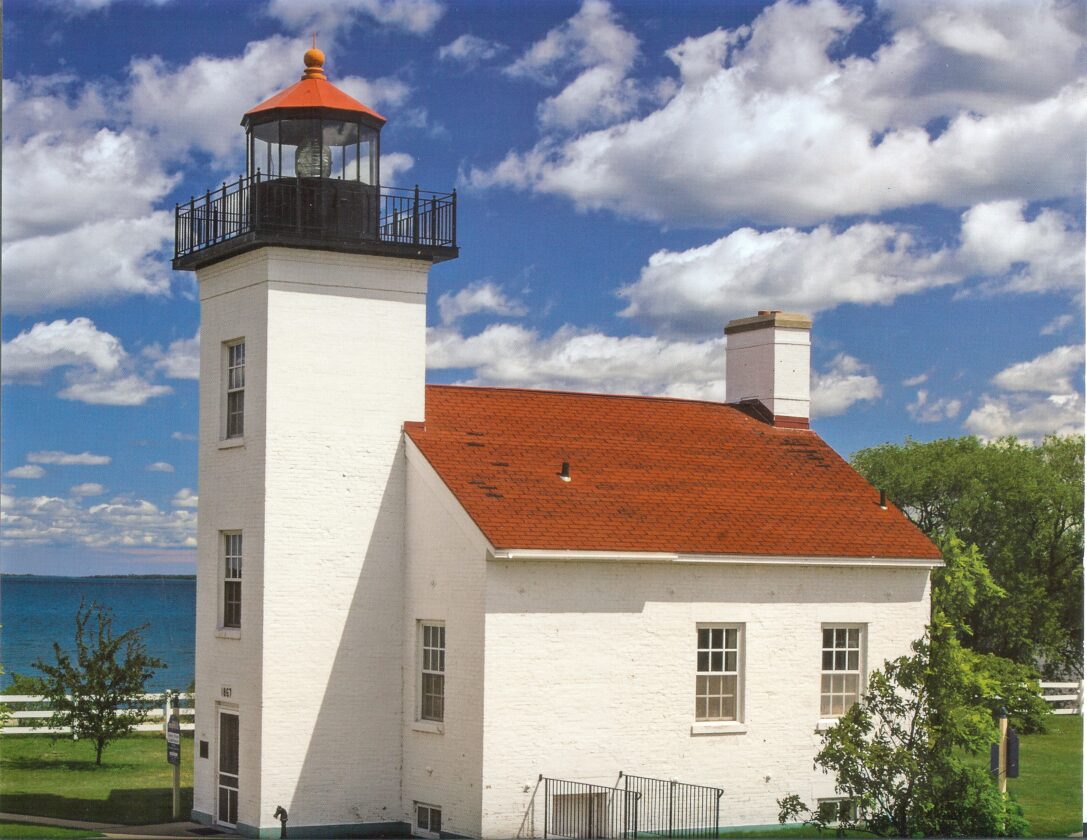
The Sand Point Lighthouse stands at the far west end of Escanaba where Ludington Street and Loren W. Jenkins Memorial Drive meet Water Plant Drive. (Photo courtesy of the Delta County Historical Society)
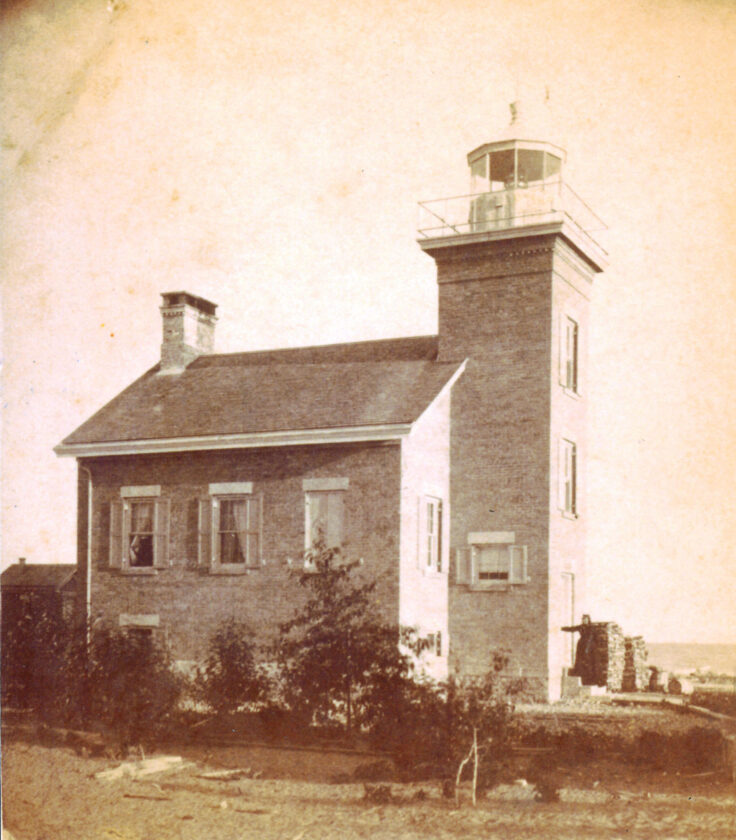
Mary Terry, one of the first female lighthouse keepers in the United States, operated the Sand Point Lighthouse from 1868 until 1886 when a fire broke out in the lighthouse. Her remains were found shortly after, and her cause of death was ruled to be unknown. This photo of the Sand Point Lighthouse is widely regarded as the only surviving photo of Mary Terry. (Photo courtesy of the Delta County Historical Society)
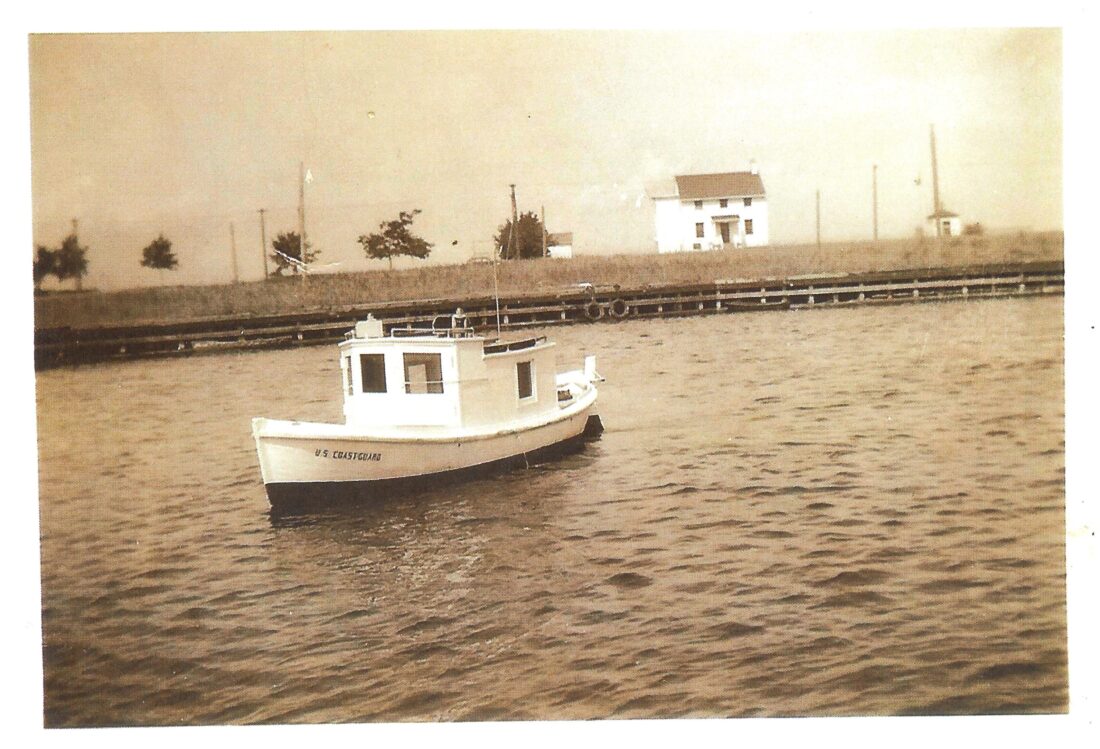
The United States Coast Guard took ownership of the Sand Point Lighthouse in Escanaba in 1939 when the federal government assumed responsibility for all navigational aids across the country. (Photo courtesy of the Delta County Historical Society)
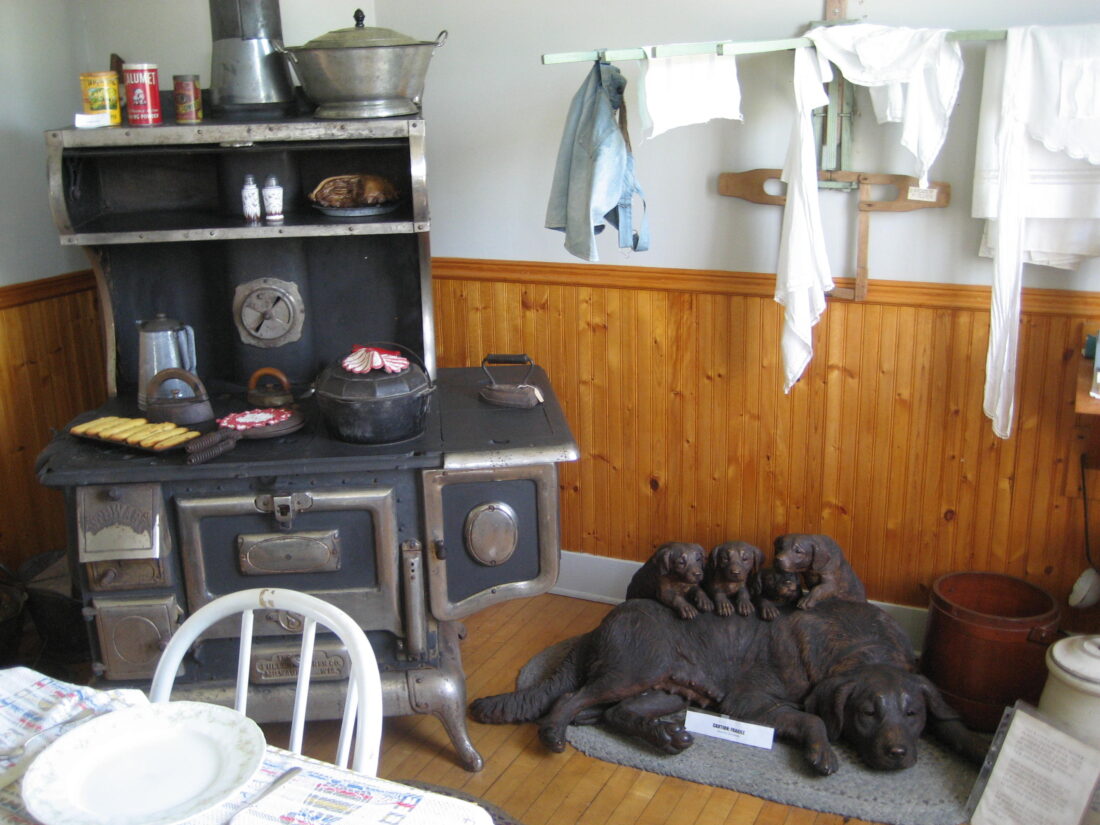
The interior of the Sand Point Lighthouse in Escanaba is furnished with vintage household items intended to reflect what would have been used during its years of operation from 1868 to 1939. (Photo courtesy of the Delta County Historical Society)
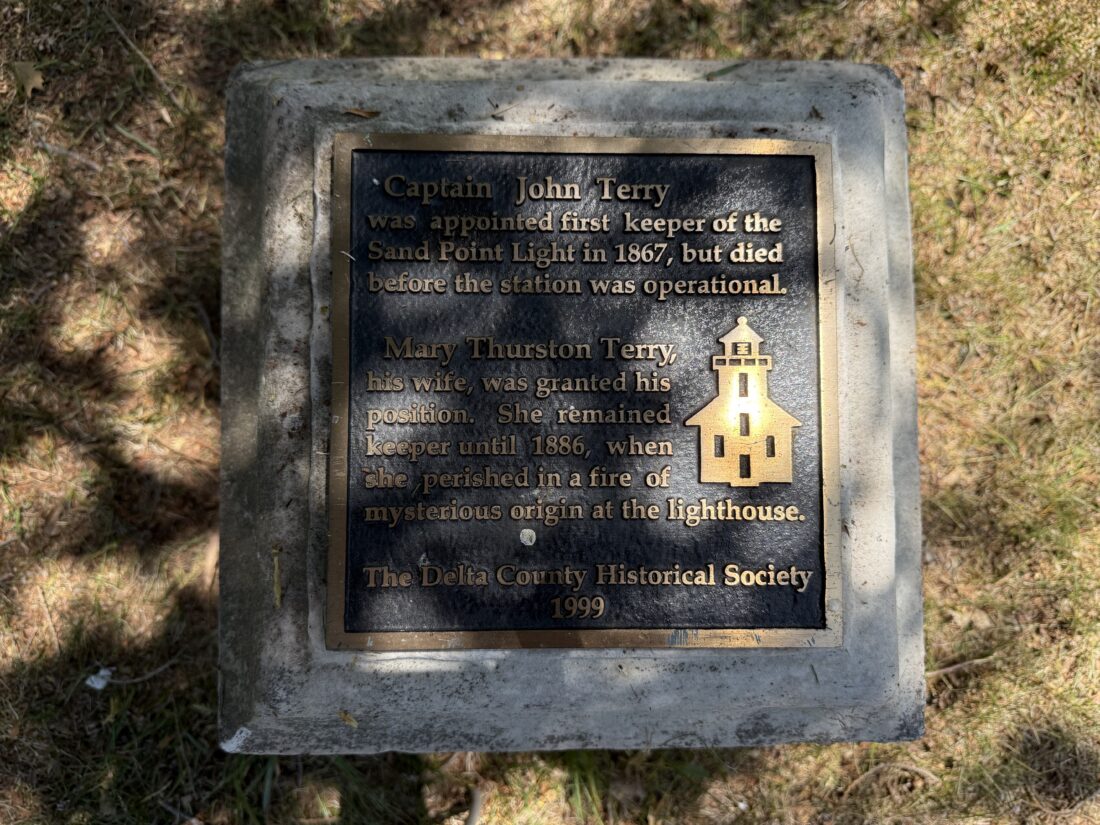
Mary L. (Thurston) Terry is one of the first female lighthouse keepers in the United States. Mary moved to Escanaba with her husband, John Terry, in 1867. John is buried in Lakeview Cemetery in Escanaba, and Mary's remains after she died in a fire at the lighthouse are said to be buried with him. (Sophie Vogelmann | Daily Press)
The Sand Point Lighthouse stands at the far west end of Escanaba where Ludington Street and Loren W. Jenkins Memorial Drive meet Water Plant Drive. (Photo courtesy of the Delta County Historical Society)
Mary Terry, one of the first female lighthouse keepers in the United States, operated the Sand Point Lighthouse from 1868 until 1886 when a fire broke out in the lighthouse. Her remains were found shortly after, and her cause of death was ruled to be unknown. This photo of the Sand Point Lighthouse is widely regarded as the only surviving photo of Mary Terry. (Photo courtesy of the Delta County Historical Society)
The United States Coast Guard took ownership of the Sand Point Lighthouse in Escanaba in 1939 when the federal government assumed responsibility for all navigational aids across the country. (Photo courtesy of the Delta County Historical Society)
The interior of the Sand Point Lighthouse in Escanaba is furnished with vintage household items intended to reflect what would have been used during its years of operation from 1868 to 1939. (Photo courtesy of the Delta County Historical Society)
Mary L. (Thurston) Terry is one of the first female lighthouse keepers in the United States. Mary moved to Escanaba with her husband, John Terry, in 1867. John is buried in Lakeview Cemetery in Escanaba, and Mary's remains after she died in a fire at the lighthouse are said to be buried with him. (Sophie Vogelmann | Daily Press)
Trending
Editor's note: The Daily Press, in cooperation with three other Upper Peninsula newspapers, is running companion pieces to Ogden Newspapers' "America at 250" series, with a focus on the U.P.'s role in building America. This is also the first in a series on area lighthouses and lightships.
ESCANABA -- More than 150 years after its light first shined across Little Bay de Noc, the Sand Point Lighthouse remains one of Escanaba's most enduring landmarks -- a place where stories of tragedy, trailblazing women and community preservation still echo through its walls.
Built in 1867 for $11,000, the lighthouse featured a rectangular brick structure with an attached tower housing a fourth-order Fresnel lens.
Ships, first schooners and later steamers carried iron ore out from the ore docks and lumber from sawmills. The light guided vessels and safeguarded them from the sandbar lying in the shipping lane near Sand Point which reached out into Little Bay de Noc.
Nine keepers served at the lighthouse during its 70 years of operation from 1868 to 1938. One keeper particularly stands out in Sand Point’s History: Mary L. (Thurston) Terry.
Born in 1816, Mary moved to Escanaba with her husband, John Terry, in 1867 after he was appointed the lighthouse's first keeper while it was still under construction.
Not much information is known about John, particularly why he was appointed to the position in the first place.
Tragically, John died of consumption -- more commonly referred to as tuberculosis today -- before the lighthouse was completed. His wife, Mary, was appointed keeper just two weeks after his death.
The light first shined upon the harbor on May 13, 1868, according to the Delta County Historical Society.
While Mary's appointment was controversial, historical archives state Mary was appointed "upon recommendation of the majority of the citizens of Escanaba over the objections of government officials who strongly opposed the services of a woman in the lighthouse."
Reflecting on her service, the Iron Port wrote, "She was a very methodical woman, very careful in the discharge of her duties and very particular in the care of the property under her charge."
Another testimonial to Mary by the editor of the Mining Journal in 1884, though strongly worded, reads, "The long-haired shouters for women's rights should come to Escanaba for a living illustration of the capacity of women to do honest, hard work. They would find it in Mrs. Terry… doing her duty in all that time to the satisfaction of the authorities in Washington and in a manner not to be excelled by any masculine 'he' in the country."
Mary also acquired over $4,000 in savings and purchased seven valuable building lots in the city. She went on to manage the lighthouse for just shy of 18 years until tragedy struck on March 5, 1886, when a fire broke out inside the lighthouse.
The exact origin of the fire remains unknown. Over time, newspapers, magazines, and novelists have offered numerous theories about what happened.
Mary's remains -- including part of her skull, several bones and portions of her viscera -- were discovered in the oil room in the southwest corner of the lighthouse, rather than in her bedroom on the northeast side of the house, "indicating that the fire -- or intruder -- didn't catch her asleep," wrote the The Mining Journal.
People have since speculated Mary -- 69-years-old at the time of her death -- was the victim of murder, robbery or arson because of her financial standing. The Iron Port reported that a door had been found open, and the lock was found with the bolt shot forward as though there had been a break in.
Additionally, a pile of gold pieces were found on the floor when they had reportedly "tumbled from a hiding place" in a burning cupboard.
Suggesting a possible accidental cause, the Iron Port further reported in 1886 that a bordman employed by the lighthouse noticed that the wood near the furnace was hot just days before the fire and notified Mary, to which she replied "she expected to be burned out by it some day, but added that she slept with one eye open."
Mary's cause of death was ruled to be unknown by a local coroner's jury, further causing speculation amongst the community and larger region.
The inside of the lighthouse, including the wood and brick structure, was damaged in the fire. Repairs to the lighthouse were completed and the light returned to service seven weeks after the fire.
The Iron Port reported in March 1886, "The scramble for the vacancy caused by the death of Mrs. Terry began before the embers were cold. We are not likely to be asked our preference in the matter, but if we were, we should name a woman, the widow of one who served in the voluntary nave, and one to whom the place would be a godsend."
Some accounts suggest there may have been another female keeper at Sand Point, though records vary. Mrs. Peterson, the second wife of the lighthouse's fourth keeper, Captain Peter Julius Peterson, is said to have become keeper after his sudden death from a heart attack in April 1912, just one month after he took the post at age 60.
Her first name does not appear in surviving historical records, but she is believed to have served briefly until June 1912, when she reportedly requested to be relieved of duty.
While the lighthouse was marked by tragedy, it also witnessed new life. Historical records note that two children of Captain Lewis A. Rose and his wife, Mary P. Rose -- who moved to Escanaba after succeeding Mary Terry as keeper-- were born within its walls.
During the early 1930s, the Escanaba Harbor underwent many changes as the Works Progress Administration (WPA) dredged and filled the area around the lighthouse, ultimately leaving the structure nearly a quarter mile inland from the navigational hazard it was originally built to mark for sailors.
The lighthouse was officially taken over by the United States Coast Guard in 1939, as the federal government assumed responsibility for all navigational aids across the country.
A Crib Light was then built several hundred feet offshore, turning the lighthouse into a residence for Coast Guard personnel.
Significant alterations to the inside of the lighthouse followed. The lantern room and tower were removed, the roof was raised to allow for construction of a bathroom and three bedrooms upstairs, three additional windows were cut into the sides of the upstairs and sheet insulation and aluminum siding were applied to the outside over the coming years.
When the United States Coast Guard planned to demolish the decommissioned lighthouse in 1985, community members rallied to save it. Although the property remains technically under Coast Guard ownership, the Delta County Historical Society stepped in to restore the structure through nearly $100,000 in fundraising and volunteer efforts.
Today, the Historical Society owns the surrounding land and maintains and occupies the site, including the lighthouse, boathouse and Coast Guard exhibit on the property.
During the Delta County Historical Society’s restoration efforts, the exterior additions of the structure were removed to reveal the hidden brick, the roof was lowered, windows were removed and a tower was added back onto the structure, aiming to resemble what it once looked like in its heyday.
Today, the Fresnel lens that sits in the lighthouse is a replica of the original, paid for by a society member around 2014.
The exhibit that was once the keepers' watch room now holds artifacts from the Nahant shipwreck of 1897 -- a ship that once caught fire in the bay's ore docks.
According to the Escanaba Daily Press reports from 1939, the wreck of the steamer rotted in the water off the north shore for nearly 40 years until a buoy was placed to mark the wreck.
Thanks to decades of restoration efforts from the Delta County Historical Society and public support, the historic beacon serves not only as a reminder of Escanaba's maritime past, but also as a testament to the people determined to preserve it for future generations.
The Sand Point Lighthouse, along with its grounds, boathouse and Coast Guard exhibit building, as well as the Delta County Historical Museum and Archives share the location at the far west end of Escanaba where Ludington Street and Loren W. Jenkins Memorial Drive meet Water Plant Drive.
The Historical Society Museum and the Sand Point Lighthouse are both open for the summer season. Both are open from 11 a.m. to 4 p.m. daily until Labor Day.
The archives in the John Beaumier Delta County Historical Society museum are open Monday through Friday from 1 p.m. until 4 p.m.
For more information, call the museum at 906-789-6790.
--
Sophie Vogelmann can be reached at 906-786-2021 or svogelmann@dailypress.net.