
Bay marks Martin Luther King Jr. Day
Trending
ESCANABA -- Bay College once again held a forum in observance of Martin Luther King Jr. Day in Cafe Bay Monday.
"This is the second year in a row that we've done the speakers' forum," Bay College Dean of Arts & Sciences Dr. Amy Reddinger -- who emceed the event -- said.
The theme of this year's event was "The Impact of Inequality."
"Our array of speakers will all be addressing this topic from various perspectives," Reddinger said.
Reddinger noted the forum -- which exclusively featured female speakers -- also served as a kickoff to Bay's year-long celebration of the 100th anniversary of the 19th Amendment's ratification.
Capt. Aimee Norton of the Salvation Army of Escanaba focused on the roles women have played in the Salvation Army over the years.
"From its inception, the Salvation Army has publicly expressed its support of gender equality in faith and practice," she said.
Norton highlighted five women who have had a particularly large impact on the organization's history. Among these women was Catherine Booth, who co-founded the Salvation Army with her husband William Booth.
"A lot of times, William gets the accolades, but Catherine -- she was fiery," Norton said, adding Catherine was a strong advocate for women having the right to preach.
Bay College biology instructor Laurie Johnson focused on environmentalism and climate change.
Dr. King was killed in 1968. Johnson said the modern environmental movement in the U.S. had just started to gain momentum then.
"At that time, environmentalism was honestly led mainly by affluent white people and did not seem to have any connection to social justice. But that has changed in more recent years -- it's become clear that the environmental movement and especially the fight against climate change is also a social justice movement," Johnson said.
Johnson went on to discuss ways in which climate change has been found to disproportionately impact people of color, women and people living in poverty.
"The cruel irony of this distribution of misery is that it is, of course, not the world's poor who are largely responsible for the carbon dioxide and other greenhouse gas emissions that have brought us to this climate crisis. It is the rich and prosperous countries of the world. Poor and marginalized communities contribute less to climate change, but bear more of its effects," she said.
June Klees, a history instructor at Bay, delivered a presentation about women in American history.
"Women's history is definitely a place where that impact has been seen," she said, referring to the theme of Monday's event.
An important element of Klees' lecture was its focus on "historiography."
"It's the ways in which history as a discipline changed, grew, developed, became more inclusive over time," Klees said in her definition of the term.
Klees provided a timeline of how women's history was studied in America from the mid-19th century to the 2000s.
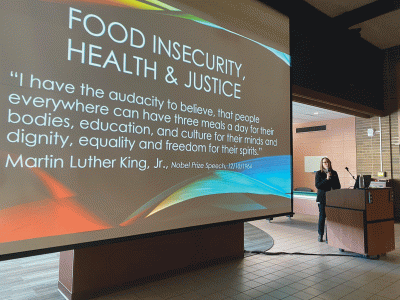
TRiO Director Jill Wiese-Martin talked about food insecurity. She shared an audio recording of Dr. King's 1964 Nobel Peace Prize speech; in the speech, King said he had "the audacity to believe that peoples everywhere can have three meals a day for their bodies, education and culture for their minds and dignity, equality and freedom for their spirits."
However, Wiese-Martin said poverty and hunger are still prevalent in America today. On average, about 31 percent of low-income households were faced with food insecurity as of 2016.
"The United States is a very wealthy country, and to have so much poverty and to have food insecurity in a country like this is kind of an alarming situation to be in," she said.
A food pantry has been set up at Bay College in response to this need. Wiese-Martin also spoke about other actions that could be taken to reduce food insecurity Monday.
While many of these potential steps were policy-based, Wiese-Martin said the actions of everyday people -- including participation in the Mass Poor People's Assembly & Moral March on Washington this June -- can make a difference, as well.
"It doesn't happen without boots on the ground," she said.
Bay College freshman Marcus Harris, who attended the event, said he thought the forum was "pretty good." He particularly enjoyed Klees' presentation.
"I take her history class," he said.
Bay freshman Audrey Naeyaert was also glad she was able to attend the event.
"It was a lot more interesting than I thought it was going to be," she said, noting she found Johnson's speech especially moving.