
Short-Term Rental rules passed in Ford River
A second ordinance will be revised
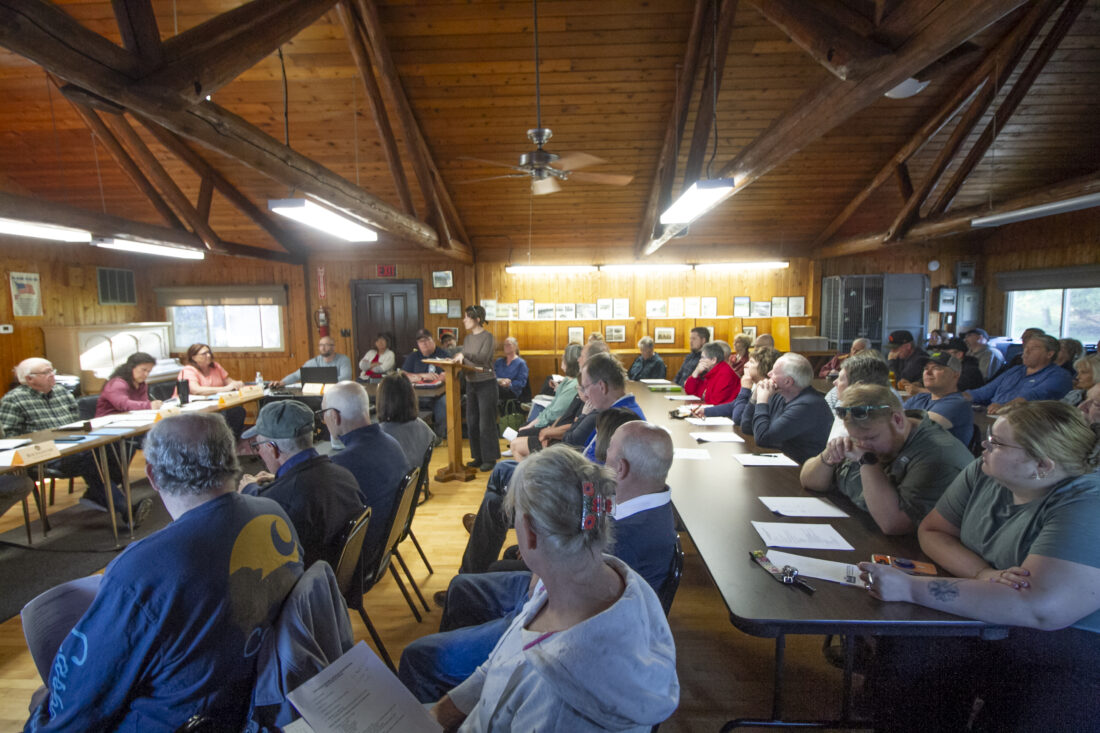
In a packed Ford River Township Hall on Monday, resident, property owner and Airbnb operator Jill Bernard tells attendees and board members that short-term rentals can benefit a community. (R. R. Branstrom | Daily Press)
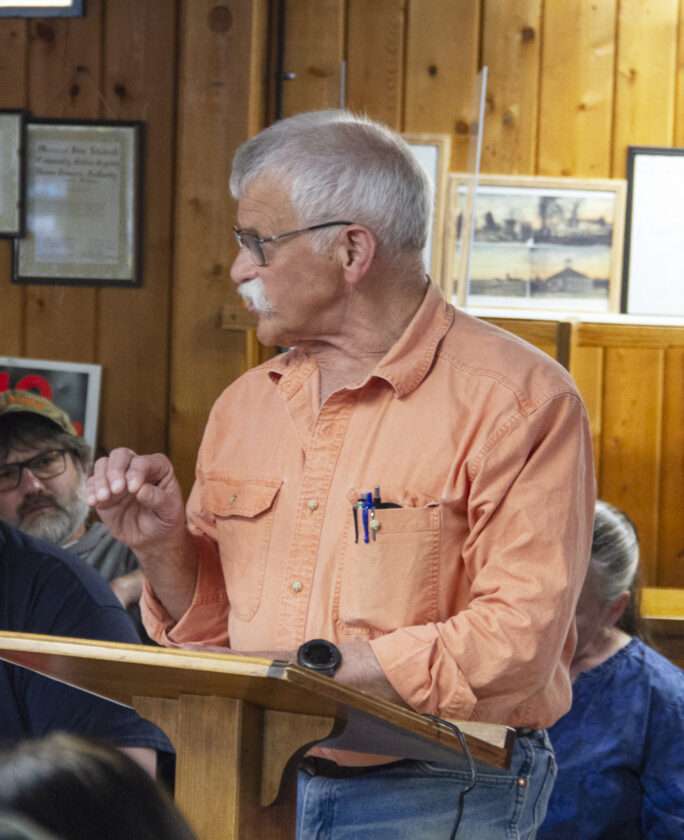
"Out of respect for residents of the township, (STRs) need to be restricted," says William Taylor of Ford River. "We need people that want to build the community." (R. R. Branstrom | Daily Press)
In a packed Ford River Township Hall on Monday, resident, property owner and Airbnb operator Jill Bernard tells attendees and board members that short-term rentals can benefit a community. (R. R. Branstrom | Daily Press)
"Out of respect for residents of the township, (STRs) need to be restricted," says William Taylor of Ford River. "We need people that want to build the community." (R. R. Branstrom | Daily Press)
Trending
FORD RIVER — A township meeting on Monday night lasted just over three hours and brought upwards of 70 residents interested in matters on the agenda.
Two items were around the contentious topic of short-term rentals (STRs).
Platforms like Airbnb and Vrbo allow homeowners to rent out houses, rooms, accessory dwelling units and other living quarters to day-trippers. In the Upper Peninsula and elsewhere, these STRs have become not only a way for vacationers to find cozy spaces to stay temporarily, but also for property owners to make quick cash. Around the country, the rapid market growth has catalyzed calls for regulation.
After much deliberation in Ford River Township — first by the Planning Commission and Central Upper Peninsula Planning and Development (CUPPAD), and then by township board members who listened to public comments — one of the newly proposed ordinances passed, and the other did not.
The first lays out rules for STRs. There are a few STRs in the township that are already operating — some have permits, but a handful are reportedly illegally operating.
Now that rules have been accepted by the township board, explained Zoning Administrator Brett Jenshak, Ford River will be able to have concrete and enforceable guidelines. STRs operating in good faith will have to make sure they’re in compliance, and any operating without permits will likely either have to shut down or go through the processes to get approved.
Though some of the people in favor of STRs tout property rights as a reason, some limitations by government can help prevent an overabundance from straining the local environment and hurting other residents.
With CUPPAD as a sort of legal liaison, Jenshak explained, Ford River is trying to make sure any new legislation around STRs does not conflict with constitutional rights, zoning or state laws.
The ordinance accepted by Ford River Township on Monday explains that the purposes of establishing rules for STRs are:
(1.) “To preserve the residential character and long-term housing supply in districts designated primarily for residential uses.”
Preserving the character of Ford River means keeping it welcoming, friendly and a place where people know their neighbors. If the faces in a house next door change every day, the community character changes.
Keeping a housing supply — meaning that homes are available to purchase or rent long-term — is required if full-time residents are to have a place to live.
(2.) “To regulate the activities undertaken in short-term rentals to align with the township's goals as established in the Ford River Township Master Plan.”
A Master Plan is meant to serve as a guide for a municipality’s development over time. It explains what is desired for various zones.
A future land use table in the Ford River Township Master Plan, adopted in 2024, says that “commercial” uses — which STRs are legally considered, said Jenshak — are “undesirable” in three zones: Rural Residential, Residential-1, and Residential-2.
(3.) “To impose safeguards that protect the general health, safety, and welfare of township residents and visitors.”
Though immediate threats to safety may not inherently accompany an STR, some residents believe that their welfare could be affected by rowdy vacationers.
“In many cases, they came to party,” said William Taylor, recounting past instances. “They didn’t appreciate they were in the residential area. Parties were going on any evening of the week, late into the evening, fireworks — there’s no regard for neighbors who had to get up in the morning and go to work.”
Taylor also acknowledged, though, that many guests were quiet and respectful.
Countering the anti-STR perspective, one proponent and current STR operator, Jill Bernard, said that she believed her business “has been an asset to the community.”
Bernard also pointed out that the regular nuisance ordinance would still apply and that visitors would still have to abide by local laws.
Passed at Monday night’s Ford River Township meeting was an ordinance that defined terms and outlined basic requirements for STRs, including details on certification, inspection and regulation. It did not place a limit on where STRs could operate or how many would be allowed.
The STR-related ordinance amendment that did not pass, but only by a narrowly-split vote, would govern which zones are allowed to have STRs.
Though some attendees left feeling frustrated that not all the STR guidance was finalized, the progress that is being made is noteworthy. Other Delta County townships and cities have yet to enact any regulations around STRs.
“We’re in a really unique spot, because I think the rest of the county is kind of watching what we’re doing, and this will be kind of a precedent-setting situation,” said Jenshak.
He explained that Ford River Township, the Planning Commission and CUPPAD have been exploring STR legislation for well over a year.
During the next session of the Ford River Township Planning Commission on June 3, members will revise the draft ordinance amendment and bring a new version to the board for a decision.
“I think we’re actually getting close,” Jenshak told the Press on Tuesday. “Basically, we have to go back and we have to revise it, and then send it to them again, and hopefully, hopefully, a resolution is found.”
Other items from the May 18 regular meeting of the Ford River Township Board will be discussed in a subsequent article.
–
R. R. Branstrom may be reached at rbranstrom@dailypress.net or 906-786-2021 ext. 140.