Memorial salutes
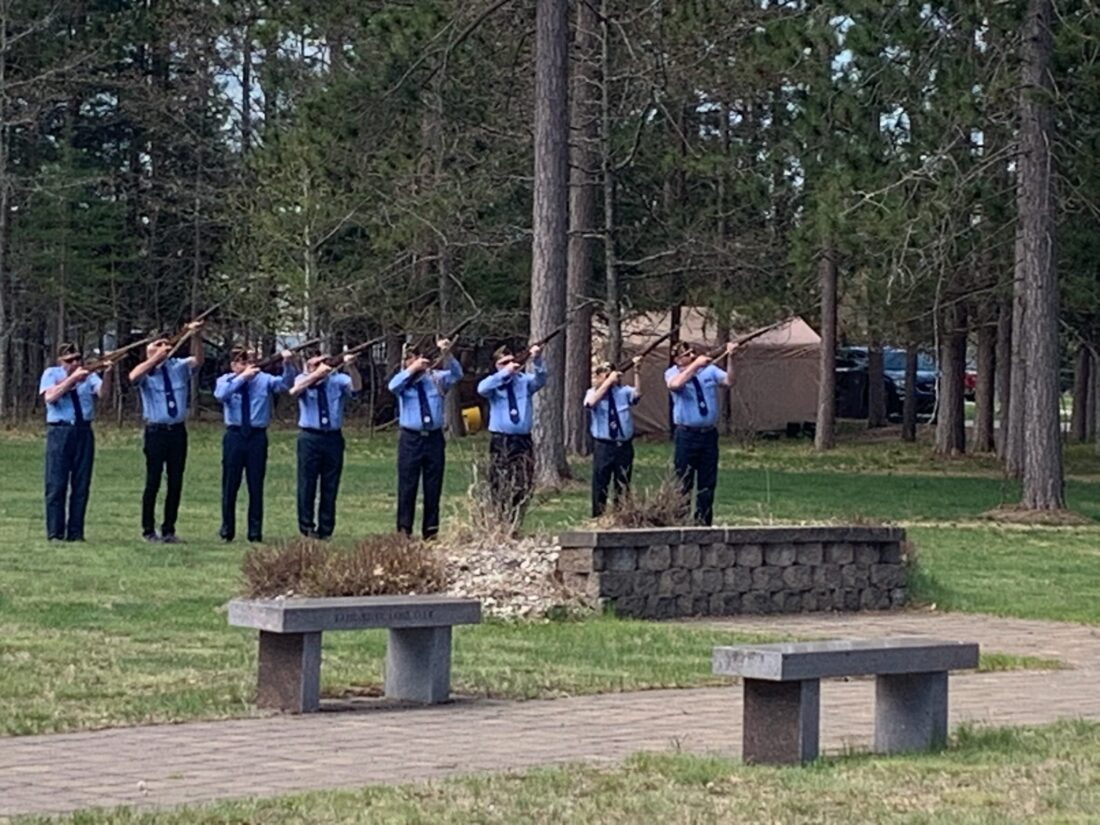
This photograph shows a scene at the Rapid River Cemetery on Memorial Day, where the final ceremony of the day was held by members of the American Legion Post 301. The group also visited graveyards in Ogontz, Moss Lake, Nahma and Stonington. (Photo by Sarah Maki for the Daily Press)
RAPID RIVER — Over countless graves on Monday, customary weapons firings were performed in honor of fallen soldiers and their families as communities around the United States recognized Memorial Day.
Shortly before noon on May 25, one of many such ceremonies was performed at the Rapid River Cemetery, which is located on County Road 509 in Masonville Township. Sometimes referred to as the Whitefish Hill cemetery, it is one local site that provides final resting places for service members from each war.
Elsewhere in the nation, explosions heard that day may have been either rifle volleys or 21-gun salutes, which veteran organizations say are often confused but are distinctly different.
A sign of respect and trust, “all personal salutes may be traced to the prevailing use in earlier days to ensure that the saluter placed himself in an unarmed position,” explains the Memorial Day Foundation.
The tradition of firing cannon salutes traces back to the British Navy, when ships at sea meant to announce peaceful intentions.
A 21-gun salute — typically performed by cannons or other large artillery — is a customary military honor fired in memory of heads of state or for international ceremonies. In the United States, it an an exceptional honor reserved for Washington’s birthday, President’s Day, Memorial Day, Independence Day, and presidential funerals.
Today, a three-volley rifle salute is performed at military funerals and other ceremonies. It is said to have stemmed from a practice that dates back several centuries.
“The practice of firing three rifle volleys over the grave originated in the old custom of halting the fighting to remove the dead from the battlefield. Once each Army had cleared its dead, it would fire three volleys to indicate that the dead had been cared for and that they were ready to go back to the fight,” reads an article on the U.S. Army Human Resources Command website.
Some sources, including the American Legion, say the three shots evolved from an ancient Roman practice of reciting a fallen soldier’s name three times as he was removed from the battlefield.
Regional News

Tornado activity surpasses yearly average as peak season begins

Michigan State Police enter annual best looking cruiser contest
MDARD takes steps to protect Michigan from new world screwworm
MARQUETTE — The Michigan Department of Agriculture and Rural Development (MDARD) recently announced new domestic ...
Cheboygan man sentenced for threatening judge, prosecutors
LANSING – Barry Hopkinson, 61, of Cheboygan, was sentenced to three to 15 years in prison on Thursday, June 18 ...

MyMichigan Health successfully performs first robotic‑assisted lung biopsy