Earth Day momentum slips
-
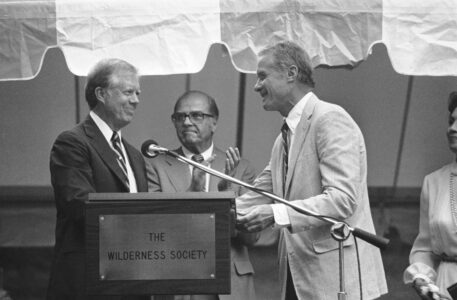
- Former President Jimmy Carter, left, is honored by Wilderness Society President Harold Jerry Jr. of Albany, N.Y., right, in Atlanta on Aug. 20, 1982. Former Sen. Gaylord Nelson of Wisconsin — the founder of Earth Day — applauds at center. Carter received the Ansel Adams Award from the society for his conservation efforts. (AP Photo/Charles Kelly)
-
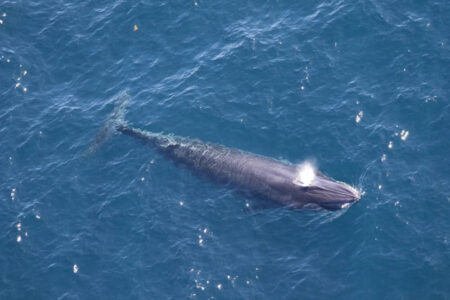
- A Rice’s whale is seen from above. This rare species – of which there are estimated to be less than 100 individuals – lives year-long in the Gulf of Mexico, where the U.S. federal government has repealed the Endangered Species Act in favor of increasing oil production. (AP photo)
-
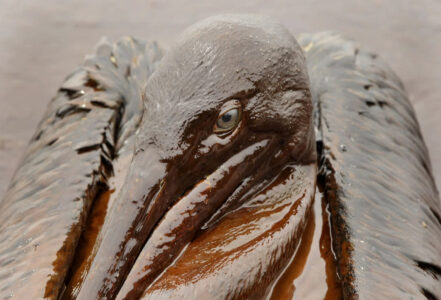
- Shown is a pelican covered in oil after the 2010 Deepwater Horizon disaster. Sixteen years after an oil rig explosion killed 11 workers and unleashed an environmental nightmare in the Gulf of Mexico/America, companies are drilling into deeper and deeper waters, where the payoffs can be huge but the risks are greater than ever. Safety rules adopted in the spill’s aftermath have been eased as part of President Donald Trump’s drive to boost U.S. oil production.(Associated Press)
-
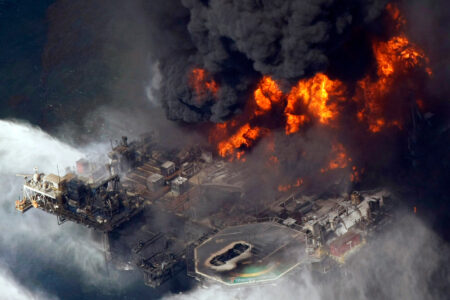
- Depicted here is the Deepwater Horizon oil rig burning on April 21, 2010, in the Gulf of Mexico. It remains the world’s largest marine oil spill and spilled 33 times as much as the 1969 incident that helped kickstart Earth Day. The current White House administration recently approved a BP drilling project in the Gulf of Mexico, and removed the Endangered Species Act from applying in the area. (AP Photo/Gerald Herbert, File)
-
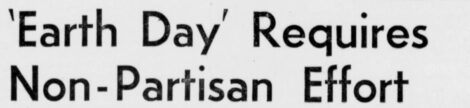
- A headline just before the first Earth Day in 1970 reads, “Earth Day requires non-partsan effort.” (Daily Press file)
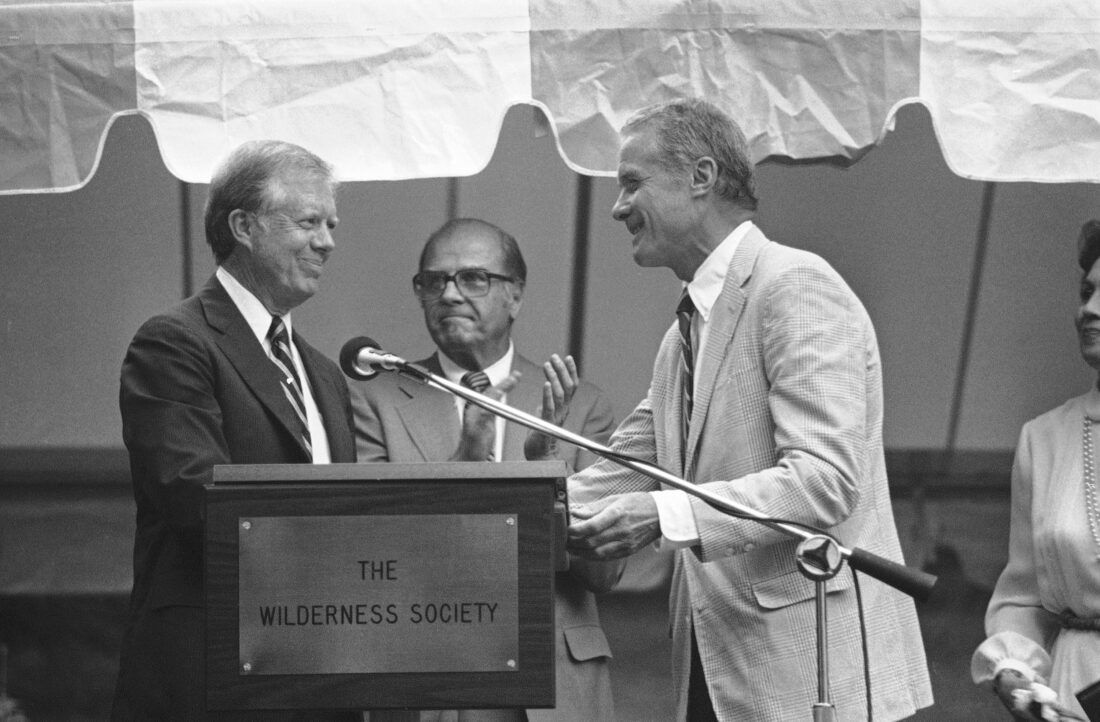
Former President Jimmy Carter, left, is honored by Wilderness Society President Harold Jerry Jr. of Albany, N.Y., right, in Atlanta on Aug. 20, 1982. Former Sen. Gaylord Nelson of Wisconsin -- the founder of Earth Day -- applauds at center. Carter received the Ansel Adams Award from the society for his conservation efforts. (AP Photo/Charles Kelly)
ESCANABA — Today is Earth Day.
The holiday began in 1970, but the idea of environmental conservation had been gathering traction for years.
For a while, environmental activism was seen as a part of hippie counter-culture and not respected. To some, it’s still viewed similarly.
Regardless, in the 1960s, “mainstream America remained largely oblivious to environmental concerns and how a polluted environment threatens human health,” as EarthDay.org put it.
“Americans were consuming vast amounts of leaded gas through massive and inefficient automobiles. Industry belched out smoke and sludge with little fear of the consequences from either the law or bad press. Air pollution was commonly accepted as the smell of prosperity.”
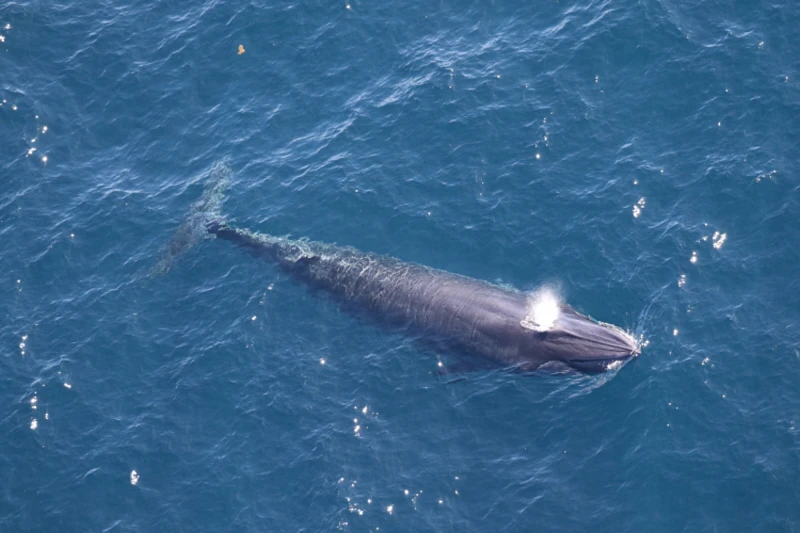
A Rice's whale is seen from above. This rare species - of which there are estimated to be less than 100 individuals - lives year-long in the Gulf of Mexico, where the U.S. federal government has repealed the Endangered Species Act in favor of increasing oil production. (AP photo)
In 1962, the book “Silent Spring” by Rachel Carson was published. It became an instant bestseller and launched concern for the planet to the forefront of public consciousness. A major point of the book was to record the harmful effects of pesticides (particularly DDT), which had been studied by some but not thoroughly exposed before Carson’s work.
In January of 1969, the largest oil spill to that point in American history took place when an oil well off the coast of Santa Barbara, Calif. had a massive blowout from a drilling project. Pressure caused the seabed to explode, releasing over three million gallons of crude oil:
“So much gas bubbled to the surface near Platform A that the water appeared to boiling. And oil from the underwater fissures began to form a slick that would eventually cover an area nearly the size of Chicago,” reported NPR.
The oil killed thousands of birds and an unknown number of sea animals. When the blackness reached the shore in California — a beloved place inhabited by the wealthy — it was no longer just the hippies who cared.
Then-Governor Ronald Reagan and other Californians forced Washington to take notice of the disaster.
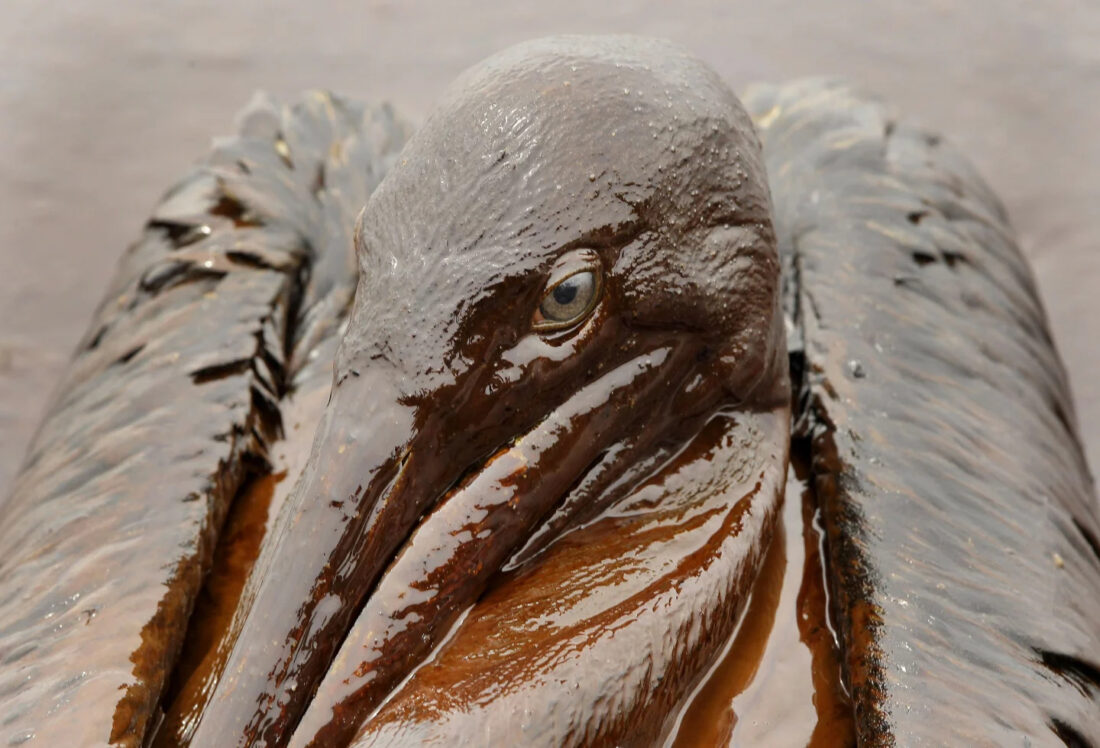
Shown is a pelican covered in oil after the 2010 Deepwater Horizon disaster. Sixteen years after an oil rig explosion killed 11 workers and unleashed an environmental nightmare in the Gulf of Mexico/America, companies are drilling into deeper and deeper waters, where the payoffs can be huge but the risks are greater than ever. Safety rules adopted in the spill’s aftermath have been eased as part of President Donald Trump’s drive to boost U.S. oil production.(Associated Press)
Senator Gaylord Nelson of Wisconsin, who had for years been a champion of the environment and public lands and had organized President John F. Kennedy’s Conservation Tour across the country in 1963, was inspired to combine the passion and indignation surrounding the Santa Barbara oil spill with the drive of young people to protest the Vietnam War.
Nelson suggested the first Earth Day — a day of education and protest, largely on college campuses — be held on April 22, 1970. The Democratic Nelson recruited Pete McCloskey, a Republican Congressman who also valued conservation, to join him.
They also enlisted the help of David Hayes, a young activist, to organize campus teach-ins and help spread the word.
Exceptional support and awareness of threats to the environment came in the years that followed. The United States created the Environmental Protection Agency, the Clean Air Act and the National Environmental Education Act.
Even criticisms of the movement acknowledged the effectiveness of crackdowns. “With the toughest anti-emission motor vehicle laws in the country, California has succeeded in lessening the amount of air pollution despite the fact that the number of cars is increasing,” an article published in the Escanaba Daily Press a couple weeks before the first Earth Day noted. The author carried a skeptical tone about whether Earth Day would keep the focus on the environment or devolve into an “anti-establishment” protest.
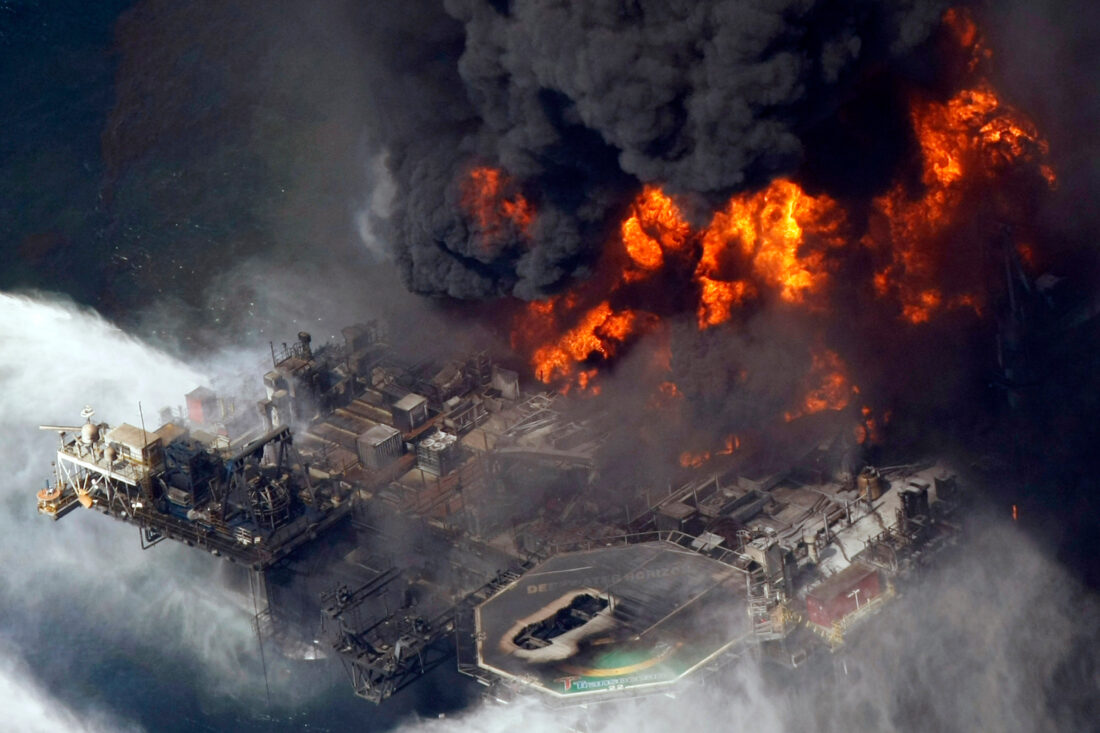
Depicted here is the Deepwater Horizon oil rig burning on April 21, 2010, in the Gulf of Mexico. It remains the world's largest marine oil spill and spilled 33 times as much as the 1969 incident that helped kickstart Earth Day. The current White House administration recently approved a BP drilling project in the Gulf of Mexico, and removed the Endangered Species Act from applying in the area. (AP Photo/Gerald Herbert, File)
By 1980, additional environmental legislation included the Endangered Species Act, Marine Mammal Protection Act, Toxics Substances Control Act and the Resource Conservation and Recovery Act.
Sour association seeped into Earth Day when a man who was known to be on stage during Philadelphia’s first Earth Day rally was convicted of murder — Ira Einhorn. While he was a relatively prominent counterculture figure of the ’60s and ’70s, Einhorn was not, as some have called him, one of the founders of Earth Day.
Concerns about the environment have continued, and Earth Day founders Nelson and Hayes were thrust back into the limelight in 1990 when Hayes helped newer environmentalists to promote Earth Day in over 140 countries. President Bill Clinton awarded Nelson with the Presidential Medal of Freedom — the highest honor given to civilians in the United States — for his role in the creation of Earth Day.
On Earth Day in 2016, world leaders made history by signing the Paris Agreement, an international treaty with a goal of keeping the rise in global surface temperature down. Each of the close to 200 parties that signed the agreement were to make efforts to reduce greenhouse gas emissions.
The United States is no longer one of those parties.
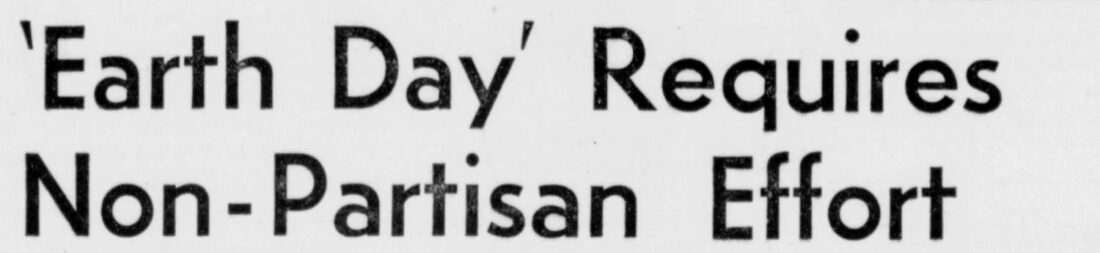
A headline just before the first Earth Day in 1970 reads, "Earth Day requires non-partsan effort." (Daily Press file)
In 2017, President Donald Trump said that the Paris Climate Accord would hurt the America by resulting in “vastly diminished economic production.”
Though the country briefly re-entered the agreement under President Joe Biden, when Trump’s second term arrived, the U.S. again cut ties with the Paris treaty.
Regulations around oil drilling that were adopted after the disastrous Santa Barbara spill that helped launch Earth Day may soon be retracted, too.
“Staying in the (Paris) Agreement could also pose serious obstacles for the United States as we begin the process of unlocking the restrictions on America’s abundant energy reserves,” Trump said when first exiting the accord.
In 2010, the world’s largest marine oil spill dwarfed the Santa Barbara one — BP’s Deepwater Horizon incident killed 11 people and spewed 134 million gallons of crude into the ocean off the Louisiana coast.
After that incident, the agency formerly known as the Minerals Management Service was disbanded, replaced by two separate bodies: the Bureau of Ocean Energy Management and the Bureau of Safety and Environmental Enforcement.
In 2020, the 50th anniversary of Earth Day was recognized globally with a reported billion participants.
The MMS was intentionally split up after BP’s spill in the Gulf because regulators were too cozy with industry and “we couldn’t trust the integrity of their work,” said Miyoko Sakashita, oceans director at the Center for Biological Diversity.
However, the Department of the Interior recently announced a plan to merge the two again, into the Marine Minerals Administration. The action is intended to “increase efficiencies” around “offshore resource management.”
The administration approved BP’s $5 billion Kaskida project in March, the company’s first new oil field developed in the Gulf since 2010. BP said it could have capacity of 80,000 barrels of crude oil per day.
On Monday, exactly 16 years to the day after the Deepwater Horizon spill, environmental groups sued the Trump administration over its approval of the project.
“The groups say information required for the approval is missing and does not demonstrate that BP has the qualifications to conduct safe drilling that deep. They also say that Kaskida endangers Gulf residents’ health, harms ecosystems and impacts fishing and tourism industries,” wrote Alexa St. John for the Associated Press.
However, according to current government operations, the health of the environment and wildlife are now a lower priority than America’s quest for energy and net economic benefits. On March 31 of this year, oil and gas drilling in the Gulf of Mexico was exempted from the Endangered Species Act.
The immediate demand for more oil was largely brought on by the current war in Iran. Though conflicts in the Middle East are not new, the situation intensified when the U.S. and Israel attacked Iran on Feb. 28.
Today, people are making efforts to do what they can to appreciate and preserve nature. Cleanups are often organized on Earth Day.
“For conservationists, it lands somewhere between a celebration and just another Tuesday — because the forests, wetlands, farms, and wild places we fight for don’t take a day off,” states The Conservation Fund, a nonprofit. “But Earth Day is also a reminder that everyone can show up for the natural world in whatever way fits their life. You don’t need to be a scientist or work for a land trust to make a difference. You just need to step outside — and maybe look at your surroundings a little differently.”
As wildlife reawakens and flowers bloom, another holiday celebrating the natural world is just two days away.
In recognition of Arbor Day, which falls on Thursday, the City of Escanaba invites the public to its annual tree-planting in Ludington Park, which is scheduled for April 24 at 10 a.m. The rain date is Monday.
Regional News
Tornado activity surpasses yearly average as peak season begins

Michigan State Police enter annual best looking cruiser contest
MDARD takes steps to protect Michigan from new world screwworm
MARQUETTE — The Michigan Department of Agriculture and Rural Development (MDARD) recently announced new domestic ...
Cheboygan man sentenced for threatening judge, prosecutors
LANSING – Barry Hopkinson, 61, of Cheboygan, was sentenced to three to 15 years in prison on Thursday, June 18 ...

MyMichigan Health successfully performs first robotic‑assisted lung biopsy