
Escanaba City Council approves updated water system improvement plan
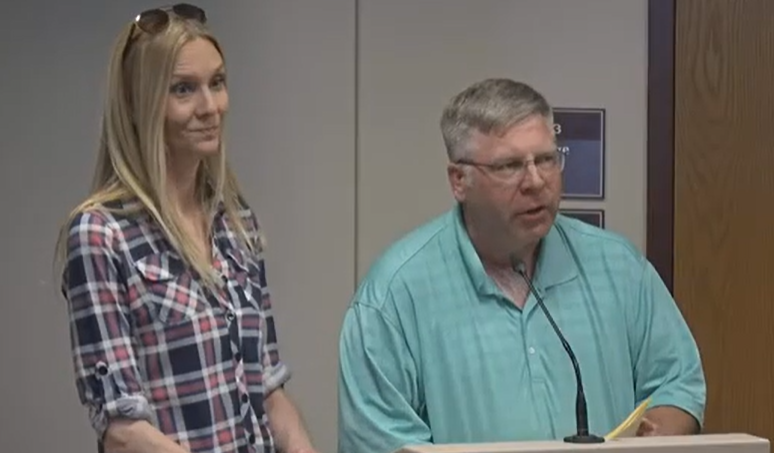
Stacey Eagle of C2AE in Escanaba, left, and Escanaba Water Superintendent Jeff Lampi addressed the Escanaba City Council Thursday regarding the FY2027 water system improvement project.
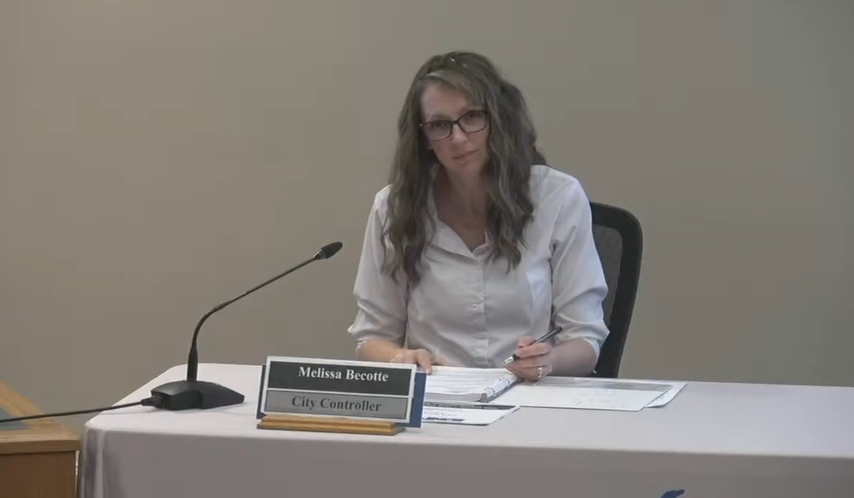
The Escanaba City Council on Thursday designated Interim City Manager Melissa Becotte as the authorized project representative for the FY2027 water system improvements project with C2AE.
Stacey Eagle of C2AE in Escanaba, left, and Escanaba Water Superintendent Jeff Lampi addressed the Escanaba City Council Thursday regarding the FY2027 water system improvement project.
The Escanaba City Council on Thursday designated Interim City Manager Melissa Becotte as the authorized project representative for the FY2027 water system improvements project with C2AE.
Trending
ESCANABA - The Escanaba City Council approved plans for the FY2027 water system improvement project during Thursday's regular meeting, moving forward with continuous efforts to replace water service lines across the city.
The project calls for the replacement of up to 420 stand-alone water service lines that do not meet current regulatory requirements.
Stacey Eagle of C2AE in Escanaba explained that the proposed project plan was scaled back from the 2025 project plan to reduce the scope and focus on lead service lines only.
Because funding is tied to lead service line replacement through the Bipartisan Infrastructure Law, the project does not include large-scale water main replacement work.
Eagle also told the council the Michigan Department of Environment, Great Lakes and Energy (EGLE) requires all lead or probable lead service lines in Michigan to be replaced by 2037. She noted the city currently has just over 2,000 known lead-impacted or probable/unknown galvanized service lines.
Eagle also outlined the city's replacement progress, saying C2AE completed 608 lead service lines in 2024, 674 in 2025 and plans to replace 900 more in 2026.
Officials said the upgrades are expected to improve water quality and system reliability while helping Escanaba comply with Michigan's Lead and Copper Rule.
Construction impacts are expected to include temporary road closures, localized surface disruption and restoration, erosion control measures and short-term water service interruptions. Some customers may experience outages of less than 12 hours or temporary connections to alternate water service during construction.
In C2AE's proposed project plan, it states, "The proposed construction is very similar to other recent projects in the City of Escanaba and will be coordinated with ongoing infrastructure improvement efforts."
The estimated cost of the next phase of improvements is approximately $8 million. Based on current state revolving fund loan rates, city officials estimate the annual loan payment would total about $394,285 over a 30-year period among an estimated 7,647 equivalent domestic units.
For a typical residential customer, that could mean an increase of about $4.30 per month if no grant funding or loan forgiveness is awarded. If funding or loan forgiveness is awarded, Eagle said the increase for users to their current fund would be about $2.30-$2.50 per month.
"Over the last five, six years, there's been a lot of project plans that have come through, resolutions passed," Eagle said. "The state was giving unprecedent amounts of grant money for a while - we’re talking tens of millions of dollars - to get these infrastructure improvements done. Those are starting to dry up a little bit."
Eagle also told the council, "We have it on good authority from EGLE that they have a lot of money right now to spend on lead service line projects. There's a good chance that Escanaba will qualify for the 49 percent forgiveness."
City officials noted the project scope will likely be adjusted to meet public support for affordability.
The council also designated Interim City Manager Melissa Becotte as the authorized project representative.
In other business, the council:
– Approved the city millage rate at 17.442 mills for 2026-27 budget year and approved the FY2026-27 operating city budget, capital improvement plan and master fee schedule.
– Approved to purchase a Wastewater Department Landfill Permanent Flow Monitor FL1500 from Pump Solutions, Inc., of Madison, Wis., in an amount not to exceed $40,000. Money is available in the upcoming fiscal year. Council’s approval came after lengthy discussion with Lampi regarding odor issues at the landfill.
– Hired Payne and Dolan for $54,780 to pave Royce Park basketball and tennis courts. The work is expected to be completed on May 26.
– Heard a presentation from John Stapleton, director of the Delta Area Transit Authority, on the Aug. 4 millage and expanded service ballot proposal. If voters approve the proposal in August, the eight-year millage would replace existing city and township transit millages -- currently 0.6 mills in Escanaba and Gladstone and 0.5 mills in seven participating townships -- with a single countywide rate of 0.689 mills. Stapleton detailed the millage, discussed DATA demographics and told council members that DATA is legally eligible to receive 50-60 percent in state funding but currently receives only 34 percent -- a figure that has steadily declined since the late 1990s.
– Held the first reading of an ordinance to make appropriations and corresponding revenues for the fiscal year ending June 30, 2027, and scheduled the second reading, public hearing and adoption for Thursday, May 28 at 9 a.m. Council also scheduled the second reading, public hearing and adoption of the city's tax levy ordinance for that same time.
– Held the first readings of the electric, water, wastewater and solid waste rate ordinances. The second reading and public hearing for each ordinance is scheduled for June 1 at 9 a.m.
--
Sophie Vogelmann can be reached at 906-786-2021 or svogelmann@dailypress.net.