
‘All aboard!’
How railroads grew in the Upper Peninsula
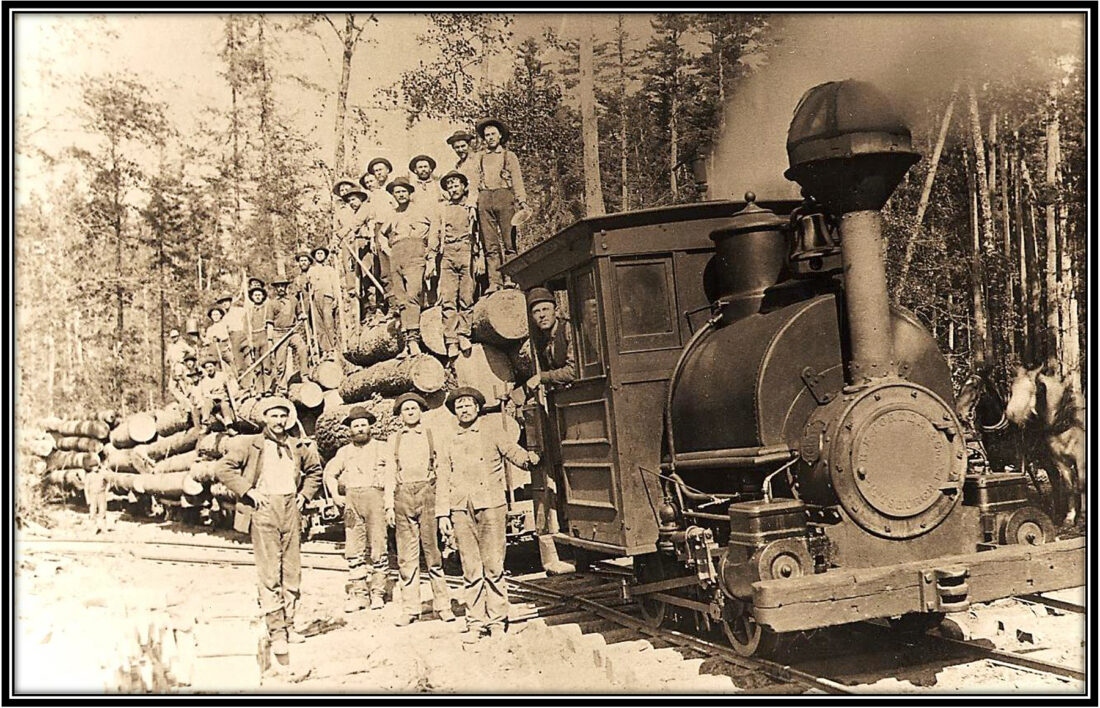
In 1886, William A. Holmes & Son were logging just across what became the Dickinson County line in Section 26 of Township 43 North, Range 31 West, east of the Michigamme River, an area in which Holmes & Son logged extensively between 1881 and 1893. The primitive narrow gauge steam engine, a 9-ton wood burner, which was used to pull carloads of pine logs along a track which extended from a point south of Sagola, then Holmes Landing or Holmes Siding, in a northwesterly direction to the Michigamme River and was used for a period of six years to move the logs from the woods to the river. (WJC Photo)
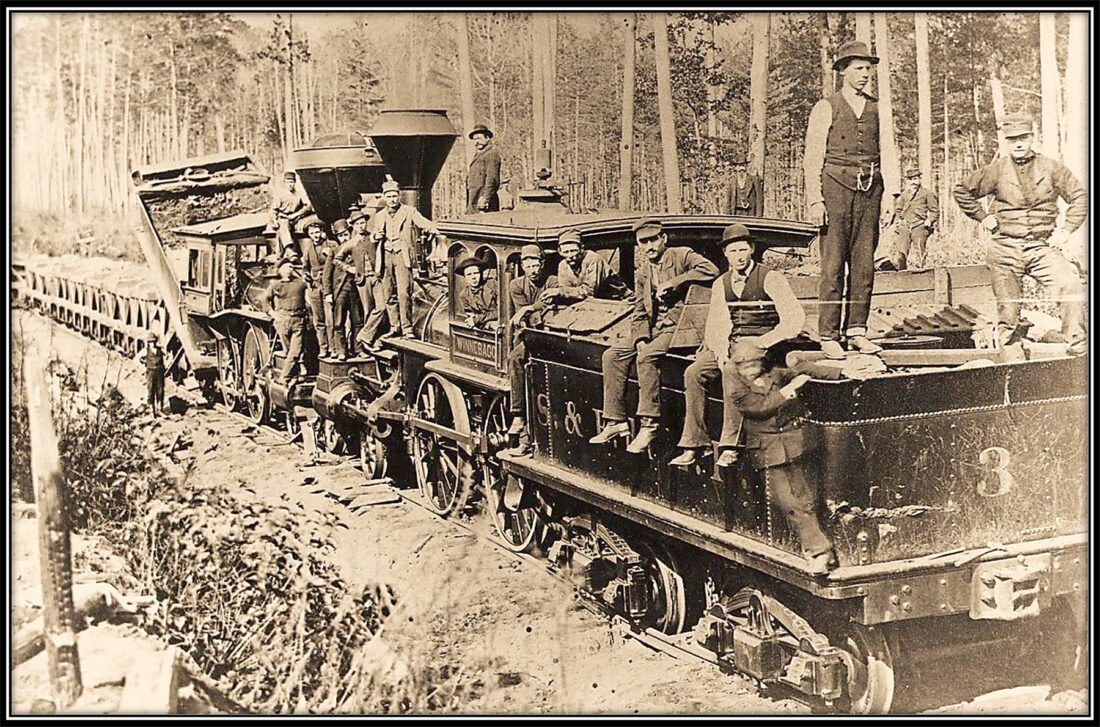
William A. Holmes & Son invested in a narrow-gauge railroad to permit year-round logging. In 1881, Holmes went to Pittsburg to purchase two H.K. Porter & Co. nine-ton locomotives, cars and rails, paying $10,000 cash. The railroad grade was started during the summer. The locomotives and cars were shipped to Florence, Wisconsin, then the railroad terminus in the fall. When there was sufficient snow, the locomotives and cars were hauled by sleigh to Holmes Landing or Holmes Siding on the Michigamme River. The locomotive on the right, named the Winnebago, pulled a coal tender with the letters S. & E.M. (or F.M.) R.R., Car 3. (WJC Photo)
Screenshot
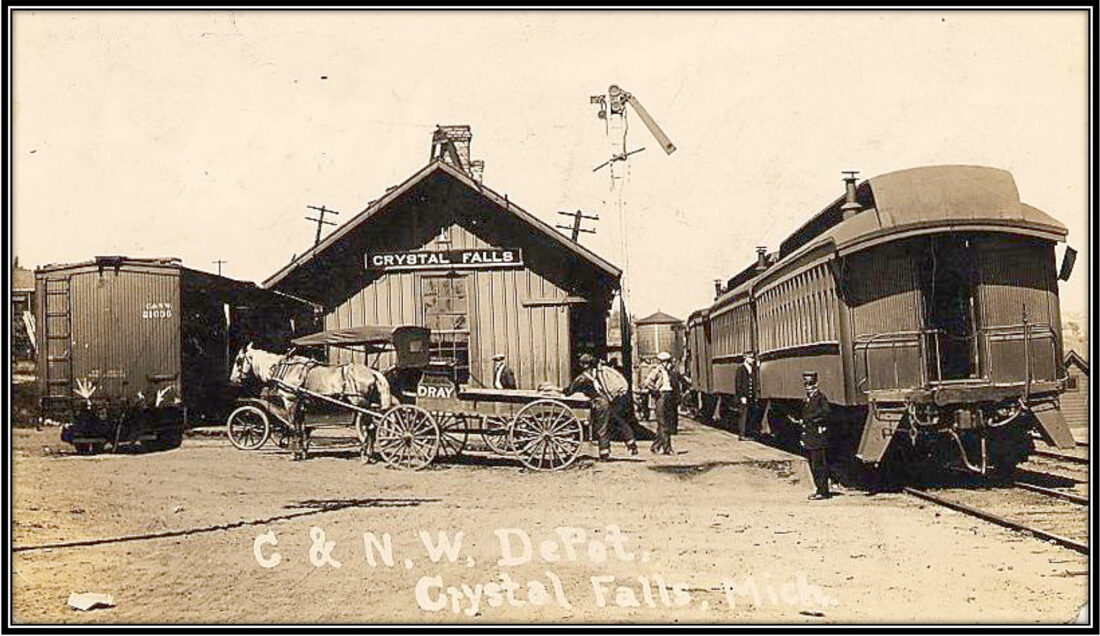
The Chicago & Northwestern Railway arrived in Crystal Falls in late February or early March 1882. The depot was on Superior Avenue, part way down the hill to the east. Postmarked Oct. 28, 1915, this postcard view shows two passenger cars and two conductors, as well as a water tank in the background. A dray wagon waits ready to be loaded with items delivered to the city by rail, and an early automobile is parked on the other side of the horse. (WJC Photo)
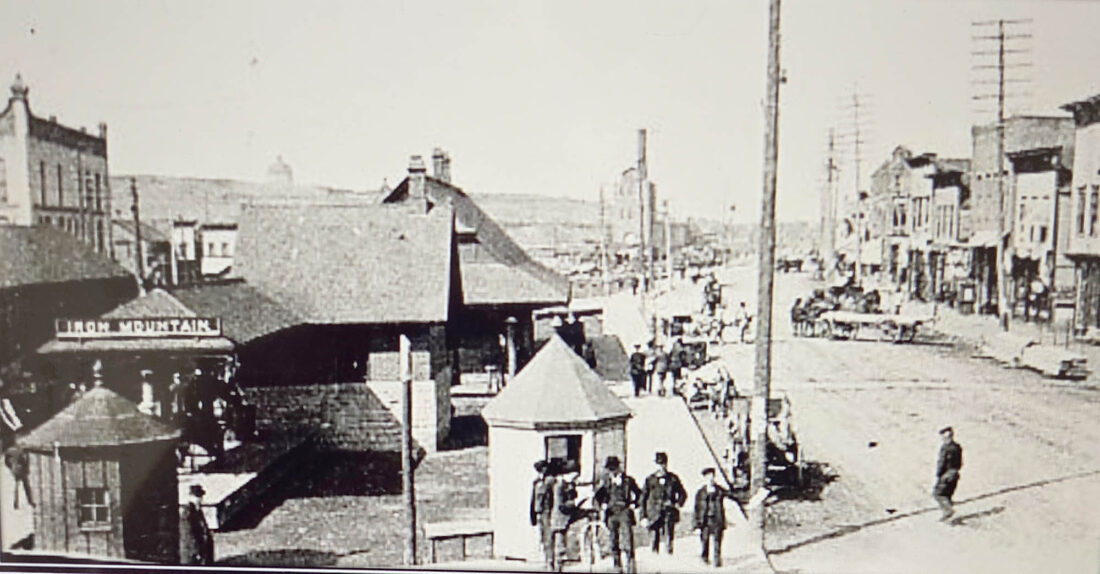
Iron Mountain’s new Chicago & North-Western Railway Depot, located on the west side of the 300 block, was opened to the public Sunday, Dec. 22, 1889. A flagman’s house at the Hughitt Street crossing is in the foreground and a similar building toward the center of the photograph served as a shelter for policemen. Further down the street on the same side is the original sandstone building which housed the Cornish pumping engine. This tall structure with a smokestack behind it was built in the fall of 1890, and was razed in June 1899, thus helping to date the photograph. The water tank can be seen on the horizon and at the extreme left is a corner of the Fisher Block that originally housed the Commercial Bank, built in 1891. (Gene Derwinski/Dick Ferris)
In 1886, William A. Holmes & Son were logging just across what became the Dickinson County line in Section 26 of Township 43 North, Range 31 West, east of the Michigamme River, an area in which Holmes & Son logged extensively between 1881 and 1893. The primitive narrow gauge steam engine, a 9-ton wood burner, which was used to pull carloads of pine logs along a track which extended from a point south of Sagola, then Holmes Landing or Holmes Siding, in a northwesterly direction to the Michigamme River and was used for a period of six years to move the logs from the woods to the river. (WJC Photo)
William A. Holmes & Son invested in a narrow-gauge railroad to permit year-round logging. In 1881, Holmes went to Pittsburg to purchase two H.K. Porter & Co. nine-ton locomotives, cars and rails, paying $10,000 cash. The railroad grade was started during the summer. The locomotives and cars were shipped to Florence, Wisconsin, then the railroad terminus in the fall. When there was sufficient snow, the locomotives and cars were hauled by sleigh to Holmes Landing or Holmes Siding on the Michigamme River. The locomotive on the right, named the Winnebago, pulled a coal tender with the letters S. & E.M. (or F.M.) R.R., Car 3. (WJC Photo)
Screenshot
The Chicago & Northwestern Railway arrived in Crystal Falls in late February or early March 1882. The depot was on Superior Avenue, part way down the hill to the east. Postmarked Oct. 28, 1915, this postcard view shows two passenger cars and two conductors, as well as a water tank in the background. A dray wagon waits ready to be loaded with items delivered to the city by rail, and an early automobile is parked on the other side of the horse. (WJC Photo)
Iron Mountain’s new Chicago & North-Western Railway Depot, located on the west side of the 300 block, was opened to the public Sunday, Dec. 22, 1889. A flagman’s house at the Hughitt Street crossing is in the foreground and a similar building toward the center of the photograph served as a shelter for policemen. Further down the street on the same side is the original sandstone building which housed the Cornish pumping engine. This tall structure with a smokestack behind it was built in the fall of 1890, and was razed in June 1899, thus helping to date the photograph. The water tank can be seen on the horizon and at the extreme left is a corner of the Fisher Block that originally housed the Commercial Bank, built in 1891. (Gene Derwinski/Dick Ferris)
Trending
Editor's note: The Daily Press, in cooperation with three other Upper Peninsula newspapers, is running companion pieces to Ogden Newspapers' "America at 250" series, with a focus on the U.P.'s role in building America. For this week's "America at 250" story, see page A-10.
Before the advent of the railroad, wagons provided the most common mode of land transportation, and were capable of covering little more than 30 miles a day. Thus, most Americans lived and died close to their birthplace, seldom traveling more than 50 miles from home.
With the departure of the nation's first passenger train from Charleston, South Carolina, on Christmas Day 1830, the railroad rapidly began to transform America's lifestyle. By 1850, powerful engines were moving trains loaded with people and goods along at 40 to 50 miles per hour, making trips of 300 miles in a single day. Indeed, the extent to which the railroad became a vital part of daily living during the 19th and early 20th centuries is difficult to imagine in the 21st century.
After the Civil War, passenger traffic continued to expand as tracks engulfed the continent like a huge spider web. Communities competed to attract rail companies as the construction fever increased. By 1900, the Official Guide of the Railways contained an index of about 55,000 stations across the United States, served by more than 1,200 railroads. After World War I, the number of passenger trains reached its peak when 20,000 scheduled trains operated daily.
The railroad depot was likely to be the busiest place in town throughout the day and half the night. Not only were passengers arriving and departing, but all of the community's mail and much of its merchandise, via the Railway Express Agency, was dispatched at the depot, which was also frequently the sole source of telegraph communication. An agent, ticket clerk, car inspector, crossing watchman, baggage men, crewmen changing with those arriving, and perhaps a waiting switch-engine crew to add or remove cars were all required to keep operations running smoothly. Drivers of rigs to transport passengers and draymen to take trunks to and from the depot were also part of the scene at the depot.
Passenger comfort varied considerably, depending on whether the cars were on through runs or local runs. The day coaches were of all-wood construction, gas lighted, heated with coal stoves that fried the nearest passengers and left those farthest away marginally chilly.
These coaches were also equipped with private but crude toilets that afforded a view of the roadbed below. Cinders worked their way inside throughout the seasons, but particularly when the weather was hot and the windows were opened. But with all its discomforts, travel by rail was far superior to the alternative.
Pullman sleepers were the first cars to be electrically lighted and steam heated. Regular overnight trains to and from such cities as Minneapolis and Chicago offered standard Pullman service, with plush green upholstered seats by day and 12-section upper and lower berths by night. Dining cars, the pride of most railroads, were often the subject of competitive advertising. Snow-white linen, sparkling table service and excellent cuisine produced meals that were equal to those of the finest big-city restaurants.
Train travel in Michigan's Upper Peninsula was at its peak shortly after the turn of the century, when 14 common carrier railroads offering scheduled freight and passenger service were in operation. In a 24-hour period no less than 178 passenger trains huffed and puffed across the peninsula, and this unbelievable figure doesn't include the many trains on lumber company railroads that served logging camps. Most of these logging trains also carried passengers on a casual basis.
Built in 1857 to replace the mule-pulled cart system used on strap railways, the Iron Mountain Railroad, the first railroad in the Upper Peninsula, was organized to move iron ore from the Negaunee-area iron mines to the port of Marquette. Two years later it became known as the Bay de Noquet & Marquette Railroad and, after a series of ownership and name changes, eventually became a segment of the Duluth, South Shore & Atlantic Railway.
The first railroad to reach the Menominee Iron Range was a branch line of the Chicago & North-Western Railway Company. This company was formed in June 1859, when several lines of railroad that had been built at various times in Wisconsin and Illinois between 1845 and 1855 were purchased and consolidated. Authorized by Congress to build a line from Chicago via Janesville, Wisconsin, to the north line of Wisconsin at the Menominee River, the Chicago & North-Western began at once to build this extension, which was completed to Fort Howard (Green Bay), Wisconsin, in 1862.
Meanwhile, back in the Upper Peninsula, a railroad was organized to build a line from the Marquette Iron Range to the head of Little Bay de Noc in Delta County in 1856 or 1857. However, this road was never built. In 1861 or 1862, William B. Ogden, president of the Chicago & North-Western Railroad Company, together with Samuel J. Tilden, one of that company's directors, and others, obtained all rights and franchises to this unbuilt railroad and organized the Peninsula Railroad. Ogden and Tilden both had interests in the iron mines on the Marquette Iron Range, and a port on Lake Michigan would facilitate getting the iron ore to the furnaces. S.H. Selden, engineer for the Chicago & North-Western Railway Company, assisted by C.E. Brotherton, located and constructed the Peninsula Railroad from Sand Point (Escanaba) to the Jackson Mine in Negaunee in 1863. A locomotive called the Appleton -- early locomotives were named, not numbered -- was shipped from Green Bay by scow and unloaded on Christmas day of that same year. With Engineer C.H. Weideman at the throttle, the Appleton powered the first train north shortly thereafter. In October 1864, the 63-mile Peninsula Railroad was taken over by the Chicago & North-Western Railway Company to become its Peninsula Division. In the meantime, work had started on the first ore dock in Escanaba in 1863 and 1864. By 1865, the dock was completed and the railroad was in operation.
The lumber business at the mouth of the Menominee River and south along the west shore of Green Bay had grown to immense proportions during the years prior to 1871. However, the various towns between Green Bay and Menominee had no railroad facilities, being served by boat during the season of navigation and by stage during the winter. Lumbermen headed by S.M. Stephenson of Marinette had been negotiating with the Chicago & North-Western Railway Company to extend its line to the Menominee River for some time. Preliminary surveys had already been made from Fort Howard to Menominee, and also north to Escanaba, when the Chicago & North-Western Railway Company finally decided to extend their line through Marinette/Menominee to Escanaba, thus making a rail connection with its Peninsula Division.
The new line was to be built in two sections -- the first from Fort Howard to Marinette and the second from Marinette to Escanaba. Work on the first section began in the spring of 1871 under Edward Powers, engineer of construction, assisted by F.H. Van Cleve. Grading began in June and by July 1, the work was well started along the whole length of the line. Contractors Dunlap and Ellis were instructed to "rush" the work throughout the very dry summer and fall. The surrounding area suffered terribly from drought, and on Oct. 8 the Peshtigo fire swept over many acres, taking many lives and destroying much property and timberland. The famed Chicago fire occurred at the same time. Nevertheless, the first section was completed so that the first regular passenger train could run from Fort Howard to Marinette on Dec. 27, 1871.
During that same year the Chicago & North-Western Railway Company had a surveying party in the field locating the line from Menominee to Escanaba. Two or three preliminary lines were run before the final line was located, following close along the shore of Green Bay the whole distance between the two places. However, when the company became aware of the discovery of large quantities of iron ore to the north on what was to become the Menominee Iron Range, Congress was successfully petitioned to change the line. The new line ran directly north from Menominee to the nearest point to the newly discovered iron range, from which a branch from the main line could readily be built to open up these new iron fields. In accordance with this permission to change, the line was located to a point 42 miles north from Menominee that became Powers Station, also known as Forty-Two. While one surveying party was locating the line to Powers, S.H. Selden, now engineer of the Peninsula Division, again assisted by C.E. Brotherton, was locating the line from Escanaba to Powers.
Work began on the second section of the extension -- from Menominee to Escanaba -- in the spring of 1872. The contract was let to Wolf and Carpenter, a railway building firm from Iowa. However, when July arrived, little had been accomplished and the firm gave up the contract. The work was immediately let to Alexander Wallace, a contractor who had just finished some railroad work in Iowa. Wallace began with quite a large outfit, but did not seem to accomplish anything more than Wolf and Carpenter, so the Chicago & North-Western Railway Company cancelled his contract and took over building the railroad. Wallace was retained for a time as a general foreman and overseer of the construction. By late fall the road was fairly well built to Powers, and trains were run between Powers and Menominee.
The work had also been pushed from the Escanaba end. By the middle of November the track was laid from Escanaba to a point about 2 miles west of a station called Indian Town in Menominee County, leaving a gap of about 4 miles of heavy work in a very unfinished condition. Due to the onset of winter, only enough work was done on this unfinished portion to lay the track and connect with track already laid and in use from Menominee. By the middle of December the track from Menominee was connected with the track from Escanaba at a station called Spalding, and a few days later the first passenger train ran from Escanaba to Menominee, and the whole road from Fort Howard to Escanaba was opened for business. Finally the Peninsula Division was joined to the great system to which it belonged.
With the line between Menominee and Escanaba completed, the Chicago & North-Western Railway Company could now turn its attention to the branch line that would leave Powers from the newly discovered iron mines then located in Menominee County.
———
This article is part of William J. Cummings' book "All Aboard! Along the Tracks in Dickinson County, Michigan." Cummings is a local historian who lives in Dickinson County.