
Senior centers keep helping despite virus
Trending
ESCANABA -- Area senior centers are working to provide necessities and maintain a semblance of connection during pandemic restrictions.
Despite being closed to the public, the centers have adapted their core services to continue providing assistance with obtaining meals and filing paperwork. Menominee County is also offering rides again, with a priority on medical appointments, for a nominal fee.
Community Action Agency (CAA) senior centers provide helpful administrative assistance regarding programs for seniors, such as enrolling or making changes to Medicare/Medicaid assistance, applying for low-income subsidy programs, and preparing information for home heating and homestead credits for taxes.
When possible, this assistance is provided over the phone and through the mail. For those who need an in-person appointment, the senior centers have set up stations with Plexiglas partitions, to maintain social distancing. In-person appointments require a health screening before proceeding into the building.
In addition to curbside food pickup and meal delivery, food commodities are also available monthly and quarterly. The monthly assistance is through the USDA Commodity Supplemental Food Program (CSFP), and requires recipients to be at least 60 years of age. The Emergency Food Assistance Program (TEFAP) is a quarterly commodities are open to all. Both programs require that household income guidelines be met. Kidd advised that anyone interested in these programs call the senior center nearest you.
Senior center meal programs continue to maintain an important social connection in addition to providing for basic needs. The centers' Congregate Meals Program is designed for those over the age of 60, and until last spring, provided an opportunity for participants to enjoy lunch in a group setting.
The Homebound Delivered Meal Program, also known as "Meals on Wheels," assists seniors who are homebound and unable to attend congregate meals at a center. The delivery program brings hot meals to homes Monday through Friday, if needed. Frozen dinners can be provided for the weekend.
The COVID-19 pandemic threw a curve-ball to both meal programs last spring.
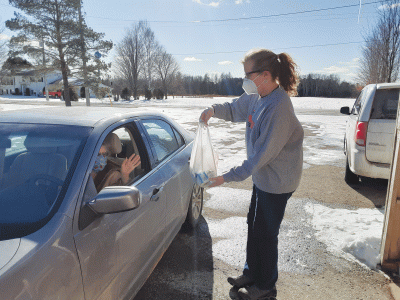
Congregate meals could no longer be served inside senior centers, and were replaced by curbside pick up. CAA Senior Services Director Sally Kidd said many of those who used to eat at the senior centers are now picking up their meals curbside. The CAA's six senior centers, including Escanaba, Gladstone, Hermansville, Menominee, Mid-County and Rock Area, served almost 44,000 meals between October 2019 and September 30, 2020-- initially in their facilities, and curbside after restrictions.
For those who are homebound, the centers delivered nearly 157,000 meals via Meals on Wheels between October 2019 and September 30, 2020. Though homebound meal recipients are still receiving deliveries, they may struggle with isolation even more than their curbside pickup counterparts, as drivers must remain contact-less for the time being.
"It's difficult because sometimes we're the only one they are interacting with that day," Gladstone Senior Center Administrator Lisa Trotter said.
The meal delivery drivers are now faced with having to refuse invitations to come inside to chat for a few minutes -- a connection both recipient and driver enjoyed pre-pandemic. Trotter said it's heartbreaking.
"Hopefully it'll be over soon and we can get back to some normalcy and come in and have a cookie," she added.
Well-checks remain an essential part of meal delivery driver responsibilities. The centers have always followed-up with phone calls to meal recipients or their emergency contacts if there is no answer when food is brought to the door. The precaution is now more necessary than ever, as leaving food outside reduces the chances of seeing the recipient.
"Hopefully they come to the window and wave, pop their heads out, and say "Hi". If we don't see the person, we call around to make sure," said Rock Area Senior Center Administrator Becky Carey.
The isolation is difficult for seniors, and for those who love and care for them. Trotter said the center lost a lot of familiar faces over past 10 months from COVID-19 or other health issues.
"It's really sad because we had no way of consoling family members, and we couldn't go to funerals. We never got to say goodbye," Trotter said.
To help ward off isolation, CAA senior centers have taken to having prize drawings during curbside pickup. These are usually held twice a month. One is a birthday drawing, in which anyone picking up a meal whose birthday falls in that month is entered. The other coincides with a holiday that falls in that month, and anyone picking up meals is entered. Gifts vary, and may include things like a gift card, gas card, goodie bag, birthday bouquet, or special meal.
Carey said the prizes bring back a little fun to those used to such celebrations when attending meals at the centers in the past. The Rock Area Senior Center is also providing take-home craft kits through their art program to help prevent boredom during social restrictions.
"By the end of it I'm fairly hoarse. We all want to get back together and miss each other. This is their circle of friends, and it's hard not being able to get together for activities. To go from that every day to nothing, you know, it's hard," Carey said of the curbside festivities.
Escanaba Senior Center Administrator Lydia LaPalm encouraged community members to come to the the Senior Center parking lot with their dauber or marker and join in Parking Lot Bingo February 24. Players receive paper bingo cards, tune into a specific radio frequency, and play bingo from their cars. Prizes will be given out. Details are still being firmed up, but those with questions can call the center at (906) 786-8850. The event is being held in collaboration with the city of Escanaba, and LaPalm credits city Recreation Director Kim Peterson for coming up with the idea.
While area centers continue to provide connection and necessities for seniors, challenges remain, especially for the homebound. Kidd said the biggest challenge right now is a lack of aides to help the homebound, many of which are on a waiting list. She put out an open plea for those interested in part-time work.
"We are struggling. If you have any time in your busy schedules to help a homebound person, man, we just need you to come help us out," said Kidd.
Kidd added that the 10 to 20 hours of weekly work is a good way to earn a little extra money, and training is provided.
"We're gonna be here. We're planning on coming back full-force as soon as we're capable to, and hoping everyone will hang in there and come back and be part of our community again. We miss everybody. Hopefully, we can all be back together and resume where we left off," said Trotter.