Group tracks local bird numbers
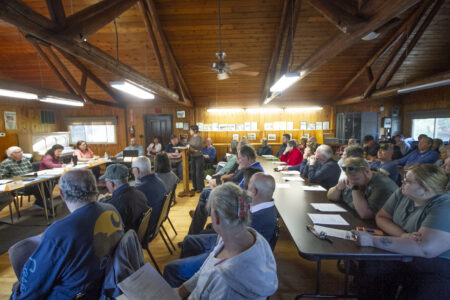
ESCANABA — Birding, the act of observing birds in their natural environment, is a year-round hobby. Little Bay de Noc Audubon and Naturalists Club in Escanaba takes part in the National Audubon Society (NAS) Christmas Bird Count every December and meets once a month during the school year.
“We had 20 people involved in the Audubon’s Christmas bird count last year, 15 field observers and five home observers, watching for birds in their yard feeders,” said organizer Charles Lindquist. “We count birds within a 15 mile radius, with the Gladstone beach house as the center, seven miles in every direction. We cover quite a bit of territory, Stonington, the Escanaba River by the Verso paper mill, dam number three, to the Escanaba beach house.”
Lindquist compiled the number of birds reported to him and gave the information to the NAS. Information gathered from around the world helps the society track birds and their environments. Each group counts the number and species of birds seen or heard on a day of their choosing between Dec. 14, 2019, and Jan. 5.
“We count birds usually the first Saturday or Sunday within the timeframe allowed, and in the same areas,” said Lindquist. “That gives the Audubon the correct report of what’s happening in the area.”
The club counted 48 different species in the 15 mile radius, 5,026 different birds.
“One of our guys has permission to go to the landfill and spotted many herring gulls. The number counted for a lot of the total number of different birds,” said Lindquist.
While counting, the club located 59 bald eagles.
“It is remarkable how the bald eagles have come back,” Lindquist said. “Years ago, we would only find six.”
According to Lindquist, a member of the club knows how to locate owls easily, and from 12:05 a.m. to 5:15 p.m. he counted owls.
“We do pretty well in the U.P., eight horned owls were located then,” Lindquist said.
During the yearly count they found robins, waxwings, and cardinals.
“We’re starting to see birds we would never see in the winter, maybe one or two cardinals, but last December we found 13,” said Lindquist. “It can be a little scientific, sometimes the numbers go up, or down.”
Delta County has a great environment for birds, the landfill, and bodies of water, lakes, rivers, and Little Bay de Noc.
“We counted many ducks, one black, 11 long tailed ducks, 58 common golden eye, which should be down south. Four red breasted merganser, five common merganser, and two ruffed grouse. We usually spot grouse in certain types of trees,” said Lindquist. “We saw 127 mallards.”
According to Lindquist, 20 years ago clubs were told not to count turkeys because the NAS considered them planted by people. Since then, the rules have changed and the club counted 81 turkeys in the wild.
Members of the club found downy, hairy, and pileated woodpeckers, 15 red bellied, and one red headed woodpecker.
“The pileated woodpecker will go after older trees and eat insects,” said Lindquist.
Overall, Carney reported 28 different species, Houghton County reported 37, Manistique found 29 different bird species, and Autrain reported 31, according to Lindquist.
“We’re doing pretty well compared to other groups in the U.P.,” Lindquist said.
Lindquist and his wife Karen moved back to Escanaba in 2006 and decided to join the Audubon club after finding out Lindquist’s old scout master, Bob Meyer, was the organizer. When Meyer retired, Lindquist became organizer of the club.
There are 30 members overall. During the summer months, the club does not meet.
“I wish we did more in the summer, but I’m busy at the historical society,” said Lindquist.
For more information, contact Lindquist at 906-786-3122, or cnlindquist@charter.net.
Local News

Louella Maniaci, 103 years old

Bay College introduces David Bahrman Memorial Scholarship
Gladstone students honored by Tech
Escanaba City Council to hold public hearings on electric, water rate ordinances
Editor’s note: Meeting agendas and their contents are subject to change. The following items were listed on the ...

Marinette High School principal pleads not guilty to battery, disorderly conduct charges involving ex