Review of “The Producers”
As performed by Players de Noc
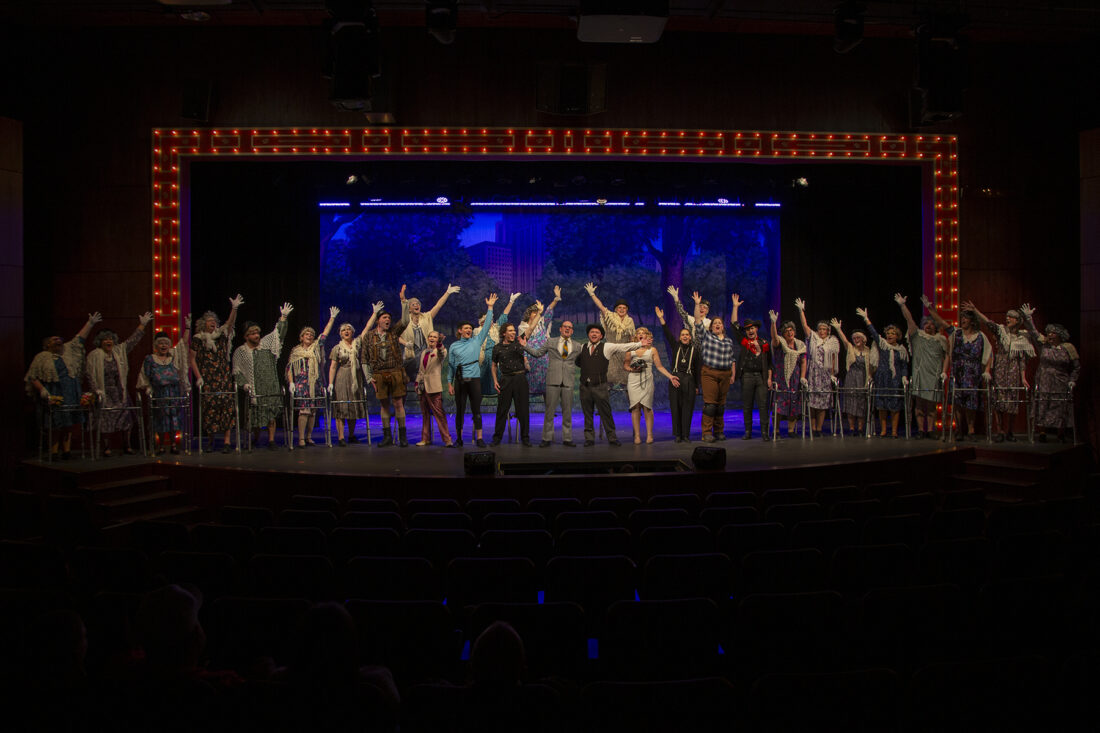
The cast of "The Producers," Players de Noc's riotous last show of the season, poses in costume on the stage of Besse Theater at Bay College. (MDH Photo | Supplied by Players de Noc)
ESCANABA — Mel Brooks’ “The Producers” was never meant to be subtle. Loud, irreverent, and gleefully outrageous, the musical thrives on embracing the absurd. Under the savvy direction of Jamie Peterson and executive producer Chris Perryman, Players de Noc’s production at the Bay College Auditorium embraced that spirit completely, delivering an evening of fearless comedy and big, infectious laughs.
Players de Noc once again demonstrated its ability to mount an ambitious musical comedy with both polish and enthusiasm.
The story follows struggling Broadway producer Max Bialystock and timid accountant Leo Bloom, who is roped into Max’s get-rich-quick scheme after the pair discover they can make more money producing a flop than a hit. Their plan: stage the “worst,” most offensive musical imaginable, and watch it close immediately. Naturally, things don’t go as planned.
Brennan Richardson was perfectly cast as Max Bialystock, with the stamina, strong vocals, and sharp comic timing required. With a confident accent, a powerful voice, and an instinct for the comedy’s rapid-fire rhythm, he leaned fully into Max’s oversized ego and showmanship. He especially shone during the frantic number “Betrayed,” where Max races through a breathless recap of the entire plot while desperately trying to talk his way out of disaster.
Chris Ogren, as Leo Bloom, provided the ideal counterbalance. His performance captured the character’s meek, anxious personality with just the right touch of manic energy. Ogren’s physical comedy and nervous delivery made Leo both hilarious and oddly endearing, and his chemistry with Richardson anchored the show even as the plot spiraled further into absurdity. Their partnership was especially fun in “We Can Do It,” where Leo is pulled deeper into Max’s plan.
Darren Widder fully embraced the role of Franz Liebkind, the eccentric and deeply misguided playwright of the worst musical ever, “Springtime for Hitler.” Franz is meant to be outrageous, offensive, and completely detached from reality, and Widder committed to those extremes with fearless enthusiasm.
As Ulla, the aspiring Swedish actress who becomes Max and Leo’s secretary — and eventually Leo’s romantic interest — Erica Mead brought strong vocals, high kicks, and confident stage presence. She commanded attention whenever she appeared, particularly in the lively number, “When You’ve Got It, Flaunt It.” The character’s humor was balanced with a playful self-awareness, and her scenes with Leo added endearing romance amid the chaos.
Harrison Bouche and Jackie Troutman added another layer of theatrical flair as Roger DeBris and Carmen Ghia. Bouche leaned confidently into Roger’s flamboyant theatrical ego, while Troutman’s Carmen delivered quick wit and precise physical comedy that energizes every scene they share. Bouche and Troutman were joined by Roger’s equally flamboyant production team for the crowd-pleasing number “Keep It Gay,” a moment that brought a burst of unapologetic theatrical joy to the stage.
Lynn Soderberg was memorable as one of Bialystock’s enthusiastic elderly benefactors, drawing some of the evening’s biggest laughs during the “Touch Me” sequence. The moment was made even funnier when Bialystock’s wealthy admirers appeared dancing with walkers and determined enthusiasm.
The ensemble carried the show’s energy throughout the production’s big musical numbers, helping create the kind of over-the-top Broadway spectacle the show demands. Many performers appeared again and again in wildly different roles, transforming from enthusiastic grannies to stormtroopers, military vehicles, and magnificent German icon follies girls. Their willingness to go all in on every ridiculous twist was a huge part of what made the show work. Musical director Betsy Perry guides the cast through Brooks’ lively score with polish and momentum, while the lush orchestra moved effortlessly from German folk-song pastiche to rapid-fire patter songs. Just as impressive was the high-flying choreography by Marissa Backlund, Madelyn Mayers, Christa Hubert, and Whitney Wentworth, which covered everything from complicated tap to the samba with style and precision. Combined with quick costume swaps, fast-moving set pieces, and a backstage crew working at impressive speed, the production rarely lost momentum.
Technically, the production made striking use of the Bay College Auditorium stage. A massive set design shifted between numerous settings throughout the show, with some scene changes executed so smoothly they seemed almost like stage magic, expertly maneuvered by a hardworking backstage crew who handled the large scenic pieces with precision. The lighting design added color and drama to the show’s biggest moments, while excellent sound design ensured every lyric, punchline, and orchestral flourish landed clearly with the audience. The creative costuming was equally ambitious, with well over 100 costumes appearing throughout the production–ranging from lederhosen and oversized steins to glittering showbiz spectacle — helping bring Brooks’ wildly imaginative world to life. All of these elements came together in the famous “Springtime for Hitler” number, which exploded into full theatrical spectacle with dazzling choreography, bold visuals, and knowingly outrageous flair.
More than two decades after its Broadway debut, the musical still works because its humor has teeth. Beneath the outrageous jokes lies a satire about spectacle and the strange things people will enthusiastically embrace if they’re packaged with enough confidence and showmanship. In a moment when ego and theatrical bravado sometimes passes for leadership, that idea feels surprisingly prescient.
Brooks understood that the real gift was the power of laughter, and that sometimes the best way to confront what feels overwhelming is to laugh at it — loudly and unapologetically. For a couple of hours inside the Bay College theater, audiences could allow the world outside to fade a little and be reminded of how good it feels to laugh together.
When the curtain fell and everyone stepped back into the real world, that shared laughter lingered — and these days, it may be one of the most valuable things a theater can offer. We can all use a little of that right now.
Entertainment
Entertainment schedule
(Please check with venues first in case of cancellation) Friday * Upper Hand Brewery, 6 p.m. to 8 p.m. – ...
Review of “The Producers”

An AI-rendered Val Kilmer will posthumously appear in a new film

What to Stream: BTS, ‘The Immortal Man,’ a new ‘Peaky Blinders’ movie, Luke Combs and Crimson Desert
Entertainment schedule
(Please check with venues first in case of cancellation) Friday * Hereford & Hops, 5 to 8 p.m. - ...