Managing oak wilt
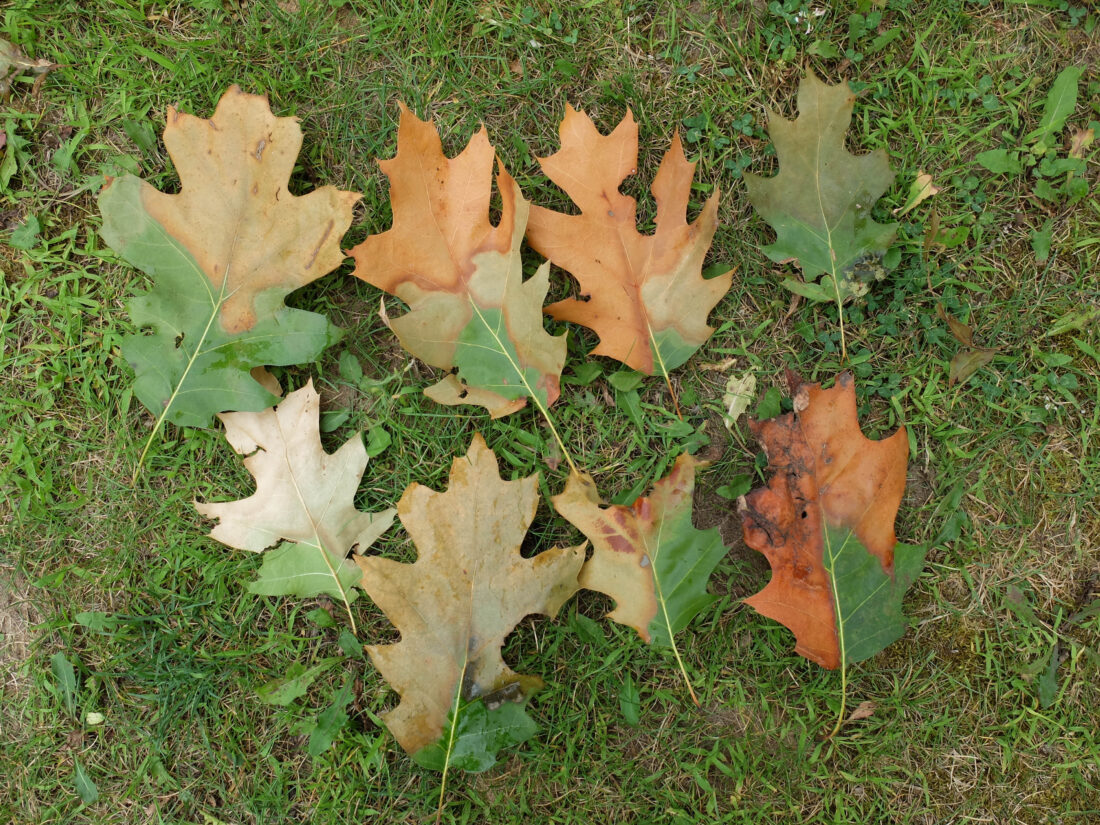
Oak leaves showing oak wilt symptoms have browning or bronzing of leaf tips and margins while the lower part of the leaf remains green (indicates oak wilt is present but requires a lab diagnosis to confirm). Photo by Monique Sakalidis, MSU.
Oak trees are valuable to the Northwoods environment, recreation and wood products industries, but many are in danger. Michigan encourages education around preventing and managing oak wilt, a disease killing red oaks across the state every year.
Major oak wilt prevention guidelines are: avoid wounding trees between April 15 and July 15, seal accidental wounds, do not move firewood, and take prompt action to control outbreaks.
Oak wilt primarily affects trees in the red oak group (Lobatae). This disease can spread two ways: through overland (aboveground) and underground transmission. Overland transmission occurs when an oak has a fresh wound that goes through the outer bark and into the sapwood (xylem cells). Sap from the wound attracts tiny picnic beetles, also known as sap beetles (family Nitidulidae), which may carry fungal spores of oak wilt (Bretziella fagacearum) on their bodies. The beetles pick up these spores when they visit spore-producing mycelial mats found beneath the bark on trees that the oak wilt fungus has killed.
When a contaminated beetle carrying spores feeds on sap in a wound on a healthy oak, the spores can infect the tree. As the fungus grows, it eventually plugs up the xylem cells the tree uses to transport water. This causes the tree to wilt and die. Trees infected in the spring can die rapidly within a few weeks. Trees infected in the fall may not die until the following year.
Researchers have found that beetles are most likely to carry spores in late spring and early summer. Therefore, activities that may wound trees should be avoided from April 15 through July 15 to reduce the risk of overland transmission and new oak wilt infections. Unavoidable or accidental wounds from storms or lawn equipment should be painted with a pruning sealer or latex paint as soon as possible.
Another way the disease spreads aboveground is when wood from oaks killed by oak wilt is moved into new areas. Sporulating mycelial mats that attract sap beetles can be produced on firewood or logs from trees that died from oak wilt the previous year. Dry wood or completely debarked wood does not contain enough moisture for the oak wilt fungus and is safe to move.
Underground transmission from tree-to-tree occurs via grafting, i.e., connected roots between infected oaks and nearby healthy oaks. A tree killed by oak wilt can become the center of a disease outbreak resulting in expanding pockets of dead and dying trees. When oak wilt is detected, management involves disrupting the connected roots, usually done by trenching, and removing both infected oaks and a buffer of healthy oaks to curtail disease spread. Managing an outbreak early and effectively prevents additional oaks from becoming infected and dying.
It is important to seek professional help when oak wilt is suspected. The Michigan chapter of the International Society of Arboriculture (ISA-Michigan) trains arborists and foresters to identify and manage oak wilt. Diagnosing oak wilt requires either the observation of a mycelial mat on a dead oak or a lab-based confirmation of symptomatic branches or leaves (samples can be sent to MSU Plant & Pest Diagnostics).
Oak trees are considered “keystone” species in Michigan because of their crucial role in the ecosystem. They support over 500 native caterpillar species, which in turn provide food for many types of songbirds. Acorns are a high-protein food source for numerous native wildlife species, including deer, turkeys, squirrels and more than 30 species of birds. As large, long-lived trees, oaks also play a vital role in carbon sequestration and serve as a valuable timber resource. With proper adherence to pruning guidelines and effective disease management, oak trees can continue to thrive and provide ecological, economic and environmental benefits for generations to come.
–
This article was produced by Ruth Dorando Marcy and Julie Crick at Michigan State University Extension and edited for length by the Daily Press.
Regional News
MDARD takes steps to protect Michigan from new world screwworm
MARQUETTE — The Michigan Department of Agriculture and Rural Development (MDARD) recently announced new domestic ...
Cheboygan man sentenced for threatening judge, prosecutors
LANSING – Barry Hopkinson, 61, of Cheboygan, was sentenced to three to 15 years in prison on Thursday, June 18 ...

MyMichigan Health successfully performs first robotic‑assisted lung biopsy

Michigan prisons leader defends oversight after three women die
Farmers brace for difficult season