Violence against Indigenous people remains
The color red calls for attention and solutions
-
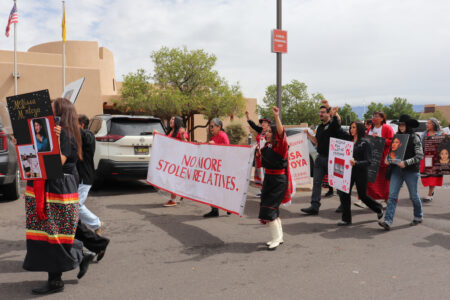
- Demonstrators participate in a prayer walk to mark the national day of awareness for Missing and Murdered Indigenous Peoples in Albuquerque, N.M., on May 5, 2026. The Hannahville Indian Community hosted a similar event the following day. (AP Photo/Savannah Peters)
-
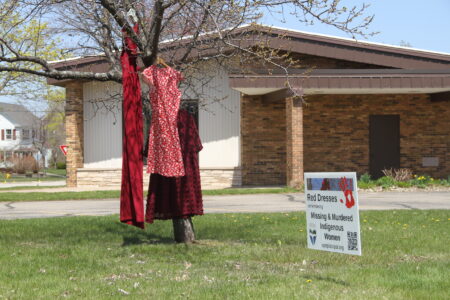
- Three red dresses hang from a tree outside St. Stephen’s Episcopal Church of Escanaba. A sign near the sidewalk informs passersby that they are displayed in recognition of Indigenous women who have been murdered. (R. R. Branstrom | Daily Press)
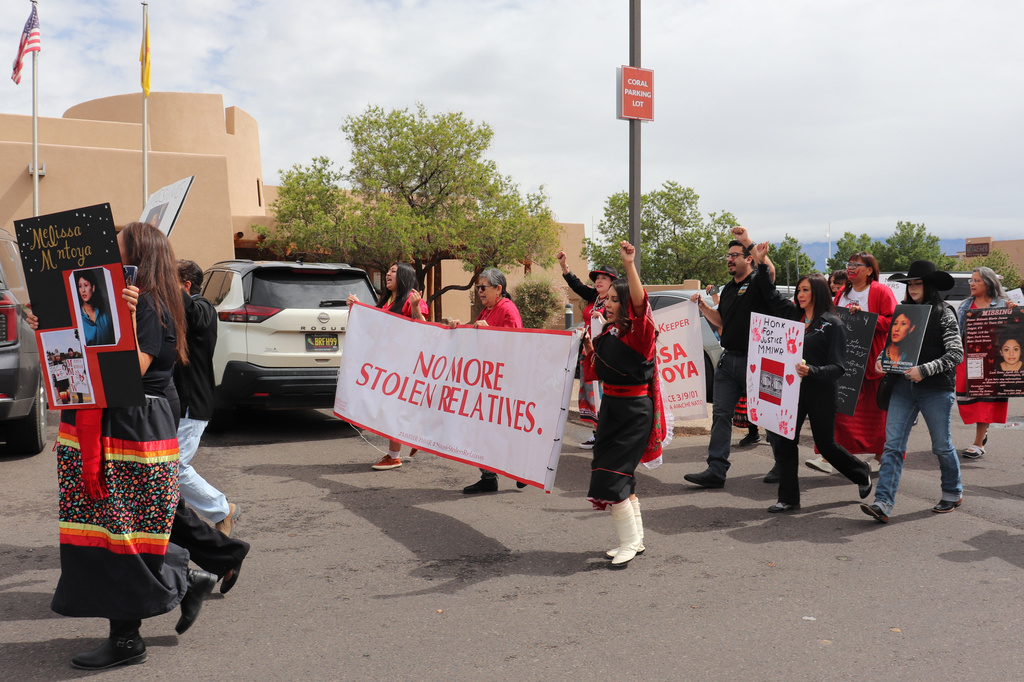
Demonstrators participate in a prayer walk to mark the national day of awareness for Missing and Murdered Indigenous Peoples in Albuquerque, N.M., on May 5, 2026. The Hannahville Indian Community hosted a similar event the following day. (AP Photo/Savannah Peters)
ESCANABA — This month, an important message spreads throughout the nation. Recently, the National Day of Awareness for Missing and Murdered Indigenous Women and Relatives passed, but observances continue. To those unfamiliar, the details may be shocking and upsetting.
Women, girls and two-spirit (a term used by some to describe Indigenous individuals who are gender-non-conforming or queer) people of Native American heritage are assaulted and killed at a higher rate than other groups, multiple sources report. The same is true for Indigenous people of Canada and Australia.
“In 2023, homicide rates among American Indian and Alaska Native people were nearly five times higher than homicide rates for non-Hispanic White people. A disproportionate number of American Indian and Alaska Native people are murdered or go missing,” reported the CDC. “Understanding why violence happens helps to prevent it.”
The same report stated that homicide was the fourth-leading cause of death for Indigenous males and the sixth-leading cause of death for Indigenous women.
The exact number varies, but the percentage of missing and murdered Native individuals is consistently disproportionately higher when compared to other populations.
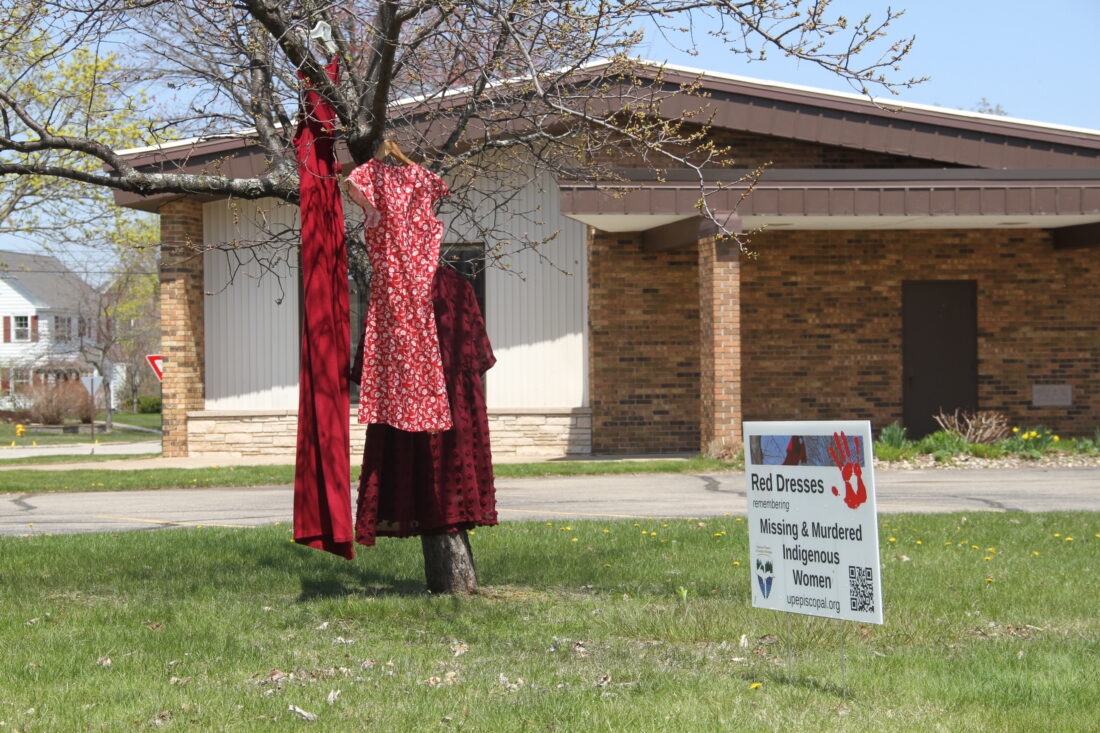
Three red dresses hang from a tree outside St. Stephen's Episcopal Church of Escanaba. A sign near the sidewalk informs passersby that they are displayed in recognition of Indigenous women who have been murdered. (R. R. Branstrom | Daily Press)
“The Australian Institute of Criminology’s report confirms what communities have long known – Aboriginal and Torres Strait Islander women are killed at rates up to six times higher than non-Indigenous women, overwhelmingly by intimate partners (76%) or family members,” reported The Conversation in March.
While crimes do often happen within reservations, it only expounds a problem that already existed outside.
In Canada and the United States, the systematic violence against Indigenous people by early European settlers has been increasingly understood to have been a cultural genocide. From rape and murder to dispossession treaties, forced assimilation and so-called boarding schools, white colonizers stripped First Nations people of their homes, rights, identities — practically their humanity.
In 2009, Congress and then-President Barack Obama signed a formal resolution apologizing “on behalf of the people of the United States to all Native peoples for the many instances of violence, maltreatment, and neglect inflicted on Native peoples by citizens of the United States.”
In response to the gesture, some felt underwhelmed. There was no verbal statement, no remediation, no legal action, wrote one journalist for the Indian Law Resource Center.
In Canada, the government launched a public inquiry that was initially called the “National Inquiry into Missing and Murdered Indigenous Women (MMIW).” It operated from 2016 to 2019, and by the time the report was published, it was about “Missing and Murdered Indigenous Women and Girls (MMIWG) and Missing and Murdered Indigenous Relatives (MMIR).”
The conclusion was that the violence was “caused by state actions and inactions rooted in colonialism and colonial ideologies” and amounted to a continuing crisis.
In 2017, after the murder of Hanna Harris on the Northern Cheyenne Reservation and other killings of Native women, two United States Senators from Montana introduced a resolution to mark May 5 as a National Day of Awareness for Missing and Murdered Native Women and Girls.
Around the U.S. and Canada in May, a number of communities hold events such as prayer walks, art exhibits, self-defense classes, film screenings, 5k runs, healing circles, and marches and speeches at U.S. state capitols to plead for better cooperation among law enforcement agencies.
The Hannahville Indian Community has been holding a walk of memoriam, prayer and healing annually in May for several years. This year, Hannahville Victim Services organized the one-mile Missing and Murdered Indigenous Relatives Awareness Walk on May 6. People wore red, which is said to be a color that spirits can see. A red handprint painted over one’s mouth represents the silencing of Native voices and lack of attention to the community’s struggles.
In some places, the initiative to promote awareness, address the situation and stimulate prevention is also called “Red Dress Day.”
In Escanaba, red dresses hung from a tree outside St. Stephen’s Episcopal Church, next to a sign urging people to learn more.
The REDress Project was an art installation created by Métis artist Jaime Black in 2009. She hung hundreds of red dresses as “an aesthetic response to the more than 1,000 missing and murdered Aboriginal women in Canada,” according to Black’s website. A portion of her exhibit remains on permanent display at the Canadian Museum of Human Rights.
In the U.S., the FBI’s National Crime Information Center recorded just under 1,500 active federal cases involving missing Native Americans by the end of 2025.
“Don’t look at the numbers and feel sorry for us,” said Abigail Echo-Hawk, a citizen of the Pawnee Nation of Oklahoma in a recent Associated Press interview. “Look at the numbers and say, ‘How do we ensure that this doesn’t continue?'”
Echo-Hawk is also the director of the Urban Indian Health Institute.
Awareness, research and active change aim to lower the statistics regarding violence against Native people. One goal, the CDC states, is “to identify and reduce factors that may lead to violence, such as prolonged stress and economic hardship.”
The National Indigenous Women’s Resource Center has information on their website at www.niwrc.org.
Any Native American or Alaskan Native seeking help from domestic or sexual abuse may contact the StrongHearts Native Helpline at 1-844-7NATIVE (762-8483). Their lines are open 24/7 and are “safe, confidential and anonymous” according to the website at strongheartshelpline.org, which also provides resources and information.
StrongHearts Native Helpline “envisions a return to our traditional lifeways where our relatives are safe, violence is eradicated and sacredness is restored… by weaving together a braid of safety, sovereignty and support.”
Sault Ste. Marie Tribe of Chippewa Indians has an Advocacy Resource Center that may be reached at 906-632-1808.
Uniting Three Fires Against Violence is another organization serving the Tribes of Michigan. Training, resources and support may be found at unitingthreefiresagainstviolence.org.