Dealing with floodwaters
-
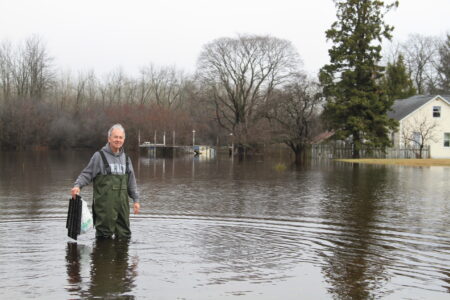
- Rick Servant of Escanaba stands in his flooded front yard late Tuesday morning. (R. R. Branstrom | Daily Press)
-
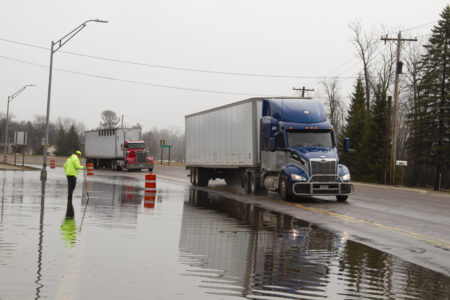
- Vehicles traveling south on M-35 were forced to use a northbound lane in part of south Escanaba on Tuesday due to water over the road. (R. R. Branstrom | Daily Press)
-
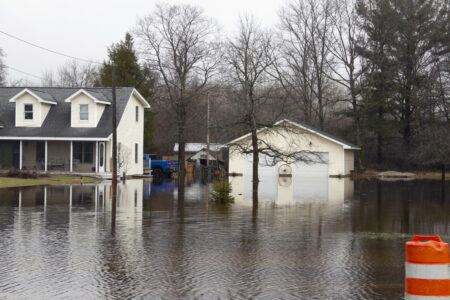
- A garage peeks over a pool of floodwater at the end of an indistinguishable driveway. (R. R. Branstrom | Daily Press)
-
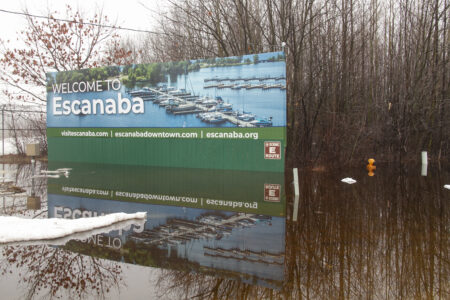
- A billboard welcoming travelers to Escanaba extends into floodwaters. Beyond, the orange top of a fire hydrant is visible peeking over the wet mix of rain and melted snow. (R. R. Branstrom | Daily Press)
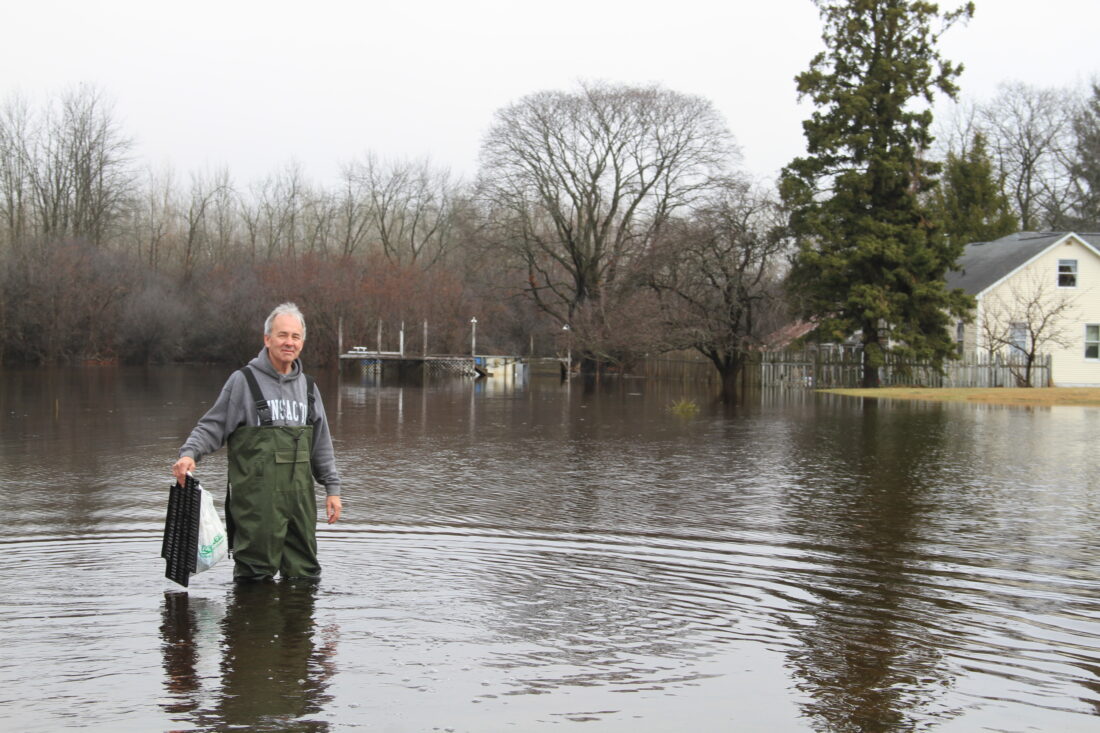
Rick Servant of Escanaba stands in his flooded front yard late Tuesday morning. (R. R. Branstrom | Daily Press)
ESCANABA — While some Yoopers were pumping water out of their basements, Rick Servant was in waders and galoshes, trudging through the knee-deep pond that spontaneously developed in his front yard Monday night.
Flooding in the Upper Peninsula this week is caused by rapidly melting snow and additional rainfall.
“This is the highest I’ve ever seen here,” said Servant, who has occupied the Escanaba residence since 1989. His property, which faces M-35 and neighbors the Delta County Airport, has been in the family since 1909, Servant shared.
A wooded area to the southwest side of his yard accumulates storm water drained from both his place and the airport, and a ditch along the highway leads to storm drains and culverts meant to allow rainwater to flow south under the roadway and towards the vicinity of Portage Marsh. On Monday morning, water was furiously gushing through the culvert, but water still stood nearly two feet deep in Servant’s front yard, several inches deep over the sidewalk, and covered much of the road surface of southbound M-35.
Large wooden garden bed frames that had been in Servant’s back yard had floated from their places and drifted to the front yard.
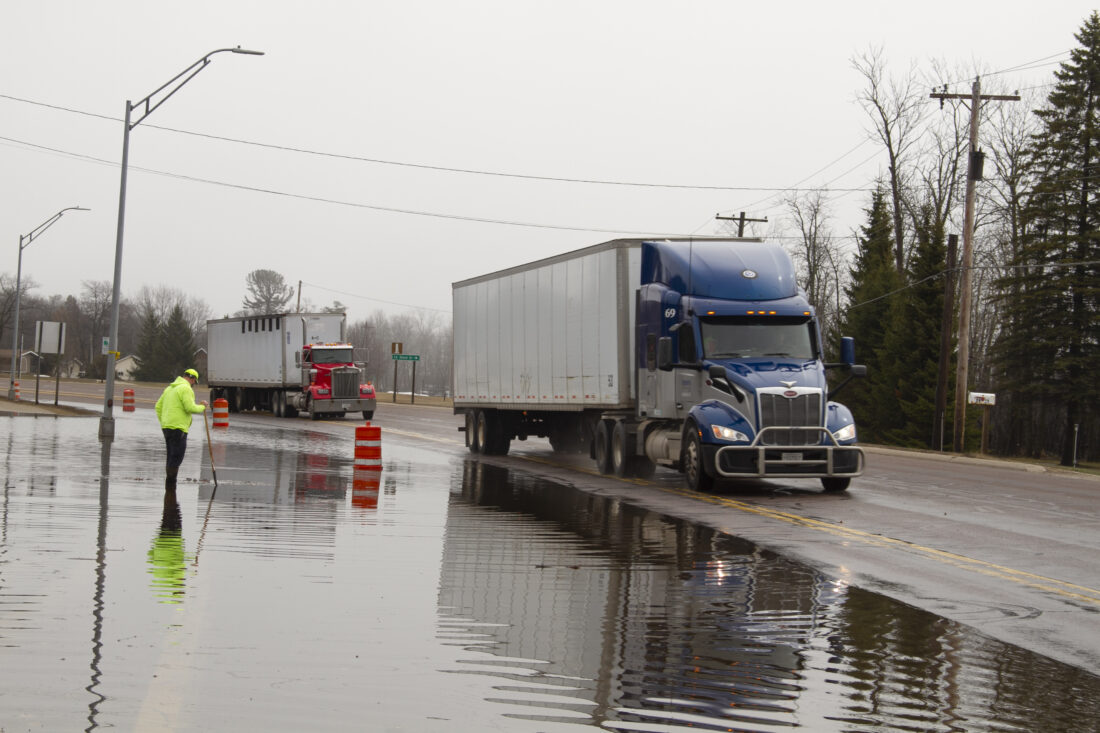
Vehicles traveling south on M-35 were forced to use a northbound lane in part of south Escanaba on Tuesday due to water over the road. (R. R. Branstrom | Daily Press)
After first making contact with the airport, Servant got in touch with the Michigan Department of Transportation (MDOT), who set up orange traffic barrels and began to help Servant and a friend clear sticks and dirt that may have been blocking a storm drain.
But MDOT’s biggest concerns in the U.P. are in Powers and Rapid River.
In Powers, both eastbound and westbound U.S. 2 is entirely closed due to water over the roadway, with a detour on local streets in place, said MDOT’s Dan Weingarten, communications representative for the region, said Tuesday afternoon.
On U.S. 41 at U.S. 2 near Rapid River, “we have alternating lanes of traffic under flag control due to water over the roadway,” Weingarten reported.
Around the state, people are on alert and infrastructure is scrutinized as waters rise.
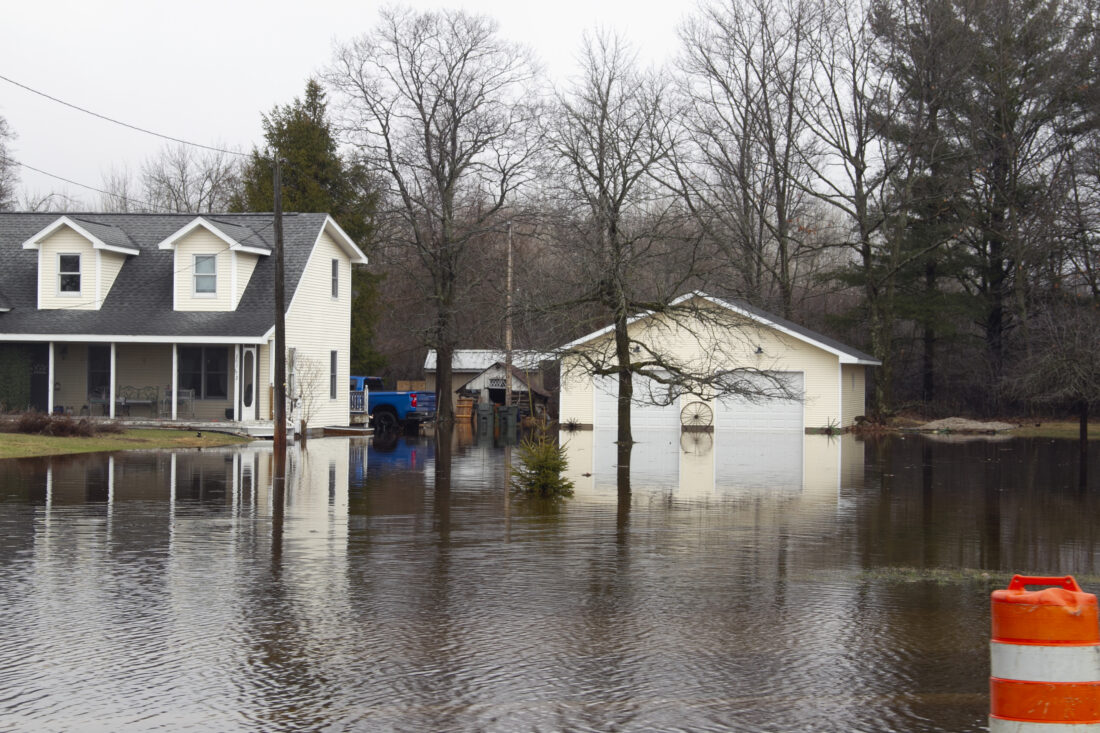
A garage peeks over a pool of floodwater at the end of an indistinguishable driveway. (R. R. Branstrom | Daily Press)
On Friday, Governor Gretchen Whitmer declared a state of emergency for Cheboygan County in order for work to be done at the Cheboygan Dam and Lock Complex, where levels are climbing. Some fear not just water spilling over the top of the dam, but an entire failure of the over-century-old structure for which repair projects have been postponed.
Whitmer extended the emergency declaration on Tuesday, saying: “Protecting Michiganders and their property is our top priority. With already high water levels across the state and more rain in the forecast over the next few days, we are proactively extending our activation of the State Emergency Operations Center. This will ensure work continues around the Cheboygan Lock and Dam Complex to increase pumping capacity and place sandbags, but it also helps us deploy additional supplies to other areas of the state that may be at risk of flooding.”
Later Tuesday, Whitmer implemented an energy emergency as well. Since fuel won’t by delivered to the major terminal of Cheboygan by barge, “it is expected that fuel transport drivers will need to travel much further distances,” the executive order said, temporarily eliminating regulations like maximum daily driving limits.
This spring may be a rough one, but officials have known for a while that civil engineering projects across the state have been in need of upkeep. Ten years ago, the Michigan 21st Century Infrastructure Commission Report cited a need for $225 million over the next 20 years to manage aging dams.
According to the American Society of Civil Engineers (ASCE), which produces “infrastructure report cards” for each state, Michigan earned a “C-minus” overall in 2023.
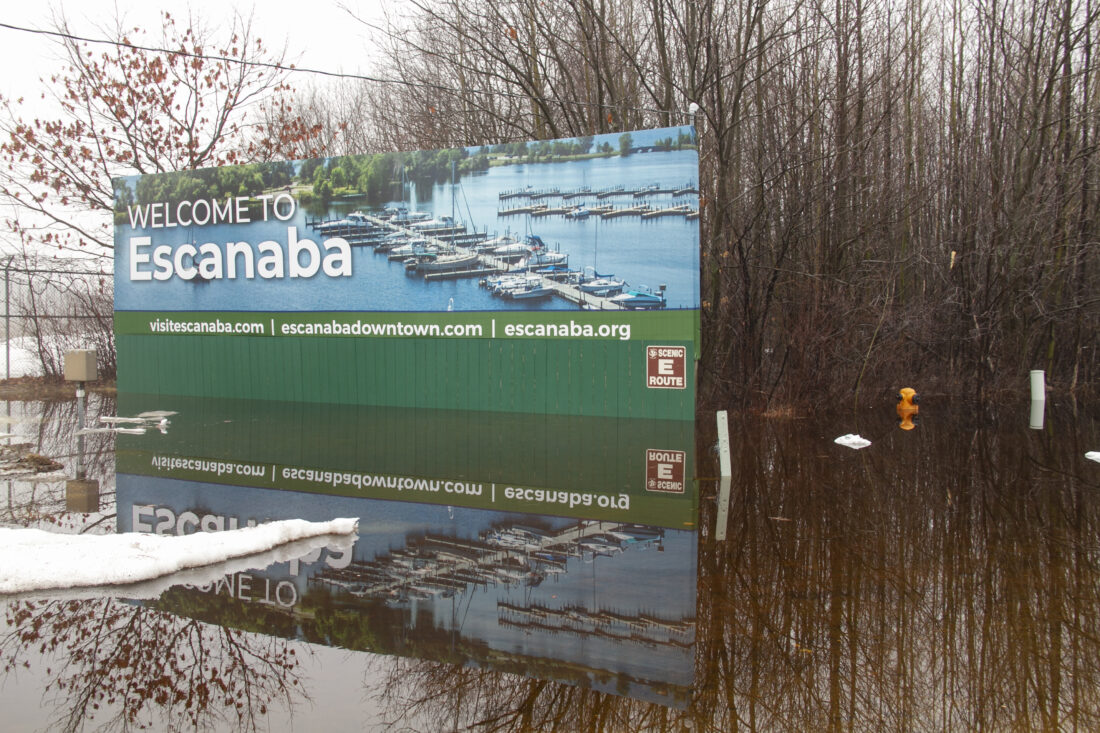
A billboard welcoming travelers to Escanaba extends into floodwaters. Beyond, the orange top of a fire hydrant is visible peeking over the wet mix of rain and melted snow. (R. R. Branstrom | Daily Press)
“New resources are needed to improve the overall condition of dams across the state,” the ASCE said. “For too long, Michigan’s infrastructure suffered the impacts of chronic underinvestment.”
Examples of underinvestment in infrastructure are seen around the state as municipalities scramble to replace water mains and sewer lines. Water treatment plants struggle with capacity; during this week’s floods, several have been forced to release partially-treated sewage into rivers and lakes.
In the Upper and Lower Peninsulas over the last couple days, culverts have swept away, streets and highways have flooded and roads have been washed out.
In Alcona County, 14 roads had washed out by Monday.
In Onaway, utility company Presque Isle Electric & Gas (PIE&G) announced that they may need to shut off service, as some of their natural gas lines were exposed due to washouts, creating hazards.
A levee was breached on the Little Black River Watershed, and impacted areas were directed to evacuate.
In Cheboygan, authorities decided to close and raise the Bascule Bridge until flood levels subside, in order to prevent erosion and potential damage to the bridge from debris coming down the river.
Dam safety engineers from the Michigan Department of Environment, Great Lakes, and Energy (EGLE) visited the known most critical dams on Tuesday.
Though many people feel overwhelmed and defeated by the state of things beyond their control, others are doing what they can to help in their own spheres.
In Indian River, where the Sturgeon River overflowed its banks, residents walked through a flooded town to help neighbors retrieve things from their homes.
In Escanaba, Rick Servant picked floating rubbish out of his yard and spoke about a couple standing inches of water in his detached garage. He referred to the scene as “depressing” but kept a smile on his face.
When asked how much water was in his subterranean crawlspace, Servant replied, “I’m afraid to look.” He also had yet to check whether he had flood insurance.
Local News

Linking people and pups

Garth Bluff Grocery to reopen
UP sees ‘The Ford Boom’ in the 1920s
IRON MOUNTAIN — For Henry Ford in the early 1900s, the Upper Peninsula wasn’t just a place to vacation, it ...
Bishop of Saginaw responds to Michigan AG’s report on alleged sexual abuse within the church
SAGINAW — Following the release of Michigan Attorney General Dana Nessel’s report on sexual abuse allegations ...

Escanaba library joins statewide reading initiative