Reduce water usage, City requests
(City of Escanaba)
ESCANABA — As the area is inundated by high water levels due to snow melt and rainfall, officials urge residents to mitigate water use and redirect sump pumps to lessen the burden on sewer systems.
Wastewater superintendents in Escanaba, Gladstone and Manistique have told people that sump pumps are not supposed to be directed into the sanitary sewers, which are for wastewater. Instead, water should be pumped towards storm drains.
“The best way for residents to help in these situations is to get their sump pumps off of the city’s sanitary sewer system,” said Gladstone Wastewater Superintendent Rodney Schwartz, emphasizing that it was unlawful for stormwater to be discharged into sewers, as per the city’s code of ordinances. “Tips for residents that have a sump pump connected to the sanitary sewer would be to put the water outside away from your home.”
Rainfall that enters the streets is meant to find storm drains, which lead to waterways like creeks or the lake. Water seeping into basements and into sumps can be directed to the same.
“They can redirect their sump pumps to the street. That will take a huge burden off of us,” said Escanaba Water/Wastewater Superintendent Jeff Lampi. “Sump pump water is considered clean water, considered storm water, and we need to get that out of the sanitary.”
Since water used in homes — for dishes, laundry, showers, flushing — all heads to the sanitary sewer, he also requests that people minimize usage until conditions improve.
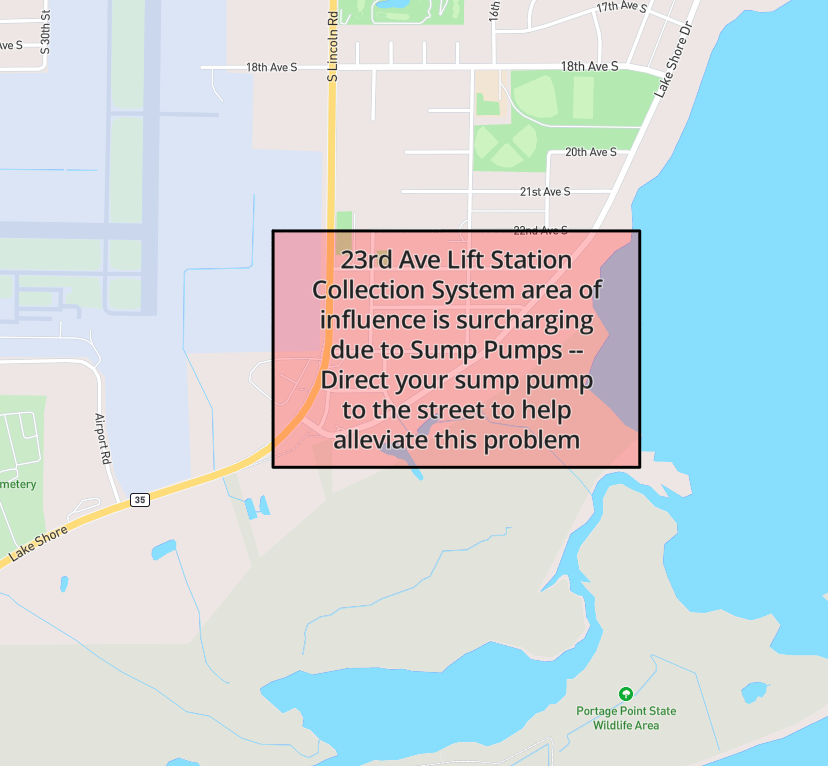
The City of Escanaba announced Monday morning that the 23rd Avenue lift station in south Escanaba was surcharged, and stated, “If you are using a sump pump, it is possible you are contributing to the flooding of your neighbor’s house and/or your own home.”
In Manistique, where yards, basements and streets have flooded, Water/Wastewater Superintendent Rebekah Weber reported: “While catch basins are functioning, the volume of water has exceeded their capacity. Residents are asked to remain patient and exercise caution until water levels recede.”
Manistique’s wastewater treatment plant is operating near capacity, she added. “To reduce additional strain on the system, residents are asked not to discharge sump pump flow into the sanitary sewer. Sump pumps should be directed to storm sewer catch basins,” Weber said. “Additionally, any open basement drains should be sealed immediately.”
Manistique experienced a combined sewer overflow at 7:40 a.m. Sunday into the Manistique River. By Tuesday morning, the overflow remained ongoing, Weber said.
The City of Manistique is currently under an order from the Michigan Department of Environment, Great Lakes, and Energy (EGLE) to separate all combined sewers into distinct storm and sanitary systems.
“Efforts are underway to secure the necessary funding to complete separation in the remaining two combined sewer areas,” Weber relayed.
At the Escanaba wastewater plant, though they have not experienced an overflow, Lampi said it’s the most he’s ever seen and that more water is coming in than the plant is rated for.
“Technically speaking, I think our plant’s rated for 5 million gallons a day (MGD), and we have a peak flow of 7.25, and we have consistently been running 7.5 MGD to 8.5 MGD on our pumps for the last 24 hours or more,” Lampi said around 1:30 p.m. Monday. “The new plant is keeping up, but there’s only so much we can put into the lake.”
In Gladstone, where a new water treatment plant was recently constructed, operators are monitoring lift stations and clearing items like rags caught on screens at the plant.
“With the new upgrades to the plant, we can focus more on the collection system than in the past,” said Schwartz.
He also noted that Gladstone’s plant had experienced higher flows from rain and melt events in past years when lake levels were higher.
“If a (Gladstone) resident believes that they are experiencing a sewer back-up, please call the wastewater plant (906-428-2311 Prompt 3, Extension 3) or 911 before calling a local drain cleaner,” Schwartz advised. “If the issue is in the sewer main, we can rectify the problem at no cost to the homeowner. Once we evaluate the situation and determine that it is the homeowner’s issue, then they can call the drain cleaner of their choice.”
In Escanaba, questions and concerns may be directed to 906-786-3291.
NOTE: This article was edited on April 14, 2026, to add details about Manistique.
Local News
Linking people and pups
ESCANABA — A man who has a way with dogs and offers sought-after training services was also recently named ...

Summer creativity
The wrong kind of fire truck
School leaders urge budget deal as July 1 deadline nears
LANSING — The Michigan Association of School Boards (MASB) and Michigan Association of Superintendents and ...

Convicted felon from Garden arraigned on with felony weapons, drug charges