
Restrictions take toll on local restaurants
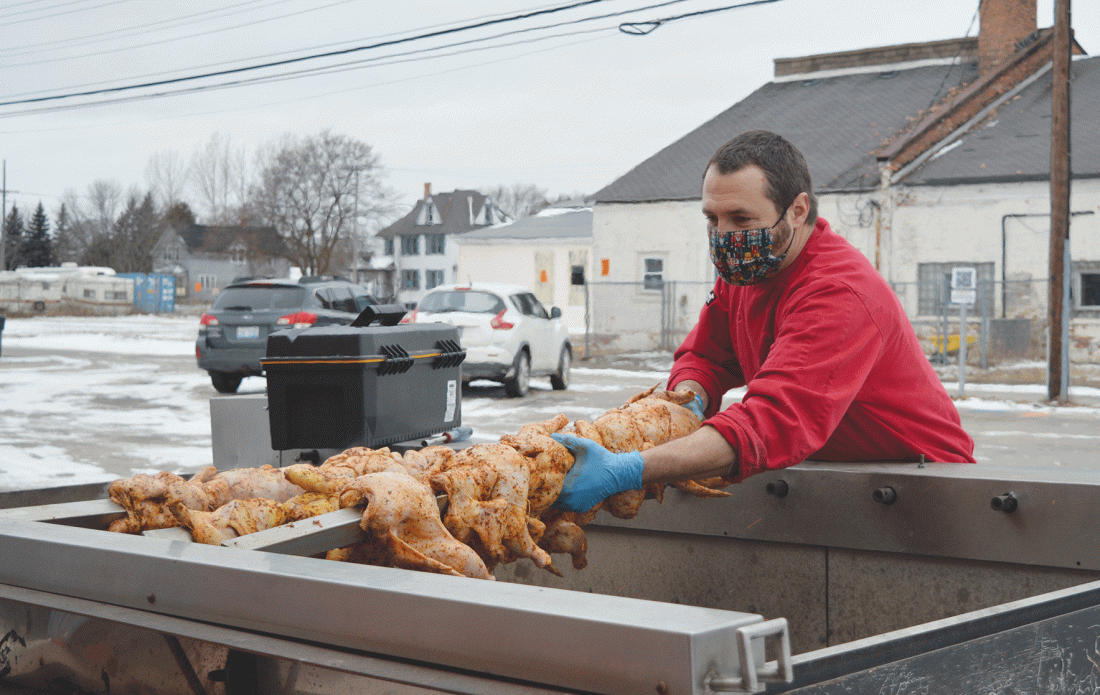
Caroline Carlson | Daily Press Bobaloon’s owner Mark Ammel loads chickens onto a rotisserie unit.
ESCANABA — The COVID-19 restrictions imposed upon restaurants have taken a toll in the Upper Peninsula as much as anywhere else — and perhaps more-so, according to some local restaurant owners.
“Especially in the U.P., it’s hard to make a living, let alone trying to ride out a storm like this,” said Liza Plourde, owner of Drifters Family Restaurant with partner Heather Schram. Plourde said she completely understands COVID-19 is real, and has herself lost family members due to the virus. She pointed out, however, Drifters spent thousands of dollars on high-tech cleaners and making many changes — including purchasing equipment they otherwise would not have needed because they were required to — only to be closed again.
“So, I get a little bit irritated when the government wants to act like they are doing us a big favor,” Plourde said, referring to the government-run relief plans.
Though Plourde does her best to be ready for tough times, COVID-19 restrictions are stretching her reserves. “I’ve always prepared for rainy days, but this day is turning into months, and a year almost. So, as good as you are at preparing, this isn’t what we expected,” she said.
Support from the community has been vital to their restaurant’s survival, she said. “Being in a small town and the support with our citizens is just overwhelming. And it does come back around. During times like this, Heather and I are thankful. The travelers aren’t keeping us in business. If it wasn’t for the local support, we’d definitely have our doors shut, for sure,” said Plourde.
Determining that it was not profitable to pay to staff the kitchen under the restrictions, Becky Moody, owner of Hereford and Hops Steak House and Brewpub, made the decision to shut down the food end of her business. “I don’t want to hemorrhage money and not have enough money when we are allowed to open for dine-in,” Moody said.
Moody said many people don’t realize that when the state shuts restaurants down, almost everything has to be thrown out. She adds restaurants like hers that make everything from scratch take at least two or three days to get ready to go again after being shut down. Moody has given away the food that would have gone to waste, as well as the cash she had on hand, to help her employees.
The liquor buyback program is of no use to Hereford and Hops, said Moody, because selling take-out liquor is their only lifeline right now. “We are actually selling some of our special cocktails, like our blackberry bourbon lemonade by the half-gallon,” she said, adding she’s not sure whether the governor isn’t aware, doesn’t understand, or just doesn’t care about the impact of shutting down restaurants. As to potential locations where COVID-19 risk lies, Moody suggests rethinking restaurants, who are continuously cleaning high-touch surfaces.
“If you’re following the science like the governor says she likes to do, then I’ve got some facts for her,” Moody said.
SHe said the Hereford and Hops ventilation system pumps 14,000 cubic feet of fresh air into the restaurant per minute to compensate for the huge fans over the two large grills., “No home has ventilation like that.” she said.
Moody hopes at the very least for a 50% open allowance in the near future, which she says will be enough for the restaurant to pay their employees and break even. She points out, however, that smaller restaurants may not be able to break even at 50%.
Bobbi Ryan, owner of Jack’s Restaurant in Rapid River with partner Cynthia Ivy, said she was on the conference call between the restaurants and the governor. “We’re going to come out with some scars, but I understand she’s doing the best she can with the limited deck she has to play with. Some of it doesn’t make sense, but she’s gotta do something,” Ryan said of working within the state-mandated COVID-19 restrictions.
In response to the restrictions the kitchen window at Jack’s was converted to a drive-through. “It’s not optimal, but it prevents people from coming into the restaurant, which is what is asked of us. It’s not really paying the bills, but for the community we’re doing what we can to stay open,” Ryan said.
Ryan intends to take advantage of available government assistance, including the recently released Restaurant Meal Program, which allows eligible food assistance recipients the opportunity to use their benefits to purchase restaurant meals at enrolled establishments. She acknowledges her business has a very different opinion from many neighboring restaurants. “We’re not the most popular kids on the block right now,” Ryan admits, but says of Governor Whitman, “I wouldn’t want to be in her shoes. If she kicks back and does nothing, she’ll hear about that, too.”
In response to COVID-19 restrictions, Mark Ammel, owner of Bobaloon’s Café, has shut down indoor dining and is only offering take-out. In hopes of adding convenience, he also added drive-up order spaces to the parking lot, where customers can use their smart phones to scan a QR Code sign to access the menu and place an order. The food is then brought out to the parking space. “Where there’s adversity also we used the opportunity for ingenuity and perseverance,” Ammel said.
While Bobaloon’s is significantly down in sales from last year, Ammel said he’s grateful for the community’s strong support of local businesses. His customers continue to order take-out and purchase gift cards. “If you let the community help you, they will. The best thing we can do is make the choices that are best for our employees, keep a positive attitude and show the community that’s the best way to get through this,” Ammel said.
Local News

Holy Name teacher retires after 39 years

Gwinn man convicted of criminal sexual conduct, child abuse

Legal counsel appointed for receiver in Bark River Knives case

Delta Animal Shelter breaks ground on new education center

Same pots, different walk
Ludington & 14th update
The traffic signal at the intersection of Ludington Street and 14th Street has been changed to a flashing red ...