A ghost of the past and a bridge to the future
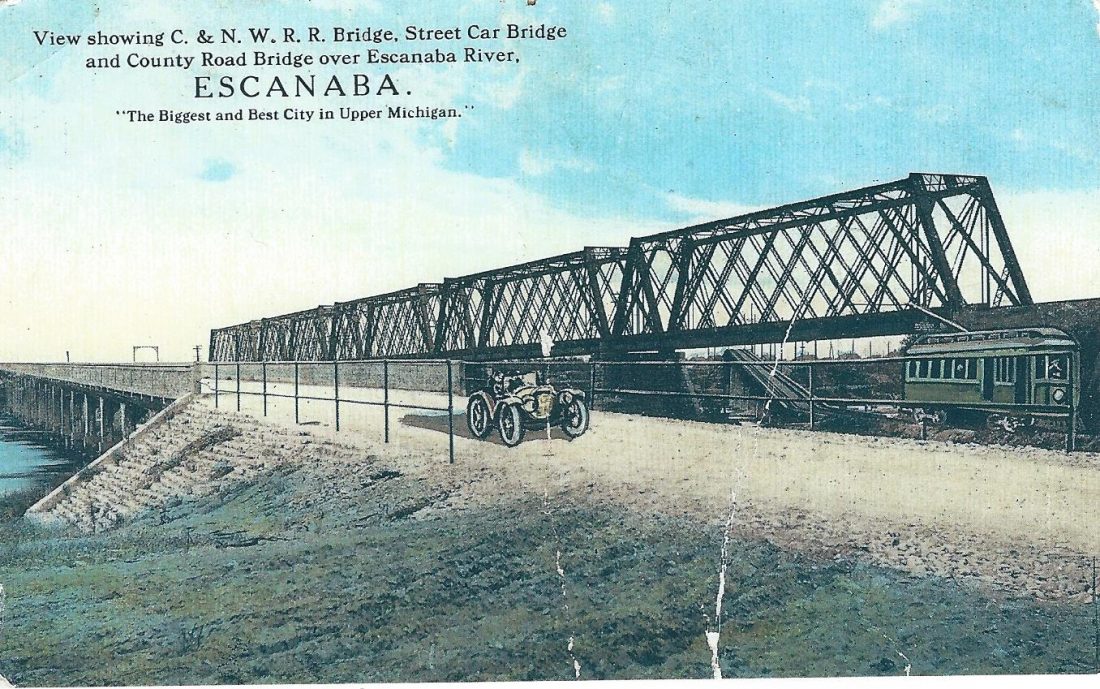
Photo courtesy the Delta County Historical Archives An old look at the bridge over the Escanaba River.
ESCANABA — A tall, lanky ghost, with a well-chiseled nose and pepper-gray whiskers, pauses among the gravel, sand and cement.
Southward, from the mouth of the Escanaba River (Wells) to north Escanaba, he meanders, retracing the footsteps of so many lumberjacks on so many Saturday nights.
His hands are calloused from years of hard work, hardwood, and from settling disagreements between rowdy lumbermen of different ethnic backgrounds.
Still as tall as a white pine tree, the old-timer surveys the reconstruction, on Highway U.S. 2 & 41 and all the way to Stephenson Avenue. He admires the modern machines, bulldozers and dump trucks, and he recalls the days when his machinery echoed through the woods.
The mouth of the river was his old stomping grounds. Bridges and roads throughout much of Delta County were something he controlled! The Michigan Department of Transportation is currently working on replacing the bridge over the Escanaba River between Gladstone (Wells area) and Escanaba.
Motorists know this all too well if they have traveled this route in the past several months.
The old highway bridge was constructed in 1929, when Al Capone still roamed, and widened in 1956, when Elvis Presley was ready to “rock ‘n’ roll.”
But some old ghosts never fade. Back in 1858, Stephenson was the talk of the town then too. Isaac Stephenson was the town. His world-famous I. Stephenson Lumber Mill produced more hardwood flooring than any place else at that time.
The ghost of this gigantic lumber baron would be proud of his namesake. Stephenson Avenue was named for Isaac Stephenson — as near as I can tell through research — around 1920. Escanaba was booming, and the Stephenson tracts of north Escanaba were developing quickly.
In the early 1900s the I. Stephenson Lumber Company spanned the whole mouth, island, and both sides of the Escanaba River. The logs, the lumber and the hard-working men there made Escanaba world famous. Yearly, the plant produced 75 million feet of lumber, 50 million cedar shingles, 10 million lath, and 20 million feet of maple flooring, plus ties, posts and poles.
Isaac Stephenson came to the north woods in the 1840s. He came from New Brunswick, Canada with his two brothers, Samuel and Robert. Both brothers also became successful lumbermen. The town of Stephenson (near Menominee) is named for after Samuel Stephenson. He also became a congressman.
Isaac was young, with practically no education, but he was not afraid of hardwood and he had a great business sense. He started out as a “cookee” in a lumber camp. He spent many months out in the weather surveying with the exploring crew in the mosquitoes and in the rain.
His friends called him “Ike.” In 1863, Stephenson began to purchase timberlands and a mill from Nelson Ludington. His business flourished in Upper Michigan and in Northern Wisconsin. At one time, Ike had a home just north of Pioneer Trail Park.
The Milwaukee Journal described Ike as a salty lumberman, a timber tycoon and a master tall tale teller with a great sense of humor.
He was a homespun leader that went on to become a US Senator from the state of Wisconsin.
Isaac Stephenson died in Marinette, Wis. in 1918 at the age of 88.
Just about all of us from Escanaba, Gladstone or Wells can go back a generation or two and find a relative working for the I. Stephenson Company either in the woods, at the mill, at the company store or at the boarding house.
The I. Stephenson Park and baseball diamond in north Escanaba (formerly called “Dock Diamond”) is named in memory of the hundreds of people that worked at the Stephenson Mill. Hard work and a proud history are handed down to another generation.
So, if you see a ghostly figure along the dirt, detours, noise and machines near the Escanaba River, that’s just Ike checking things out. It’s a new road into Escanaba’s future.
It sure has been a little inconvenient, stopping at the bridge construction site. Slowdowns, detours and bridge closure days are no fun. The two-year project will be such an improvement though, with even a pedestrian path.
So if you’re cruising into Escanaba, slow down and be cautious at the construction site.
Maybe you’ll catch a glimpse of him wandering eastward towards the mouth of the great “flat river.”
Ike is out there, between the pilings and pillars of yesterday, bridging a new era for us!
As the Escanaba River Bridge project nears its completion, it is time to welcome visitors to our area for the 70th Annual Upper Michigan Historical Conference, June 28-29. Enjoy our awesome history by taking part at one of the sessions or by visiting the Delta County Historical Museum, Lighthouse and Archives.
——
Karen (Rose) Wils is a lifelong north Escanaba resident. Her folksy columns appear weekly in Lifestyles.