
Wolf killing condemned by Tribes
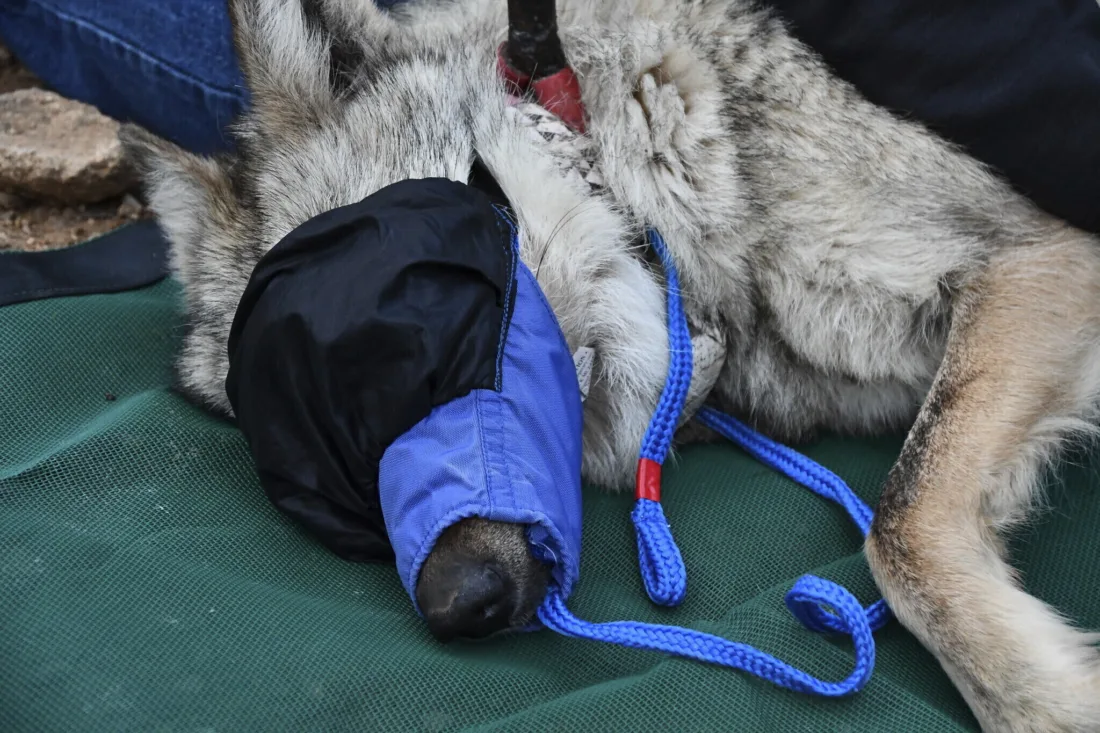
This 2023 image provided by the U.S. Fish and Wildlife Service shows a wolf during a health check before being released into the wild in southeastern Arizona. More recently and more locally, nine wolves in Wisconsin were trapped — but for another reason. The pack in Price County, Wis. was euthanized due to reported threats to human safety. (Associated Press file)
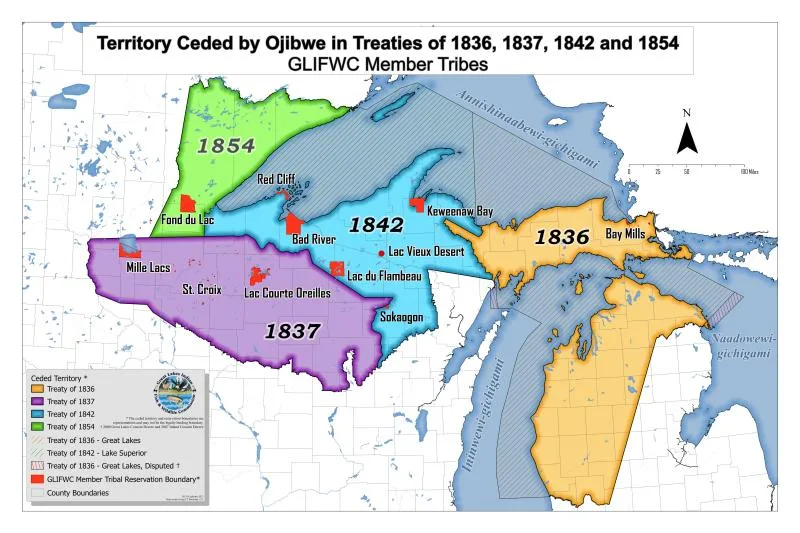
Land once occupied by various Chippewa tribes, ceded to the U.S. Government through a series of treaties, is shown. Gray wolves that were recently euthanized by federal and state agencies had been living on ceded territory — most of Price County was part of the Treaty of 1837. According to the commission representing tribal interests, they should have been involved in conversations; meanwhile, the WDNR states that the tribes were notified, and that further communication was not required since the incidents were not in the immediate vicinity of current tribal land. (Image via the Great Lakes Indian Fish & Wildlife Commission)
This 2023 image provided by the U.S. Fish and Wildlife Service shows a wolf during a health check before being released into the wild in southeastern Arizona. More recently and more locally, nine wolves in Wisconsin were trapped — but for another reason. The pack in Price County, Wis. was euthanized due to reported threats to human safety. (Associated Press file)
Land once occupied by various Chippewa tribes, ceded to the U.S. Government through a series of treaties, is shown. Gray wolves that were recently euthanized by federal and state agencies had been living on ceded territory — most of Price County was part of the Treaty of 1837. According to the commission representing tribal interests, they should have been involved in conversations; meanwhile, the WDNR states that the tribes were notified, and that further communication was not required since the incidents were not in the immediate vicinity of current tribal land. (Image via the Great Lakes Indian Fish & Wildlife Commission)
Trending
WISCONSIN -- After an announcement from the Wisconsin Department of Natural Resources (WDNR) that they had collaborated with the USDA Wildlife Services to euthanize nine gray wolves in Wisconsin's Price County, another party expressed umbrage that the agencies failed to consult a certain group who should have had a say in the situation -- the Great Lakes Indian Fish & Wildlife Commission (GLIFWC).
The GLIFWC serves 11 Ojibwe tribes in Minnesota, Wisconsin, and Michigan who reserved hunting, fishing, and gathering rights in the 1836, 1837, 1842, and 1854 Treaties with the United States government.
Price County falls fully within ceded territory; most was transferred in 1837, with a corner of the county being included in the Treaty of 1837.
As reported in the Daily Press Oct. 2 based on the WDNR release, Price County landowners observed wolves that appeared not to be fearful of humans in 2025 and 2026. The DNR and USDA followed up and classified the incidents as "verified threats to human health and safety."
The first measures to be taken to attempt to resolve the issues were non-lethal: "auditory harassment, vegetation modification, increased hazing and human presence, installation of flagging (fladry) and effigies, increasing the height of fencing around the yard as well as modifications to care of animals present on one property," a Public Affairs Manager representing the WDNR explained this week. "Unfortunately, these efforts did not have an impact on the behavior of the wolves and over time, the behavior was being passed on to additional pack members."
Subsequently, in August and September of this year, the wolf pack in question -- four pups, three yearlings, and two adults in Price County -- were subject to "lethal removal actions," the WDNR announced Oct. 2.
"The DNR consulted with the U.S. Fish and Wildlife Service throughout the process," the release said, concluding with: "The DNR also recognizes the profound cultural and spiritual significance for the Ojibwe and other tribes. As a result, the DNR is working with the US Fish and Wildlife Service to respectfully transfer the remains of the euthanized wolves to the Great Lakes Indian Fish and Wildlife Commission (GLIFWC) so the wolves may be appropriately and respectfully handled consistent with cultural beliefs."
However, tribal representatives say that the way the situation was handled was not only disrespectful, but that the federal and State agencies failed to carry out their required duties when they "bypassed consultation with the GLIFWC."
Decrying the government's action, a press release issued by the GLIFWC on Oct. 5 referenced a 1983 court case: Lac Courte Oreilles Band v. Voigt.
"Under the LCO v. Voigt ruling, the State of Wisconsin and GLIFWC member tribes are required to co-manage resources within the Ceded Territories, which equates to present-day northern Wisconsin," stated the GLIFWC release, reminding the WDNR and USDA to involve tribes in the decision-making process.
According to Anishnaabe tradition, wolves -- "Ma'iinganag," in the Ojibwa language -- are brethren; the animals are sacred relatives, not a lower lifeform.
"This action damages existing relationships and fractures trust. We remind the WDNR and USDA Wildlife Services to involve GLIFWC and its member tribes in the decision-making processes. Simply handing us the remains of our relatives after killing them does not constitute meaningful consultation," the Oct. 5 release stated.
The WDNR Secretary Karen Hyun apologized, saying, "I am deeply sorry for the DNR's lack of communication with Tribal Nations and GLIFWC in this process and, as I discussed with the tribes and GLIFWC at annual consultation, I am committed to improving our collaboration and communication with the tribes around wolf conflicts going forward."
However, a WDNR spokesperson on Wednesday said that policy was followed.
"When wolf conflicts are verified, the DNR posts information on the conflicts to our public website and sends out electronic notices to anyone subscribed to receive them. In addition, per current DNR policy, we send notices to an email list serv which includes GLIFWC and several Tribal biologists which have previously expressed interest in receiving such notices. Numerous notices of the verified conflicts in Price County occurred in 2025 and 2026," wrote the WDNR spokesperson in an email to the Press. "The DNR did not receive requests from any Tribes or GLIFWC staff member for further information to express particular interest in any of these reports."
The WDNR spokesperson said that the notices were sufficient, and that direct consultation was not required as the events were not in the immediate vicinity of a tribal reservation.
"Such decisions are not made lightly. They are made by experienced wildlife professionals after full consideration of the totality of the circumstances including animal behavior, proximity to people, potential for escalation, previous mitigation efforts, state and federal law, and as outlined in the DNR's policies on wolf conflict abatement," the WDNR wrote Wednesday.
Still, tribal representatives question whether lethal action was taken too hastily and unnecessarily. Incident reports never labeled the Price County wolf complaints as the highest level of urgency.
Lethal action is only approved if live capture and release is not reasonably possible, GLIFC Outreach Specialist Jenny Van Sickle pointed out.
"From what little information we have, it appears the DNR did manage to trap the animals prior to lethal action. Part of the federal trust responsibility, working nation to nation, would have flagged tribal consultation and produced a more thorough response. What discussions, if any took place regarding re-location efforts? Red Cliff and Lac du Flambeau both have experienced, professional experts who could have helped guide relocation efforts. Every single day that went by was a missed opportunity to reach out."
The WDNR, however, said: "In this case, relocation was not possible due to the constraints of available suitable habitat, the number of wolves in the pack, and the risk of relocation harming other wolf packs or causing exacerbated behavior from the wolf pack."