‘A world of difference’: Teachers, parents increasingly back cell phone bans in Michigan schools
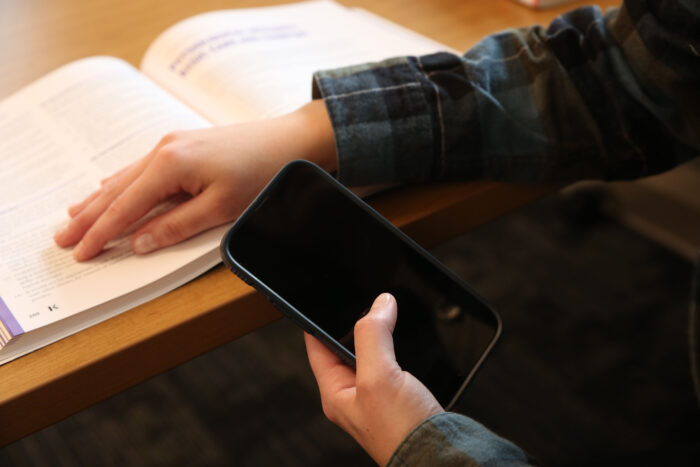
As Michigan considers a school cell phone ban that received overwhelming bipartisan support in the Michigan House last week, an increasing number of Michigan school districts have enacted bans and passed cell phone policies limiting use in the classroom in recent years. (Photo illustration by Makenzie Huber/South Dakota Searchlight)
In his 30 years as teacher and administrator, Jason Purcell felt the weight of responsibility that often fell on his shoulders in enforcing the prohibition of cell phones in the classroom.
When Purcell was convinced to come out of retirement this past fall to teach at Mackinaw City High School, he saw a remarkable difference teaching students in a district that had long banned cell phone use during the school day.
“It makes a world of difference when there is a school wide policy that is enforced by all the teachers consistently and supported by the administration,” said Purcell, who has taught math, been an academic counselor and served as an assistant principal throughout his career. “Students have and always will find ways to be distracted from the learning, but not having cell phones may take away the biggest distraction that students face.”
Mackinaw City Public Schools’ cell phone ban was instituted around 2010, coinciding with the rise of teen cell phone ownership, longtime Superintendent Jeffrey Curth said.
Teachers have all taken on the responsibility of enforcing that students’ cell phones are left in their locker with the ringer off from 8 a.m. to 3 p.m, Curth said, removing a major source of distractions and potential source of cyber bullying.
“Because we’ve just had it in place so long, it’s just what’s expected,” Curth said. “I think when you see the amount of cyber bullying and things that it’s raised to the level that it has in society today, I think it’s just further strengthened our stance that we feel that we’ve done the right thing.”
As the state considers a school cell phone ban that received overwhelming bipartisan support in the Michigan House last week, an increasing number of Michigan school districts have followed Mackinaw City’s lead by enacting bans and passing cell phone policies limiting use in the classroom in recent years.
Nationwide, 26 states have passed full bans on cell phone use, while six others have required districts to establish their own policies or limited cell phone use in class, according to Newsweek. A 2024 American Association of Educators survey of 1,517 teachers from across the country, on the other hand, found that 70% want cellphones to be banned during the school day.
From passive presence to active participation
Anchor Bay High School student success teacher Jamie Pietron said she was initially apprehensive about how students would adjust to the districtwide ban that started this fall, wondering how the policy would be enforced by administration.
There have been consequences for students who violate the district’s “away for the day” cell phone policy, Pietron said, helping contribute to a more connected learning atmosphere.
“In the past, when kids were done with their work, they went on their phones,” Pietron said. “Teachers are making lessons and activities more engaging to cover any ‘down time’ and students are focused on what they need to do.
“… It is amazing to walk through the cafeteria and see kids actually talking, playing cards and having conversations with each other instead of staring at their screens.”
Northville Middle School teacher Richard Tabor said he also has seen a shift from “passive presence” to active participation in his classroom since the district enacted its cell phone ban in 2024-25 for students in grades K-8 during class time, requiring them to be collected by teachers at the start of the day.
Prior to the ban being in place, Tabor said it was teachers’ responsibility to enforce their own policies on student cell phone use, leading to inconsistency in where students were allowed to use cell phones and where they weren’t.
Without the option to scroll during downtime, students are able to engage with the classroom environment,” Tabor said. “Students are more likely to ask questions, take physical notes and participate in discussions because they have no alternative ‘escape’ during moments of boredom or difficulty.”
Mackinaw City special education teacher Elizabeth McNeil said her transition from teaching in a district without a cell phone policy to one where a ban has long been in place has been a “breath of fresh air” in removing “distraction and drama.”
“At my previous district, there were daily arguments about giving up phones and discipline problems, even when just asking a student to put their phone away,” she said.
“In a society where adults are addicted to their phones, it is encouraging to see that we are encouraging students here at MCPS to realize that their phones are not part of their lifeline,” McNeil said”
Parental approval
Beyond support from teachers, bans have largely been met with approval from parents, who acknowledge that devices that continually cause them distractions throughout the day shouldn’t be in the hands of their children during school.
Heather Gatny’s opinion has evolved on the issue, from trying to hold off on getting her son a cell phone until he is in high school to recently getting him one as an eighth grader for Christmas.
She likes the idea of him having one in his possession, even if it is kept off while he is in class at Plymouth-Canton Community Schools, but stressed that in the classroom it can only cause distractions.
“If the kids were allowed to have their phones in the classrooms, they’d be looking at them the whole time,” she said. “I think that’s for the best for them to not have access to it, because they’re just on apps. They’re goofing around. They’re not paying attention to what the teacher is saying. They’re paying attention to what their friends are texting them.”
With two young children in second and fourth grades at Plymouth-Canton Community Schools, Sarah Krzyzanski said she is for cell phones being stored in a central location in the classroom for those who are concerned about students being able to respond to an emergency.
In the classroom, however, she said schools should be aiming to keep the focus on learning and not conditioning students to be dependent on having a cell phone by their side.
“These kids are at the point where they’re kind of addicted to that ‘ding,’ and they get to where they crave it, and it becomes an impulse,” she said. “I don’t believe that a child with a phone on their person has the ability to pay attention to the teacher and actually follow lessons and do it with enough of their brain engaged to be taking that educational content out the way that they should be.”
Michigan News

139th Annual Ishpeming Ski Jumping Tournament draws large crowds, top jumpers

Alpena house fire burns two people
MVAA encourages veterans to connect with their earned benefits in the New Year
LANSING – The Michigan Veterans Affairs Agency (MVAA) is encouraging Michigan veterans and their families to kick ...
‘A world of difference’: Teachers, parents increasingly back cell phone bans in Michigan schools

Whitmer warns of worsening auto industry under Trump’s tariffs