Remain Vigilant against ticks this season
50% of deer ticks found to carry Lyme disease bacteria in Wisconsin study.
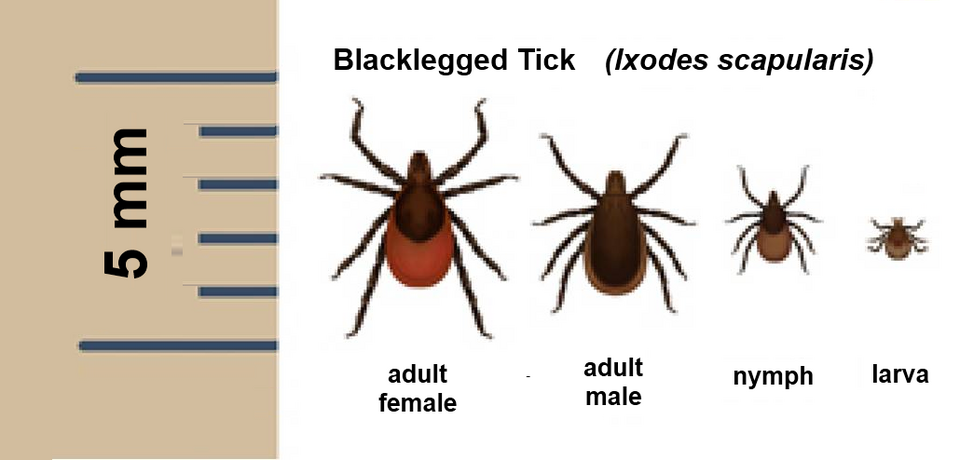
Ixodes scapularis larva, nymph and adults in millimetre scale (US federal government Center for Disease Control via Wikimedia Commons)
As residents continue to engage in beloved spring activities, such as camping, hunting, hiking and more — it is important to remain vigilant and take steps to prevent tick bites.
Ticks continue to be a major concern for Michigan residents as these bugs can carry bacteria that cause serious illnesses like Lyme disease, Anaplasmosis and Babesiosis.
Lyme disease, caused by the bacterium Borrelia burgdorferi, is the most common tick-borne illness in Michigan.
Lyme disease cases in Michigan have increased by roughly 168 percent over the last five years. The state recorded 1,215 cases in 2024, as compared to 452 cases in 2020. Anaplasmosis cases in Michigan have seen an almost fivefold increase over the last five years, with 82 cases in 2024 compared to 17 in 2020.
According to MDHHS data published in 2024, the five counties with the highest Lyme disease incidence per 100,000 residents are all in the UP — Dickinson, Baraga, Menominee, Iron and Ontonagon. Residents and visitors in these counties and the surrounding areas should be particularly careful when it comes to preventing tick bites this season.
“Preventing tick bites is the best way to prevent tick-borne diseases, including Lyme disease and anaplasmosis,” Dr. Natasha Bagdasarian, chief medical executive, said in an MDHHS article. “If you find a tick attached to your body, promptly remove it. Monitor your health, and if you experience fever, rash, muscle or joint aches or other symptoms, or if you suspect a tick has been attached for more than 24 hours, consult with your medical provider.”
TICS study in Wisconsin
In a tick study conducted by the Marshfield Clinic Research Institute, more than 50 percent of deer ticks tested were found to carry the bacteria that causes lyme disease.
This data comes from the Marshfield Clinic’s Tick Inventory via Citizen Science (TICS). Over 700 Ixodes scapularis, commonly known as the blacklegged or deer ticks, submitted by members of the public were tested for Borrelia burgdorferi — the bacteria that causes lyme disease — with 51 percent testing positive for Borrelia burgdorferi and other bacteria.
The Marshfield Clinic Research Institute launched the TICS in the spring of 2024 to investigate tick species ranges in the upper Midwest, as well as the pathogens carried by I. scapularis, also known as the deer tick or black-legged tick.
Deer ticks, which may only be the size of a poppy seed, can be found across the midwest in wooded areas and grasslands. They make contact as people brush past, latch onto their host and engorge in blood. The ticks can potentially carry pathogens that can lead to different diseases.
“Ticks may be small, but the illnesses they carry are not,” said Jennifer Meece, PhD, Marshfield Clinic Research Institute senior vice president of research. “Knowing the symptoms of tickborne illnesses can mean the difference between early treatment and long‒term health complications.”
Meece and Alexandra Linz, PhD., a staff scientist at Marshfield Clinic Research Institute, published a pre-print paper May 15 that outlines the TICS study’s early findings. A preprint is an early posting of a research article before peer review by independent scientists or accepted at a journal.
New tick species are becoming more prevalent or detected for the first time as climate conditions shift. In the upper Midwest, Lyme disease is the most common tickborne disease, by far. The deer tick, which carries Lyme disease, can also transmit the pathogens causing anaplasmosis, babesiosis, ehrlichiosis, and several more tickborne diseases in this region.
“Having a clear understanding of tick species’ endemic ranges is critical,” Linz said. “Knowing where and how these ranges are changing, including each species’ local pathogen prevalences, will be crucial to a public health response to tickborne diseases.”
Background on the TICS project
In TICS first two years, citizens submitted 12,493 ticks. The most common tick species submitted was D. variabilis (American dog tick or wood tick), followed by I. scapularis. Combined, these two species comprised 99.7% of all submissions. Wood ticks are larger than deer ticks and, in the midwest region, essentially never transmit infection to humans. Researchers received more wood ticks from citizen science submissions than from traditional tick collection methods, which suggests that people miss smaller ticks.
Multiple pathogens were identified in 14 percent of tested specimens, and significant associations were observed between B. burgdorferi and B. microti, and B. burgdorferi and E. muris eauclairensis.
The large sample size provided by the participation of citizen scientists allowed researchers to detect rare species of ticks not yet established in the upper Midwest. One example is the northward range expansion of A. americanum (lone star tick). Over two years, the Research Institute received 22 specimens that were identified as lone star ticks, 16 of which were from Wisconsin. Lone star ticks have a sugar molecule in their saliva that can cause an immune response to red meat called alpha-gal syndrome or “red meat allergy.”
Researchers and clinicians offer caution on their results–the study doesn’t indicate that there is a 50% chance of acquiring Lyme disease from a deer tick bite. It is known from other studies that the risk is about 3percent — and that risk decreases to 0.3% for people who receive doxycycline post-exposure prophylaxis. For a person to be at risk of developing Lyme disease, the deer tick must be attached for at least 36 hours.
“We don’t want to scare people off from being outdoors – Wisconsin residents and its visitors love the state because of the natural wonders and beauty,” Meece said. “We just encourage people to take proactive steps to protect themselves from ticks and be observant if they do find themselves with a tick bite.”
Tick research in Michigan
Both Michigan State University and the MDHHS conduct active citizen science tick research. The MDHHS has a free public tick submission service that allows residents to send in a clear, well-lit photo of ticks they find for identification via email to MDHHS-Bugs@michigan.gov. Residents can also mail ticks to the MDHHS. Residents interested in mailing a tick to the MDHHS should visit michigan.gov/emergingdiseases/ticks and click on the “submit a tick by mail” button.
To streamline tick submission and identification, the MDHHS has developed a tick submission kit, made available at no charge to members of the public. These kits consist of a screw cap plastic vial; a self-addressed, padded return envelope; a submission form; instructions for submission; and the Ticks and Your Health brochure. These kits can be obtained at your local health department. Alternatively, kits may be ordered via the Communicable Disease Division’s publication order form found at michigan.gov/mdhhs/keep-mi-healthy/infectious-diseases/cdinfo.
MSU also accepts tick submissions through The Tick App, a mobile app which lets users take and submit photos of ticks for identification, as well as supply other information about their environment and activities to help MSU with their tick research.
What to do if you find a tick
If you find a tick attached to your skin, use tweezers to remove the tick as soon as possible. Grasp the tick close to the skin’s surface to avoid squeezing the tick’s body. Pull the tick away from the skin with steady pressure to avoid causing the tick mouthparts to break off and remain in the skin.
Symptoms of illnesses resulting from a tick bite can include rash, fever, joint pain, and fatigue within several days to weeks. Contact your medical provider if you have these symptoms. Lyme disease doesn’t always result in the classic bullseye rash. Bring the tick in a small plastic bag to your provider, if possible.
“Testing is important, because early treatment is highly effective in preventing later stages of the disease from developing,” said Dr. Thomas Boyce, a pediatric infectious disease physician with Marshfield Clinic. “If you remove a deer tick that is attached and engorged, a single dose of an antibiotic (doxycycline) can reduce the risk of contracting Lyme disease ten-fold.”
To reduce the risk of tick bites, spray the insecticide permethrin on clothing, sleeping bags, and tent fabric. Wear clothing that covers your skin. Finally, have someone help you check for ticks after time spent outdoors.
Always check for ticks on yourself and your animals after being outdoors, including in your own yard. It can also be a good idea to bathe or shower as soon as possible after coming indoors (preferably within two hours) to wash off and more easily find ticks. Wash clothing in hot water and dry on high heat to kill ticks in clothing.
—
This article is adapted from an original article published by the Marshfield Clinic. Additional information was added by the Daily Press, sourced from multiple MDHHS and MSU publications.
Local News
Linking people and pups
ESCANABA — A man who has a way with dogs and offers sought-after training services was also recently named ...

Summer creativity

The wrong kind of fire truck
School leaders urge budget deal as July 1 deadline nears
LANSING — The Michigan Association of School Boards (MASB) and Michigan Association of Superintendents and ...

Convicted felon from Garden arraigned on with felony weapons, drug charges