
Think you know how to ride a motorcycle?
Even experienced riders should reassess their skills
Trending
EDITOR'S NOTE: Daily Press staff writer Rachel R. Branstrom is a certified RiderCoach for the Motorcycle Safety Foundation.
-- -- --
By R. R. Branstrom
rbranstrom@dailypress.net
ESCANABA -- Think you know how to ride a motorcycle?
A truly good rider is wise enough to answer honestly and without an overabundance of confidence. It is important for motorcyclists on the road to continually reassess their own skills, state of mind, and the situation at hand. Even experienced riders make errors. Sometimes it is possible to get away with them, but too often, bikes go down.
There are a number of basic street strategies that may help to reduce crash risks when kept at the front of a motorcyclist's mind. Most vehicle crashes are caused by an interaction of factors. On a motorcycle -- without the protections and stability offered by enclosed four-wheeled vehicles -- accidents can have dire consequences. Because not every problematic factor is within one individual's control, it is important for riders to mitigate the risks in their power.
– The diligent rider scans the roadways ahead, taking note of other drivers and anticipating what moves cars and trucks may may make that could potentially disrupt the ride, whether it be veering or changing lanes suddenly and without signal, slamming on the brakes, or dropping objects from the vehicle's interior, rooftop, or bed. By keeping multiple escape paths in mind, we increase our chances of reacting with success.
– One strategy when riding among other vehicles is to act as though you are invisible. 40% of motorcycle-car collisions happen at intersections, where there is an increased number of vehicles, directions, and confusion, so pulling out into an intersection without being sure the intended path is open is inadvisable. Wearing bright colors, reflectives, and additional lighting are great to help a rider be seen, but the fact remains that a lot of drivers are distracted, on their phones, or simply not looking for a shape as small as a bike. Drivers expect to see cars, and it is possible for them to look right past a motorcyclist without registering their presence.
– In most circumstances, curves and turns should be ridden with steady or increasing throttle. Slowing - whether by shifting, braking, or using the clutch — removes power from the rear wheel, which reduces available traction. The 100 Motorcyclists Naturalistic Study -- which recorded data from riders on their own bikes in the real world for 2 years -- showed that over half of single-vehicle (motorcycle) crashes occurred in curves.
– Similarly, we should avoid braking in a swerve. In an emergency maneuver to avoid an obstacle when there is not enough time to come to a complete stop, the two best options are to (a) slow and then swerve or (b) swerve and then slow/stop. Again, this is to not lose traction while leaned.
– The Motorcycle Safety Foundation supports the decision the wear a helmet and complete protective gear every time, no matter how short the ride. No one ever plans on crashing; the best way to fend off some of the worst injuries is to be prepared for the unexpected. Brain injuries are the number one cause of motorcyclist deaths. Especially cautious riders may choose to look for Snell-approved helmets, as the Snell Memorial Foundation has stricter testing protocols than the Department of Transportation.
– Before carrying a passenger, it is the rider's responsibility to adjust the tire pressure and suspension according to the combined total weight. Appropriate settings may be found in the motorcycle owner's manual or online. During passenger-carrying rides, the motorcyclist is required to use more throttle input to accelerate; it also takes more braking power and greater distance to come to a stop. The pair will be more susceptible to the effects of side wind. Both rider and passenger should be aware that even on a bike designed with a second seat, the passenger is at greater risk of being thrown from the bike in the event of a crash.
– Any passengers should be informed what they need to do: lean with the rider, look in the same direction as the turn, and keep feet securely on the pegs -- even when stopped -- until dismounting. To a motorcyclist, these may seem like common sense, but for people who do not ride themselves, instinct often tells them differently. If a passenger behind the rider tries to remain upright by leaning against the turn, the weight fights the intended maneuver, which can result in the motorcycle failing to turn tightly enough and hitting a barrier. Another easy mistake is for a passenger to stick their foot out when they feel unbalanced when leaned, but touching the pavement while the bike is moving can result in broken bones in the foot, ankle, and/or leg.
– Everyone knows that alcohol causes impairment. But on a machine that demands more fine motor skills, a greater number of total operations than a car, and only balances on two wheels, the slightest delay or error in a rider's reaction can have disastrous consequences. Having a BAC greater than 0.05% (less than one average drink) increases the risk of crashing forty-fold, according to the National Highway Traffic Safety Administration.
– Fatigue can be as debilitating as intoxication. In some states it is illegal to drive drowsy. 18 hours without sleep resembles one alcoholic drink in the system, while 24 hours without sleep results in performance levels mimicking a BAC of 0.1%, according to the Governors Highway Safety Association. Even when rested, however, it is possible for a person to tire from a number of causes -- stress, exertion, or even sitting in the seat for too long. Uninterrupted rides can result in inattentional blindness (failing to see what is plainly visible) and motion-induced blindness (a type of illusion which occurs when a constantly moving environment, such as the roadside, makes stationary objects such as deer, stopped cars, or other hazards disappear from perception). These ill effects can be avoided by taking frequent breaks and shifting position.
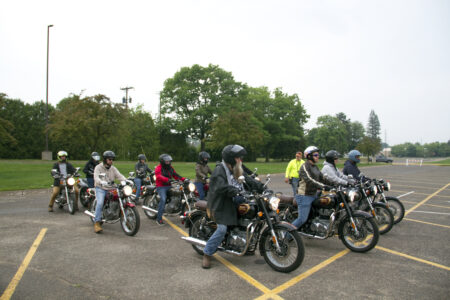
– Continuing education has been shown to improve performance, whether the class be a Basic RiderCourse for novices to learn basics on training bikes, an Advanced RiderCourse for current bikers to refine skills on their own motorcycles in controlled environments, or track days with the California Superbike School to go beyond the boundaries of what should be attempted on the street.
"Everyone can benefit from additional training. There is not one single professional athlete that does not have a personal trainer and a coach," says Robert Zurich, MSF RiderCoach. "And all those athletes constantly practice. Riding a motorcycle is far more important."
The value of structured learning is echoed across organizations. "Nothing replaces proper hands-on training," stresses Andria Yu of the Motorcycle Industry Council.
"On their bikes, bigger bikes, it's interesting for them to realize they don't have as good of a clutch-throttle control as they thought they did," said Yu, referring to her experience observing experienced riders in the "Skills Check," which is a short, free offering that will be done as part of Ride Day at training centers later this summer.
Courses conducted by experts -- available at multiple levels to provide low-stress, controlled but challenging learning environments -- are the best way to build skills, because trained coaches tend to notice things a veteran rider with mostly good habits could adjust, and timely tips to help them maneuver even better. In Michigan, the state funds a motorcycle safety program, so the fee to students is minimal. Information may be found at msf-usa.org.