County seeks names of indigent veterans
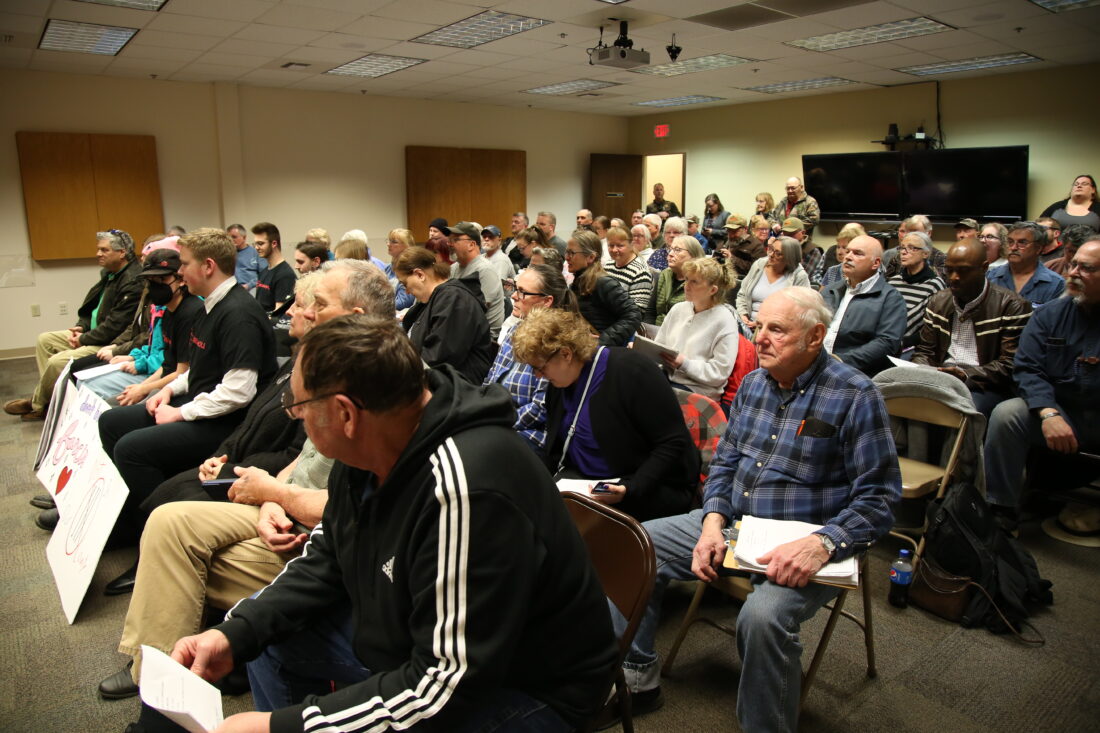
Ilsa Minor | Daily Press It was standing room only at the Delta County Board of Commissioners meeting Tuesday. As in the past, protestors opposing commission members Dave Moyle, Bob Barron and Bob Petersen sat in the front row carrying signs.
ESCANABA — The Delta County Board of Commissioners, which is seeking to come into compliance with a 124-year-old law providing veterans services, voted to move forward with collecting names of indigent veterans from municipalities within the county during their meeting Tuesday. However, it may be an uphill battle to get lists of eligible veterans from communities that don’t keep records of veterans.
“The city does not maintain records of veteran status or eligibility for veteran benefits, and it is our understanding that counties who levy this millage typically develop an application process to evaluate eligibility,” said Escanaba City Manager Jim McNeil when asked by the Daily Press about the law in late March.
The motion, made by Commissioner Bob Barron and approved unanimously by the board Tuesday, was to “request that the administration get a list of the indigent sailors and soldiers from all of our municipalities so we can further work on the P.A. 214.” The motion and vote on the issue followed a closed session for two attorney opinions, one of which was related to implementing the law.
Public Act 214 of 1899, which was brought to the board by Commission Chair Dave Moyle at the March 21 regular commission meeting, specifies that county boards shall annually levy a tax not exceeding one-tenth of a mill on taxable property in the county for the purpose of creating a relief fund for honorably discharged service members, women’s auxiliaries, and indigent spouses, minor children, and parents of indigent or deceased war veterans.
In Michigan, a mill is defined as $1 for every $1,000 of taxable value. The total millage that would be levied under the act to 10 cents per $1,000 in value.
The act, however, is far more than just a millage. It also establishes county soldiers’ relief commissions, which are composed for three veterans appointed by the county’s probate judge. This commission weighs a list of veterans and their qualifying relatives who are in need of assistance, based off lists provided once a year by officials from municipalities within the county.
Questions have been raised about how municipalities would develop the required lists, as Delta County communities typically don’t maintain records of who is and is not a veteran, and neither Escanaba nor Gladstone have the ward/alderperson structure prescribed in the process under the law.
Both Escanaba and Gladstone use so-called “strong manager” governmental structures, where the city manager functions as the chief executive officer of the city, unlike communities that vest the highest authority in an elected mayor or supervisor. It is unclear if the responsibility for developing the list would fall on a city manager, as the highest-level officer, or would fall to the cities’ councils and commissions as the elected representatives of the people.
Other counties that collect a millage under P.A. 214 use different processes for identifying veterans in need. Marquette County, for example, provides a fillable PDF application on its website for veterans and their families to apply for emergency grants for assistance under the law.
However the lists are developed, the soldiers’ relief commission meets the first Monday in October each year to review the lists and determine who is paid and how much. If a decision of the relief commission is contested, appeals of the relief commission’s decisions could be taken to Delta County Circuit Court, which would have the final say.
Local News
Linking people and pups
ESCANABA — A man who has a way with dogs and offers sought-after training services was also recently named ...

Summer creativity
The wrong kind of fire truck
School leaders urge budget deal as July 1 deadline nears
LANSING — The Michigan Association of School Boards (MASB) and Michigan Association of Superintendents and ...
Convicted felon from Garden arraigned on with felony weapons, drug charges