Local effort brings endangered bird colony back to Ludington Park
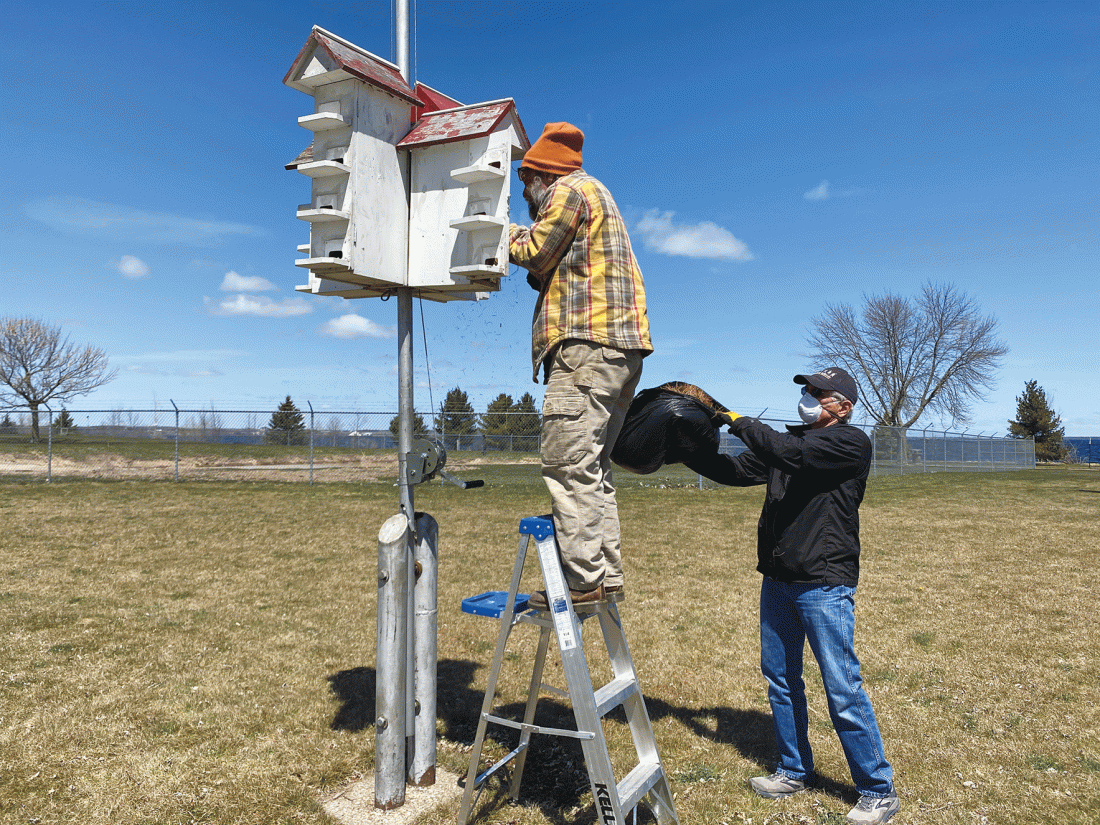
Jordan Beck | Daily Press Common Coast Research & Conservation Co-Director Joe Kaplan, left, and volunteer Mike Segorski clean out boxes on Sand Point in Ludington Park where purple martins nest and add more nesting material Monday.
ESCANABA — Once at risk of dying out, a purple martin colony on Sand Point in Ludington Park has stabilized and started to grow in recent years as a result of local management efforts. Joe Kaplan, co-director of the non-profit organization Common Coast Research & Conservation, spoke about the factors that have played a role in the colony’s recent success.
The purple martin is a type of swallow that spends part of the year in North America.
“When they leave in the fall, most of them winter in the Amazon Basin,” Kaplan said.
The work done to help Escanaba’s purple martin colony was part of what is known as the Escanaba Migratory Bird Enhancement Initiative. The initiative was established by Common Coast in partnership with the city of Escanaba and other organizations, including Wildlife Unlimited of Delta County.
According to Kaplan, purple martins — which nest almost exclusively in man-made boxes in the east — were once more common in the Upper Peninsula than they are today. The species’ range in the area has decreased by 95 percent over the past 20 years.
In 2010, 40-50 pairs of martins were known to nest in boxes in Ludington Park. By 2012, the population had declined to a single pair. One major reason for the decrease was the fact that starlings, which can outcompete martins, were nesting in the boxes that were then used in the park.
Making matters worse, a box fell off the pole it was on during a storm in 2011. The birds inside were killed.
“We were going to lose our martins, just like everywhere else in the U.P.,” Kaplan said, noting the Escanaba colony is — to his knowledge — the last major colony of purple martins in the peninsula and the northernmost colony in the Great Lakes region.
Kaplan said most of the city’s old boxes were made from plastic and aluminum, which provided limited insulation during the winter months. In the early 2010s, Wildlife Unlimited arranged to build wooden boxes and donated them to the Escanaba Migratory Bird Enhancement Initiative. The new boxes were built with entry holes that let purple martins nest there while excluding starlings.
Northern Machining & Repair Inc. fabricated and donated a pulley system allowing the boxes to be easily raised and lowered for maintenance. The boxes and pulley systems were installed as needed over the following years, and the last original box was replaced in 2016. By the time the last box was switched out, the colony was down to two females and one male.
Thanks to the new boxes, the colony has begun to grow again. In 2020, Kaplan has seen at least five adult males and three females return to the Ludington Park colony (including young birds recruited from Wisconsin). He estimates that the colony now produces 30 chicks per year.
“I think we’ve stabilized the population,” he said.
Looking forward, Kaplan’s goal is to encourage purple martins to move further north. This process will involve setting up satellite colonies in areas to the north of Escanaba and mimicking a birdsong that should encourage purple martins to join these colonies.
“We’re going to start playing tapes where we’ve put up boxes with no martins,” Kaplan said.
The Escanaba Migratory Bird Enhancement Initiative plans to start experimenting with satellite colonies this year.
Kaplan said he is glad to see that Escanaba’s purple martin colony has begun to rebound.
“It’d be great to be able to introduce a new generation of human beings to how nice it is to have martins,” he said.
Local News

‘A death sentence’: Prison conditions under fire after third death at Women’s Huron Valley

Flag Day ceremonies in Esky and Gladstone

MSP promotes troopers to serve at Gladstone Post and Manistique Outpost
MIOSHA reports Daggett farm worker death
DAGGETT — The Michigan Occupational Safety and Health Administration (MIOSHA) has reported the death of a ...
Strings on the Bay kicks off season with new director
ESCANABA – Bay College recently announced a new season of Strings on the Bay, its annual chamber music concert ...