Grandparents share life experiences with students
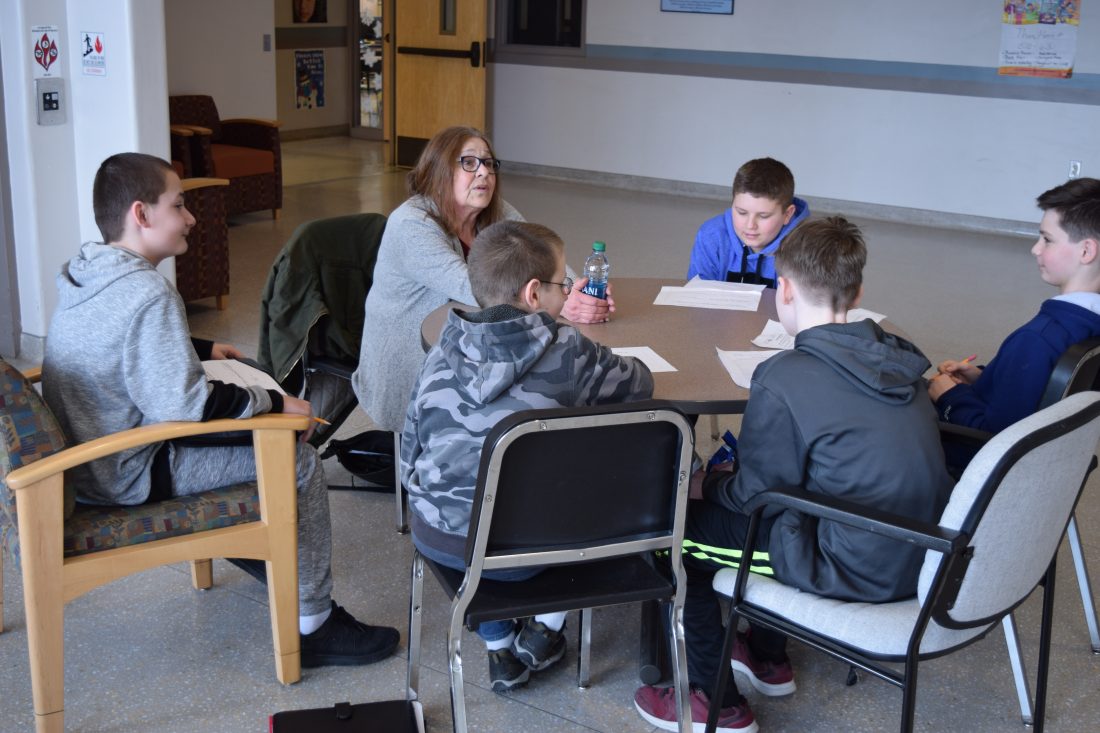
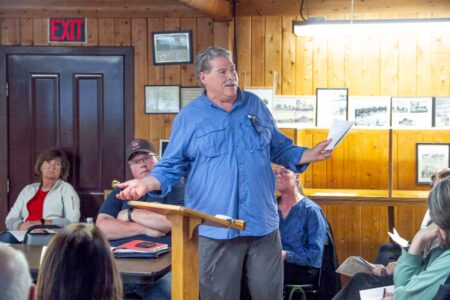
Deborah Prescott | Daily Press Anita Gillis responds to a question her grandson asked about her life experiences. Friday sixth-grade students at Escanaba Upper Elementary asked questions of invited guests to learn their history during Oral History Day. In photo from left are Tyler Feathers, Gillis, Alex Lockhart, Ashton Dery, Cole Royer, and Chase Royer.
ESCANABA — Friday afternoon sixth-grade students from Escanaba Upper Elementary heard firsthand how their grandparents lived “back in the day.”
“We got to learn about their past, like what they did for a living, where they lived, happy times, and more. It gave us a taste of the past,” said sixth grader Serenity Acosta.
Some of the students’ grandparents participated in Oral History Day, and talked about their culture and how they lived years before the students were born.
“Students learned about culture, local history … interviewing, note taking, essay writing, listening skills, respect, and much more,” said Upper Elementary sixth-grade teacher Michelle Dykema.
The idea came from a history project offered at the Intermediate School District (ISD) Dykema attended about 15 years ago. The project was led by Kristine Paulsen, ISD educational consultant, who wrote a grant entitled “Foundations of Democracy – Teaching American History.” The goal was to support programs that raise student achievement by improving teachers’ knowledge, understanding, and appreciation of American history.
“I feel like you should know your history,” said sixth-grader Gracelynn Schafer. “I always like hearing stories about the past.”
The languages arts students focused on listening to the stories told by their guests then wrote the information down to collect the stories in a planned and organized way.
“This way we will have a record, a glimpse of a time and place of the past experienced by our relatives,” said Dykema.
Oral history, oral tradition, or oral lore, are all forms of preserving a person’s account of the world they lived in.
“I feel like it is important to know about how it was back when the interviewee was in their childhood,” said Owen Fields.
Societies of long ago relied on oral tradition to preserve and record past events in the absence of written histories. The use of oral material goes back to the early Greek historians, who made extensive use of oral reports from witnesses. According to Dykema, the modern practice of collecting oral history has become a research technique used worldwide to preserve otherwise undocumented information, often from the historically voiceless.
“In addition to preserving information about past times and places — often highlighting day-to-day lives of ordinary people — oral history collections also offer insight into the meaning narrators attach to those times and to their participation in bygone events, thus contributing new variegated strands to historians’ efforts to weave tapestries about the past,” said Dykema.
During the week, Dykema and the students created a list of questions to ask their guests. The students had many questions to choose from after sharing information about their grandparents with Dykema.
“I was nervous meeting new people, but it was exciting to learn about their past,” said Landon Corrao.
Some grandparents came in with stories ready to tell the students and others arrived with artifacts and other items to share and talk about.
“It’s so nice to be able to have time to spend with my grandparents,” said Austin Erickson. “I love my grandparents.”
According to Dykema, all grandparents will receive copies of the stories written by the students upon completion.