Soo Locks bottleneck after opening
Lake Carriers' Association pleads for more icebreakers
-
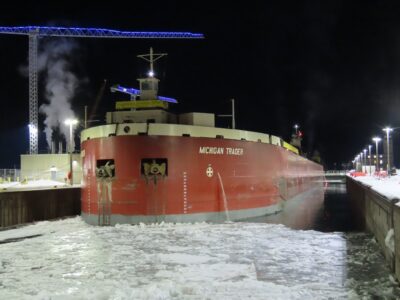
- The Dirk S. VanEnkevort with its barge Michigan Trader were headed for Superior, Wisconsin to load iron ore. The first to hit the Soo Locks this season, they are seen here entering shortly after midnight on Wednesday. (U.S. Army Corps of Engineers photo)
-
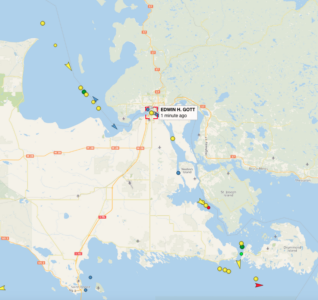
- Though it had been the third ship to arrive in the Sault on Tuesday before the opening of the Locks, it only finally passed through on Sunday evening, as seen in this screenshot from 5:52 p.m. yesterday.
-
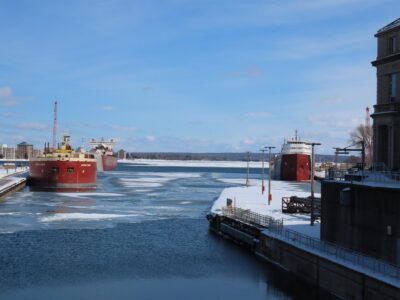
- The day before the opening of the Soo Locks, three ships waited at the pier. First to arrive the Dirk S. VanEnkevort with the barge Michigan Trader, followed by the John J. Munson seen tied up to the south pier, and behind the Dirk, the 1,004 foot-long Edwin H. Gott. (U.S. Army Corps of Engineers photo)
-
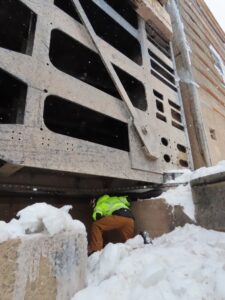
- In a drained Poe Lock, a structural engineer climbs below one of the 143-ton upper operating gates to check for cracks, wear and tear and any issues that might require attention. (U.S. Army Corps of Engineers photo)
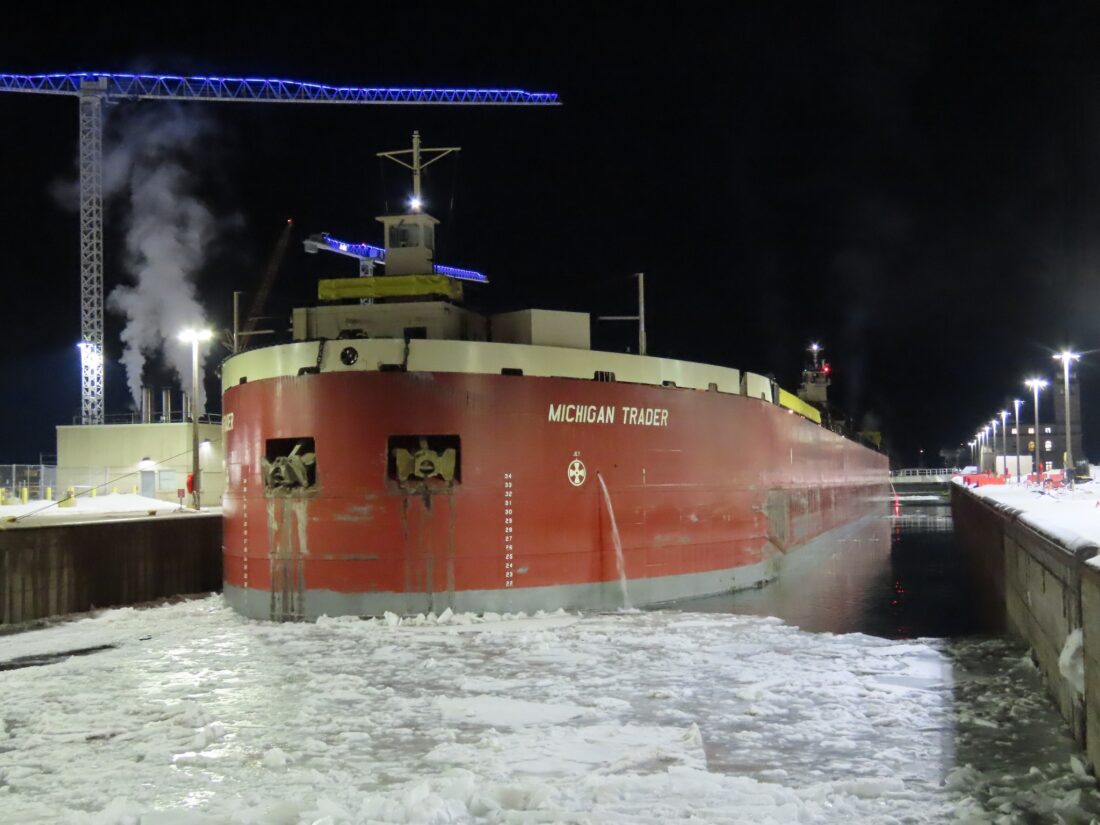
The Dirk S. VanEnkevort with its barge Michigan Trader were headed for Superior, Wisconsin to load iron ore. The first to hit the Soo Locks this season, they are seen here entering shortly after midnight on Wednesday. (U.S. Army Corps of Engineers photo)
SAULT STE. MARIE — Though the Soo Locks opened for the season on Wednesday, a standstill followed. As ice prevents ship traffic from flowing, an organization representing the U.S. Great Lakes fleet blames Coast Guard inadequacies.
“The U.S.C.G. has systematically cut icebreaking services on the Great Lakes over the past 40 years, reducing their fleet of 17 icebreakers in 1979 down to nine today. With fewer icebreakers, they cannot address many icebreaking needs within this vast system, and that has placed mariners in danger and cost companies millions of dollars in ice-related damage,” states the Lake Carriers’ Association (LCA), which has been urging Congress for years to fund another heavy icebreaker.
By this point in the year — late March 2026 — the lower lakes are open, but ice buildup remains in the north. However, the Soo Locks opened on schedule.
Ships began posting up near Sault Ste. Marie on Tuesday, waiting for the season’s opening of the world’s busiest locks. Hundreds of people gathered on the observation platform as midnight approached.
The first ship of the season was the Dirk S. VanEnkevort accompanied by the barge Michigan Trader. As is tradition, city officials and community representatives gathered to offer an official welcome prior to the VanEnkevort’s passing through the system. The Soo Locks Visitors Center Association presented the captain with a plaque and traditional First Ship baseball caps for the crew.
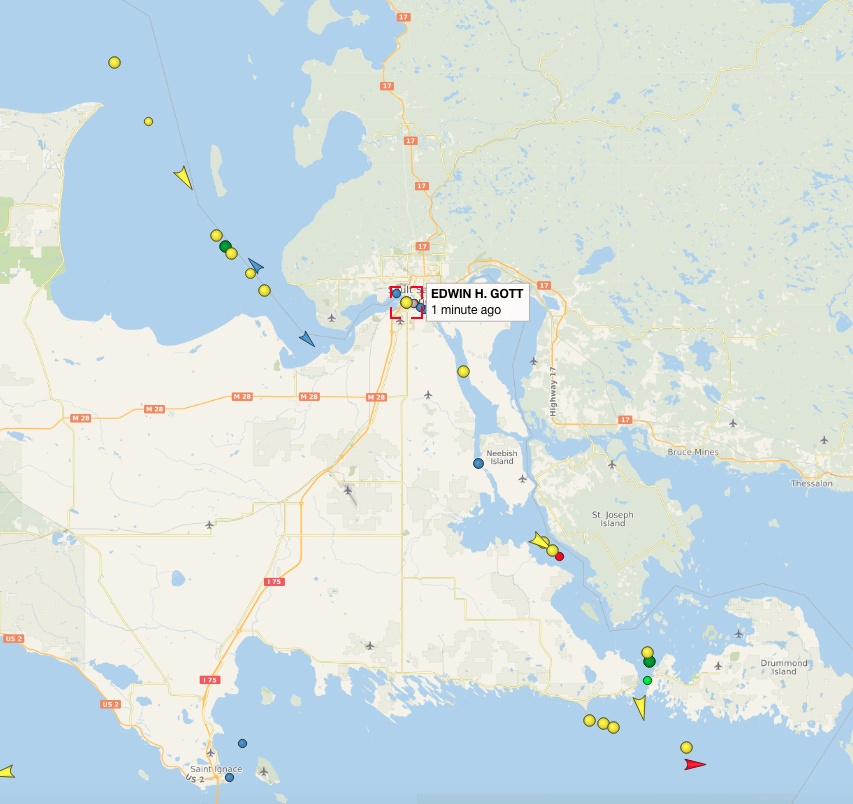
Though it had been the third ship to arrive in the Sault on Tuesday before the opening of the Locks, it only finally passed through on Sunday evening, as seen in this screenshot from 5:52 p.m. yesterday.
The park at the locks opened at 11:30 p.m. on Tuesday night to allow the public to watch the the new navigation season kick off at the Poe Lock.
“At one minute after midnight, March 25, the traffic light turned to green for the first time in 10 weeks and the first ship of the season made its approach. …About 300 people braved the cold to watch the opening of the Poe Lock and welcome the ship from the observation platform,” reported the U.S. Army Corps of Engineers.
Following the VanEnkevort were the John J. Munson and Edwin H. Gott. Several more vessels had queued up before the first ship cleared the river, and about 20 were halted in the icy waters waiting their turn to cross the only connection between Lake Superior and the other Great Lakes for what some felt was far too long.
As ice froze the big ships in place, the Mackinaw — the only heavy domestic U.S. Coast Guard icebreaker — was reportedly unavailable to assist due to problems with its bow thrusters. A Thursday press release from the LCA stated that the Mackinaw was “unable to lock up to Whitefish Bay where ice conditions are in excess of two feet in spots covered by three feet of snow.”
A Canadian icebreaker was sent to assist in the Soo area, but then left to prioritize assisting Canadian vessels reach Thunder Bay.
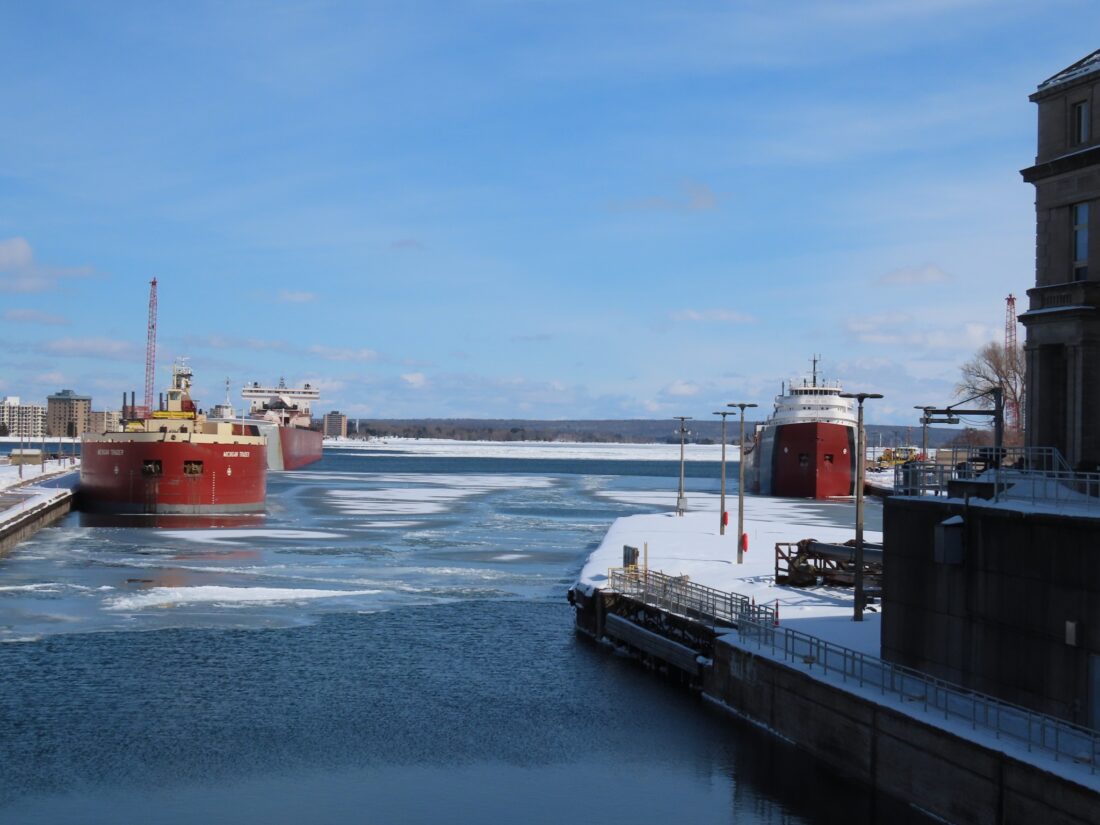
The day before the opening of the Soo Locks, three ships waited at the pier. First to arrive the Dirk S. VanEnkevort with the barge Michigan Trader, followed by the John J. Munson seen tied up to the south pier, and behind the Dirk, the 1,004 foot-long Edwin H. Gott. (U.S. Army Corps of Engineers photo)
“As witnessed over the past day, depending on the Canadians to move U.S. cargo is not a reasonable expectation and definitely not in the best interest of the U.S. economy,” wrote the LCA. “U.S. manufacturing like steel production continues to feel the pain of an inadequate U.S. Coast Guard icebreaking fleet.”
The next day, Friday, the LCA issued an update: “Ninety-six hours after the Soo Locks opened for the year, the first vessel loaded with iron ore finally cleared the St. Mary’s River. That is the one and only downbound vessel to make it in four days. 19 vessels remain beset in the ice, waiting for icebreakers to clear the way to either get their loads or deliver them.”
By midday Sunday, the Edwin H. Gott still had not made it through the Soo Locks.
LCA President Jim Weakley said, “This logistical nightmare clearly demonstrates the problem with the early opening of the St. Lawrence Seaway. The Canadian Coast Guard brought in an additional heavy icebreaker to open up the Welland Canal too soon. Immediately after adding additional vessels to an overtaxed system, the heavy icebreaker left. The under-resourced Great Lakes Navigation system is now broken. Vessel flow needs to be established between the upper Great Lakes before opening the system to outside vessels.”
The LCA press release continued: “The ice delays experienced by the ships will have impacts for weeks to come even after the vessels begin moving. With many ships using the same docks, vessels will be delayed again as the fleet continues to ‘bunch up’ at the Soo. With adequate icebreaking the fleet would have naturally spread out by now.”
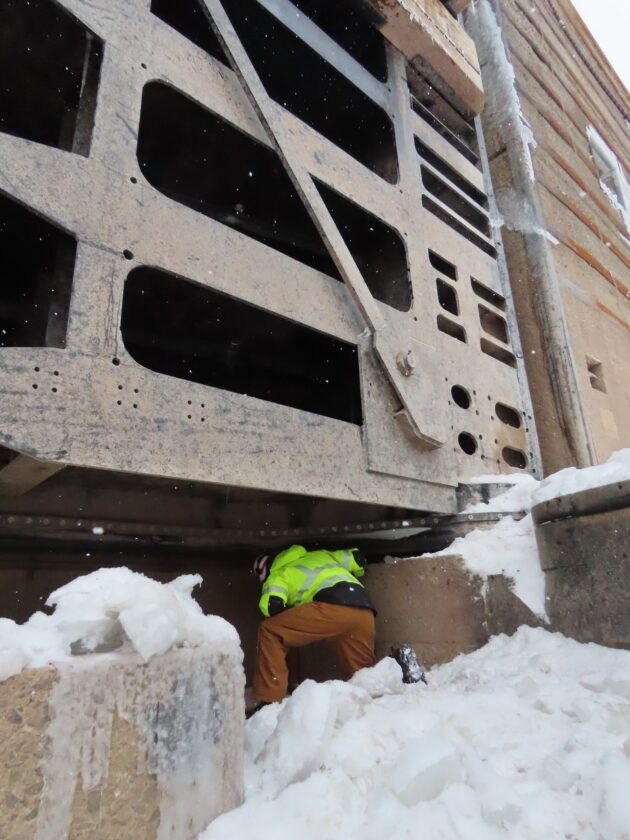
In a drained Poe Lock, a structural engineer climbs below one of the 143-ton upper operating gates to check for cracks, wear and tear and any issues that might require attention. (U.S. Army Corps of Engineers photo)
On Sunday morning, “The work continues here in Sault Ste. Marie to get everyone moving through the ice which has been an issue in recent days,” wrote Andrea Guerriero of DRE Designs – Great Lakes Marine Products. “With temps not warming as we normally see here, the ice is being broken and then re-freezing and ships are only able to move so far before they are stopped dead in their tracks again, thus affecting the traffic behind them.”
Lock maintenance of winter 2026
Beginning in January, the locks close each winter for inspection and maintenance. The U.S. Army Corps of Engineers uses 10 weeks to examine and work on the drained locks during that time. Equipment used by the crews is lowered about 60 feet to the lock floor by a crane on the surface.
This year, one of the big projects was the five-year inspection of the Poe Lock. After steaming out all the ice, a team of engineers and technicians examined the lock and its operating equipment, checking the concrete for soundness, culverts for wear and tear and the gates for cracks. Their findings will help direct maintenance for the next five years, reported Chief Park Ranger Michelle Briggs. “This winter, crews replaced jack pads below one of the Poe’s operating gates,” Briggs explained. “These pads support hydraulic jacks used to lift the 250-ton gates during maintenance.
“…The lower guard gates, a set of unpowered gates at the downstream end used most years as a temporary dam, had new lifting equipment installed this winter,” she added, noting that the original, 57-year-old lifting tugs and cables had lost their structural integrity.
One task that takes place every winter at the Soo is mucking. After dewatering, crews enter the drainage area below the lock floor and shovel out accumulated debris.
“This year, crews removed 90 tons of debris from the lock floor and debris pits,” Briggs said.
Local News
Soo Locks bottleneck after opening
SAULT STE. MARIE -- Though the Soo Locks opened for the season on Wednesday, a standstill followed. As ice ...

We Rock the Spectrum fun for kids of all abilities

Michigan officials warn residents of ongoing scam tactics

Ludington Street construction is needed despite disruption, DDA chair says

Investigating maple for rehydration