
A Smoldering History
Million-acre fires here? Yes. They’re part of our Lake States history and contributed to the forest composition that we enjoy today. While monster conflagrations are unlikely to happen in the near future, wildfire remains a threat to human welfare.
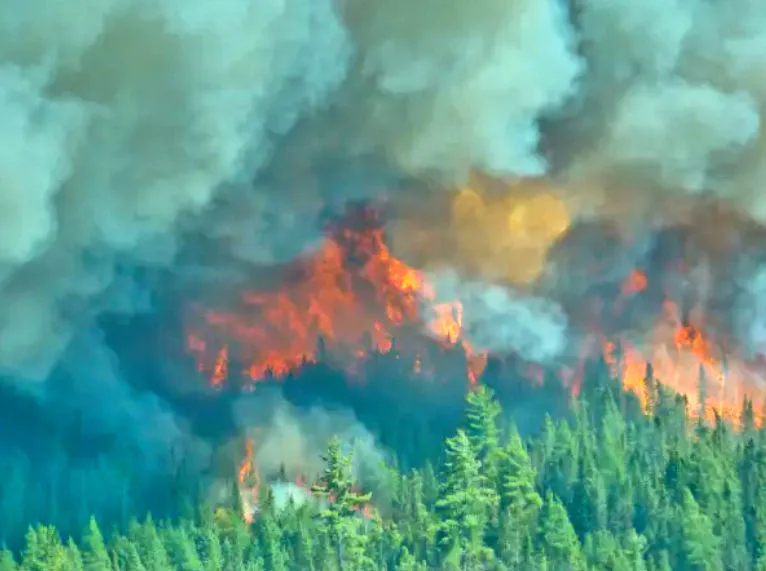
Duck Lake Fire. (Michigan DNR photo)
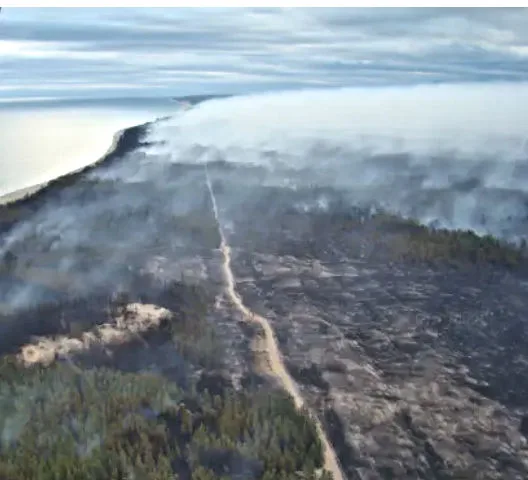
Duck Lake Fire. (Michigan DNR photo)
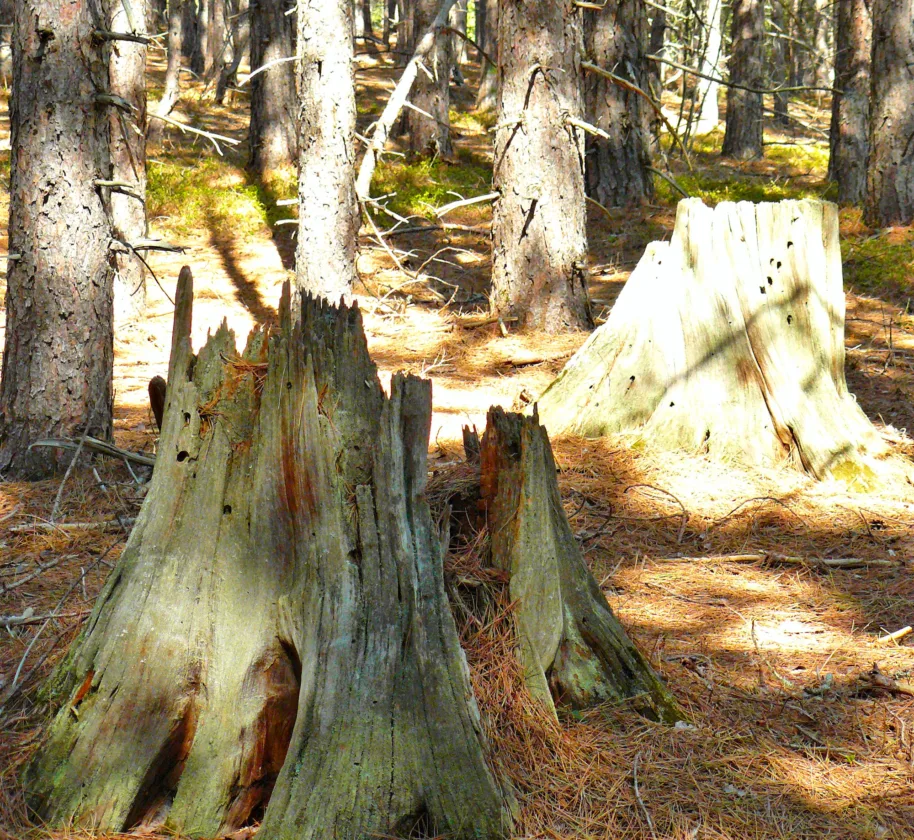
Old white pine stumps within a CCC red pine plantati. (Courtesy photo)
Duck Lake Fire. (Michigan DNR photo)
Duck Lake Fire. (Michigan DNR photo)
Old white pine stumps within a CCC red pine plantati. (Courtesy photo)
Trending
The deadliest wildfire in the U.S. was the 1871 Peshtigo Fire. It scorched well over a million acres, torched 17 villages, and killed more than 1200 people. The personal accounts are horrific. And, this was a time when relatively few people lived in the northern hinterlands. Most the fire was in Wisconsin, with roughly 150,000 acres creeping into the southern Upper Peninsula along Green Bay.
In the same year, well beyond 2.5 million acres burned across the Lower Peninsula in the Great Michigan and Thumb complexes. In 1881, another million acres burned through the Thumb. These fires ran unchecked.
In 1896, 300,000 acres of wildfire took down the burgeoning towns of Ontonagon and Ishpeming. In 1908, multiple complexes scorched 2.3 million acres in the Lower Peninsula. Among these complexes, the Metz Fire blackened over 300,000 acres and created a legendary set of gruesome tales.
Wisconsin fire history is similar, with the first large fire recorded in 1854 that ran 100 miles from Amery to Iron River. Most of the Peshtigo Fire occurred in northeastern Wisconsin. In the early 1930s, over 300,000 wantonly burned annually.
How much is a million acres? It's roughly the size of Marquette County in the UP, or more than that of Roscommon and Crawford Counties combined. Alternatively, a ten-mile swath would run from Frankfort on Lake Michigan, through Grayling, then across the Lower Peninsula to Harrisville on Lake Huron. Imagine the destruction these fires inflicted upon the landscape.
If you look at a line graph of Michigan wildfire acreage over the past 150 years, huge spikes occur during the historic era of logging and agricultural development. After World War II, the line becomes relatively flat.
The federal Smoky Bear campaign did much to highlight the need for fire control. The success of fire suppression has allowed forest recovery and subsequent support for the vibrant northern economies that we enjoy today. Michigan led the way in developing protocols and technologies.
About half of Michigan's forest grew back, with a lot of help from industry and government. The forest is not the same as 150 years ago, but Michigan still has 20 million acres of forestland. And, much of it remains fire-prone.
The other big change, and perhaps more salient, is the expansion of human infrastructure, especially "wildland" homes. In 1870, about 150,000 people lived "up north". In 2025, that number had risen to about 2.5 million. When wildfires occur, which they do every year, much of the suppression effort is expended on protecting structures.
This intermingling of buildings and forestland is termed the "Wildland Urban Interface", or WUI, for short. The WUI (woo-ey) is the subject of much debate and planning. And, protection is costly.
In both Michigan and Wisconsin, the current annual acreage burned typically remains under 2000 acres, with some notable exceptions, but none as severe as those from a century ago. Most wildfires are quite small, but there are hundreds each year that get suppressed. Most of these fires are human-caused.
Michigan's more recent big wildfires include the Seney in 1976 (78,000 acres), Sleeper Lake in 2007 (18,000 acres), Meridian 2010 (8586 acres), and Duck Lake in 2012 (21,000 acres). In Wisconsin, the White River Marsh Fire blackened 4261 acres, the 2005 Cottonville Fire burned 3410 acres, and the 2013 Germann Road Fire charred 7500 acres. The year 1980 saw 20,654 wildfire acres, and in 1977, 40,161 acres. All of these fires included the loss of housing and other structures.
Forest management has long been the best way to curb wildfire potential by creating age class diversity, maintaining tree vigor, and employing prescribed fire in appropriate forest types. While prescribed fire reduces fuel loads in fire-prone systems, it also encourages native ecosystem dynamics among forest types, and other vegetation, that depend upon fire for regeneration, health, and habitat. So, fire isn't always bad. It can also be a great tool.