Don ’t put all your (fish) eggs in one basket
Restored reef in Saginaw Bay diversifies spawning habitat and promotes resilience
-
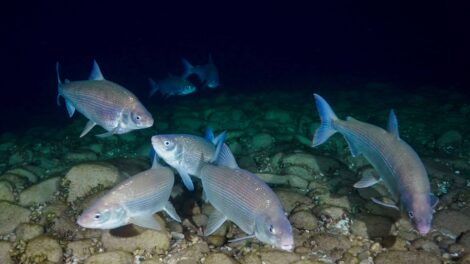
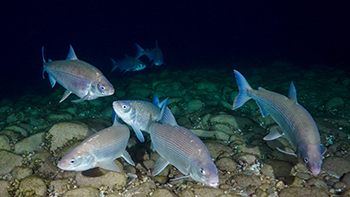
- Lake whitefish are shown congregating over rocky cobble. (Photo: Inspired Planet Productions)
-
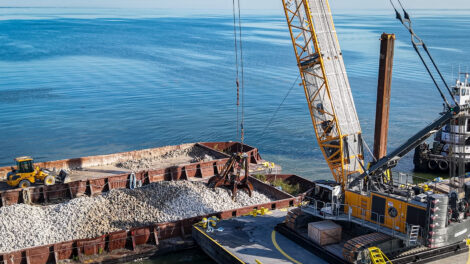
- During construction of the Channel Island Reef, stone cobble was dropped into place by crane. (Photo: Zak Allan, Great Lakes Fishery Commission)
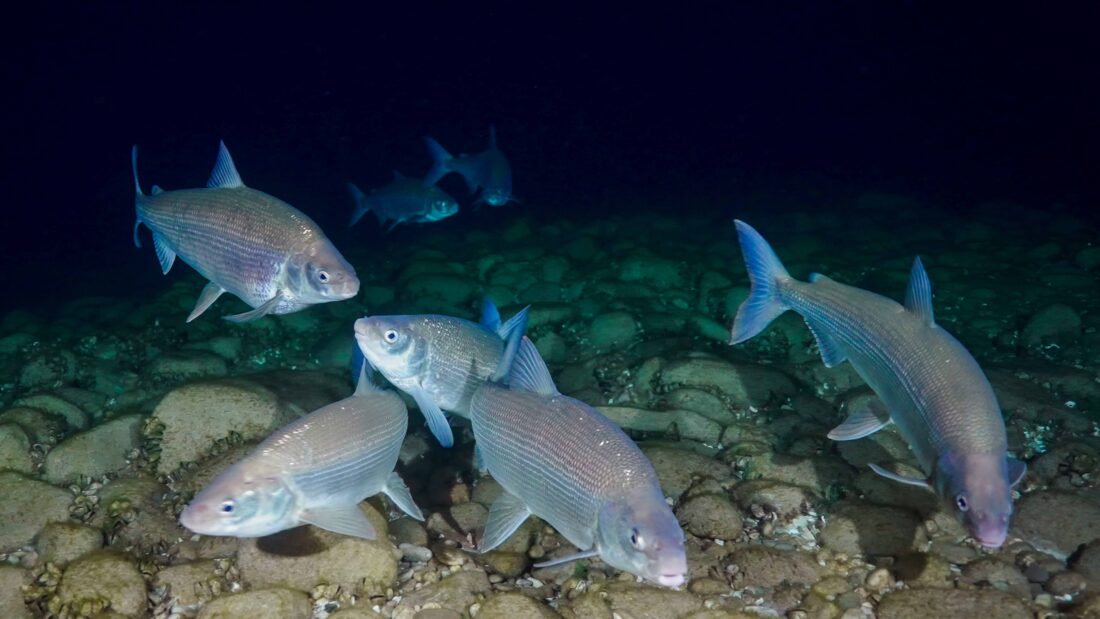
Lake whitefish are shown congregating over rocky cobble. (Photo: Inspired Planet Productions)
Imagine a reef: sunlight streaming through the azure water reveals a vibrant underwater community, where fish, large and small, dart into holes and crevices or swim around the reef’s edges while other aquatic creatures make their homes or search for food.
Did you think of a coral reef, covered in pink anemones and surrounded by brightly colored tropical fish like blue tang and clownfish?
Now imagine a reef, with dappled sunlight and teeming with fish, in Lake Huron, in Saginaw Bay.
Surprised?
Maybe you shouldn’t be.
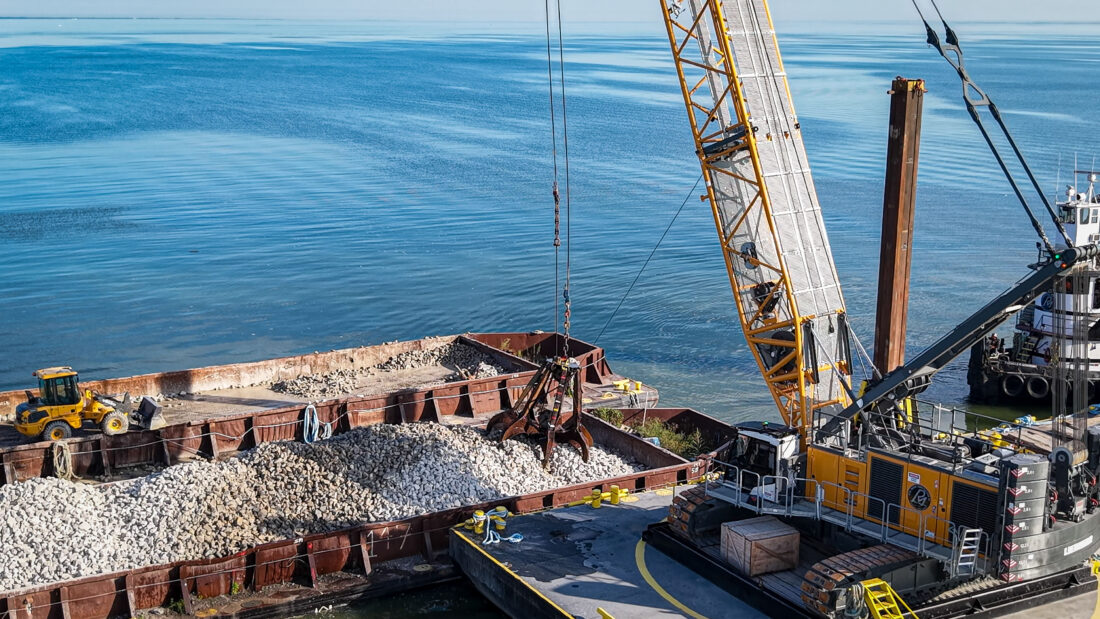
During construction of the Channel Island Reef, stone cobble was dropped into place by crane. (Photo: Zak Allan, Great Lakes Fishery Commission)
Pieces of limestone, quarried locally in the Thumb area, were moved out to the reef location on barges.
Reefs used to be common in Saginaw Bay, and organizations like the Michigan Department of Natural Resources and others are working to restore reef habitat for the benefit of fish like lake whitefish and walleye, as well as many other aquatic species.
The disappearance of rocky reefs
Though corals did once thrive in the northern Lower Peninsula about 350 million years ago (the remains of which are now Petoskey stones), the reefs that existed in Saginaw Bay were rock reefs. These reefs, mainly comprised of granite and limestone, were formed by the movement of glaciers.
Since Saginaw Bay has an otherwise very flat bottom and a relatively consistent depth (about 25 to 30 feet), the thousands of acres of reef in the bay were important habitat for the bay’s aquatic species, providing places to deposit eggs, hide from predators or find a meal.
Rock reefs are comprised of cobble – rocks that vary in size from about the size of an orange to the size of a basketball, piled and rising from the lake bottom.
These stones of different sizes create crevices – called interstitial spaces – and ledges perfect for spawning fish to deposit eggs into and for young fry (newly hatched fish) to hide from predators.
Reefs, depending on their location and depth, can get a lot of wave action. The continual movement of water keeps sediment from building up and filling in those useful interstitial spaces. It also washes oxygenated water over fertilized fish eggs, which they need to develop and hatch into healthy fry.
But what happened to the reefs in Saginaw Bay? They were buried.
Logging, industrial and agricultural land uses in the area surrounding the bay exposed sediments, which caused excess erosion and movement of sediment, which washed out into the bay, covering the rocky structures.
Dredging the lake bottom to remove this sediment and resurface the original rock reefs would be incredibly costly and disruptive to the use of the bay by humans and fish, if not economically impossible. It would also likely be ineffective, given current activity in the region causing continued sedimentation.
The solution researchers have arrived at is to restore reef habitat not by resurrecting remnants of former reefs, but by building new ones. This kind of reef restoration work is gaining traction in the Great Lakes and elsewhere.
Walleye decline and recovery strategies
The reef habitat restoration story in Saginaw Bay begins not with a project, but a problem. Historically, walleye were abundant in Saginaw Bay. But in the 1940s, this fish population collapsed due to declines in water quality and habitat, caused by pollution and sedimentation, along with unrestrained fishing .
The opportunity to recover walleye came after the Clean Water Act took effect in the early 1970s and the negative impacts were better managed around in the bay.
The DNR began stocking walleye, which boosted the population, but the fishery didn’t recover to pre-1940s levels and remained dependent on stocking.
During construction of the Channel Island Reef, stone cobble was dropped into place by crane.
DNR researchers attributed that to degraded and ongoing degradation of spawning habitat (particularly rock reefs, but also dams blocking migrating fish), along with walleye fry predation from invasive alewives.
Then suddenly, something shifted.
“Along comes 2003, and we have this big food web change in Lake Huron and invasive alewives disappear,” said Dr. David Fielder, fisheries research biologist with the DNR and one of the authors of the report resulting from the research.
This change, due in part to increased predation on alewife by other fish, but mostly by the invasion of dreissenid mussels – zebra and quagga mussels, which consume much of the phytoplankton that are the base of the food chain – reduced the number of alewives eating walleye fry.
This had a big effect, and reproductive success boomed. Stocking was discontinued in 2006, and by 2009, walleye abundance reached recovery targets.
Even though walleye populations were seemingly back to normal, work remained to be done.
Researchers noted that since rock reef habitat was lost in the bay, the walleye that demonstrated sustained reproduction were primarily spawning in the tributary rivers, among them the Saginaw River.
That’s not ideal, because it makes the walleye population vulnerable to changes in those rivers, like barriers, contamination or natural disasters.
If the river spawning habitat isn’t available, the walleye will be unable to reproduce with much success. According to Fielder, whether fish spawn in a river or on a reef is something they likely inherit from their parents, not something they choose based on environmental conditions.
Without preferred spawning habitat, walleye are left to deposit their eggs wherever they can. In the case of the few reef-spawning walleye still hanging on in the bay, this is often on the bottom of the lake.
But eggs on the bottom have a low chance of hatching out into fry, as the dissolved oxygen they need to develop is low and they’re not hidden from the predators that like to eat them. Plus, sediment can bury the eggs, just like it buried the former rock reefs.
While restoration efforts won’t bring back all the rocky reefs once present in the bay, restoring some of that habitat will still be immensely beneficial.
The metaphor project partners have used to describe this is the portfolio effect: Like diversifying your investment portfolio can help you weather volatility in the market, diversification of spawning habitat can help insulate the species from the effects of big ecosystem changes.
The goal isn’t necessarily more walleye reproduction but more consistent or dependable walleye reproduction. To ensure a resilient walleye population in Saginaw Bay, walleye need various spawning habitats, both reef and river.
Outdoors
Don ’t put all your (fish) eggs in one basket
MiCorps Volunteer Stream Cleanup and Monitoring grants available
The Michigan Clean Water Corps (MiCorps), a volunteer monitoring program network that collects and shares surface ...

Snowfall and shadows under the cedar trees
Team completes UP moose collaring and capture effort
Scientists say genetic analysis could greatly speed restoration of iconic American chestnut