Railway Safety Act adds costly mandates with no proven gains
The White House is calling on Congress to include a railroad regulation bill as part of a larger transportation funding package this year. It’s not the first time President Donald Trump has supported it, and the legislative branch would be wise to ignore his counsel again.
The Railway Safety Act was first introduced in 2023 after the train accident in East Palestine, Ohio, where chemicals were vented and burned, causing environmental damage and horrific visuals. Then-Sen. JD Vance was among the bipartisan group of legislators who introduced the bill. Trump, then campaigning for president, urged Republicans to support it.
It’s understandable that Congress wanted to do something. But rather than digging into the details of what caused the accident and proposing fixes, the bill consists of unrelated mandates that would drive costs higher and slow innovation. Due largely to conservative opposition, the Senate never voted on the bill.
Perhaps there was an excuse for the bill’s authors to not know any better right after the accident. In June 2024, however, the National Transportation Safety Board published a 216-page report showing exactly what happened. Rather than removing extraneous provisions in the light of better information, legislators have again introduced the Railway Safety Act with few major changes.
The bill would turn the current industry standard of two crewmen in the cab into a government mandate. Never mind that there were three crewmen in the cab during the East Palestine accident, or that repeated investigations by the Federal Railroad Administration — including during the first Trump administration — have been unable to demonstrate that crew size correlates with safety. This provision is supported by rail unions who are afraid technological advances could reduce staffing needs.
Regulation should be based on evidence, especially when that it could be costly. Another provision of the bill, which would mandate sensors to detect overheated wheel bearings every 15 miles, would cost an estimated $1.1 billion to $2.2 billion. There’s no evidence that the 15-mile rule would have prevented the East Palestine accident. The sensors have already significantly reduced overheating accidents without being mandated at all.
The bill would also mandate increased inspections of railcars by certified mechanics, another union demand that would preserve working hours for members with little or no safety evidence to support it. The railcar that caused the Ohio accident passed inspection before its departure. The NTSB found “insufficient evidence” that a more thorough inspection would have caught the cause of the accident and did not recommend any changes to current federal railcar inspection regulations.
The staggering finding from the NTSB report was that the decision to vent and burn the chemicals being transported by the train was mistaken and based on poor communication. There are lessons to be learned from this incident, but they are more about how to respond to accidents than the wisdom of regulatory requirements.
Nor has Norfolk Southern, the operator of the train, dodged accountability. The CEO apologized during Senate testimony. Between its direct actions to clean up the spill, settlements with both the federal government and the village of East Palestine, as well as a class-action suit, Norfolk Southern has paid over $1 billion, an astonishing sum for an accident with no deaths.
Four of the 34 recommendations from the NTSB’s report were addressed to Norfolk Southern. The company has adopted all four of them, including one where it went beyond what the NTSB asked. None of the 10 recommendations made to the Federal Railroad Administration have been adopted yet.
It’s not as though railroad safety has declined in the meantime. By several measures, including the rates of derailments and employee injuries, 2025 was the safest year on record. And railroads are much safer today than they were before 1992, when crews of three or more were standard.
Transporting goods by rail is much safer than doing so by truck, which is the closest substitute. Increasing costs for rail through pointless mandates would result in some shippers opting for trucks instead, causing more highway traffic and a greater probability of freight accidents overall.
Just because a bill has “safety” in the title doesn’t mean it will make Americans safer.
ONLINE: https://www.washingtonpost.com/opinions/2026/03/08/railway-safety-act-train-safety-norfolk-southern/
Editorial
Railway Safety Act adds costly mandates with no proven gains
The White House is calling on Congress to include a railroad regulation bill as part of a larger transportation ...
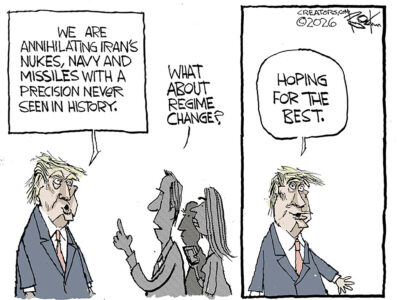
Editorial cartoon for March 10, 2026
State offering naloxone kits for drug overdoses
The state is making available — at no cost — kits for treating a drug overdose, when minutes can make the ...
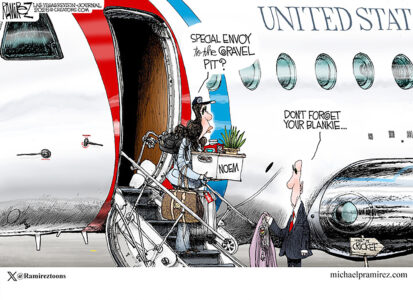
Editorial cartoon for March 9, 2026
As clocks get changed, test alarms in home, too
As Michiganders move their clocks ahead one hour for daylight saving time Sunday, the Michigan Department of ...