
Tuskegee wreckage found in Great Lake provides opportunity to uncover untold stories
Trending
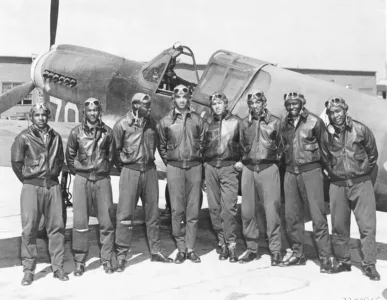
LANSING -- Wreckage of aircraft recovered from Lake Huron and the St. Clair River is uncovering untold stories of the Tuskegee Airmen, predominantly African-American fighter and bomber pilots and crew who fought in World War II.
A new book about archeological finds from relatively recent history, "Post-Contact Archaeology of Michigan and the Upper Great Lakes Region," (Berghahn Books), contains a chapter about the Tuskegee Airmen's relationship to the Great Lakes.
The chapter's author, Wayne Lusardi, is a maritime archaeologist who has studied the Tuskegee wrecks.
The chapter says the discovery of the wrecks - an unusual find, given there are "very few places where the Tuskegee Airmen trained, fought or occupied [that] are conductive for archeological research" - provides an important opportunity to dive "into history - and into men's lives."
Based in Alabama, the Tuskegee Airmen sometimes traveled to air bases in Michigan for training.
Training accidents did occur, resulting in the deaths of pilots such as Lt. Frank H. Moody, whose aircraft crashed during an exercise.
Despite the prominence of the Tuskegee Airmen in American history, most people aren't aware of the aviators' time in Michigan or of the presence of the wrecks, said Lusardi.
"I didn't know anything about it before [Moody's] airplane was discovered in 2014," Lusardi said.
"I would imagine that the average Michigander doesn't know about the Tuskegee presence here, and certainly not about where they were training and what they were doing here."
The wrecks were discovered incidentally during the recovery of a sunken barge, Lusardi said.
He added that if the barge had not sunk, Tuskegee wrecks would not have been found at all.
"It was quite literally stumbling upon it," Lusardi said. "They were going around in that wreck site area and picking up things and helping to clean up that whole mess. In the process, they came across this airplane wreck site."
"All of the accounts from the Army and the Coast Guard that were looking for Lieutenant Moody and his airplane in 1944 placed that wreck site in a much different location than it was actually found. So if I had found that information ahead of time and did a survey where they said it would be, I would not have found it."
Amanda Ford, a curator and collections manager at the Tuskegee Airmen National Historical Museum in Detroit, said archaeologists are "treading into a new territory of archaeology" involving aircraft wrecks, such as conserving new material.
"Aluminum is, in the archaeological record anyway, a very new metal. It was only produced in the late 1800s," Ford said. "It's a very 20th-century science, and there isn't too much literature on 20th-century archaeology in that respect. We're like the trailblazers of this new sort of archaeology."
Ford said that 15 members of the Tuskegee Airmen were killed in the Great Lakes, and only five of the men and their wrecks have been found so far or are speculated to be found.
That is why archaeologists and researchers need more education and financial backing.
"That's why our initiative is more important than ever as a museum," Ford said.
"These stories need to be preserved and explored as we preserve our history of the Great Lakes and the Midwest. We want to be able to find these wreckage sites as soon as possible from an archaeological perspective because these aircraft have been underwater for 80-plus years now," Ford said.
Lusardi said that it is important to continue these expeditions, not only to learn more about the past but to bring closure to family members whose loved ones were lost and not recovered until recently.
"We were able to find Eric Bryant, Frank Moody's nephew, and we brought him, his wife and his daughter out to the wreck site," Lusardi said.
"There are other airmen that are out there, planes out there. There is a missing airman, Lieutenant Hill, who was killed in a plane crash in Lake Huron, and his body hasn't been recovered.
"I think that would help bring answers to his family members, and there is some effort right now to carry on with the search for these airplanes," he said.