
Regional collaboration aims to make Great Lakes leader of mass timber
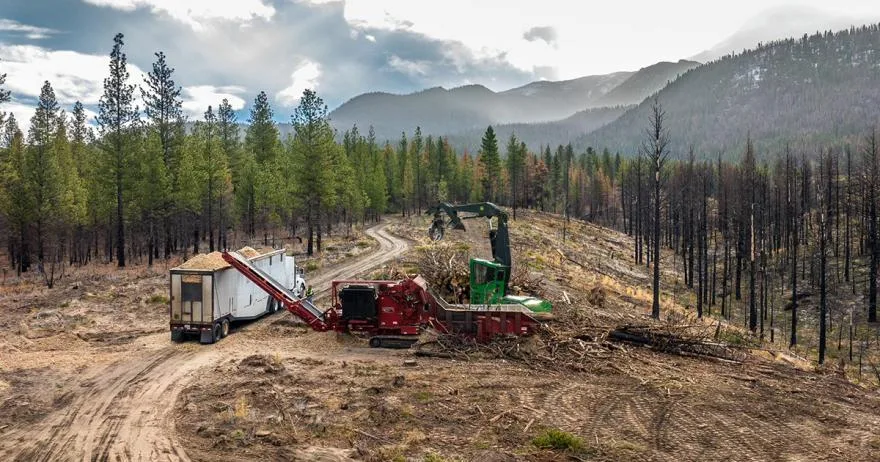
A processor makes wood chips from burned trees on the Shasta-Trinity National Forest in California as part of a project using the U.S. Forest Service’s “wood innovations program grants,” which are expanding in the Great Lakes region. (Photo by Zane Peterson)
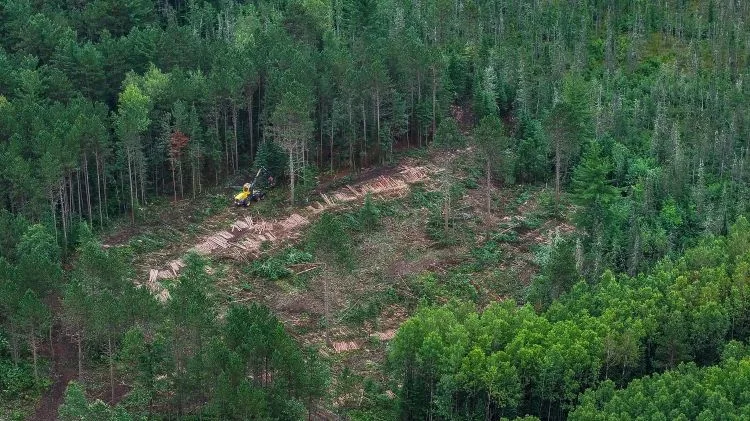
Through its Wood Innovations grants, the Forest Service is assisting in developing new markets for companies like Great Lakes Timber Professionals in Wisconsin. (USDA Forest Service photo by Preston Keres)
A processor makes wood chips from burned trees on the Shasta-Trinity National Forest in California as part of a project using the U.S. Forest Service’s “wood innovations program grants,” which are expanding in the Great Lakes region. (Photo by Zane Peterson)
Through its Wood Innovations grants, the Forest Service is assisting in developing new markets for companies like Great Lakes Timber Professionals in Wisconsin. (USDA Forest Service photo by Preston Keres)
Trending
MICHIGAN - A new grant from the U.S. Forest Service for the purposes of expanding timber-related innovation will enable the next phase of Great Lakes Mass Timber Collaborative (GLMTC), a relatively-new movement intended to "envision and realize a regionally specific and coordinated mass timber economy" across eight states.
Bringing together leaders from Minnesota, Wisconsin, Illinois, Indiana, Michigan, Ohio, Pennsylvania, and New York, GLMTC was founded in 2024 by Michigan State University's Mass Timber program, which is a division of the College of Agriculture and Natural Resources. The Mass Timber program "focuses on research, education, and outreach to promote sustainable building practices in Michigan, the Great Lakes region and beyond," MSU states. As one of its offspring, the GLMTC has the same overall goal, but with different specified targets based on observations.
"The idea for a Great Lakes Mass Timber Collaborative arose from the realization that each state in the region was engaging with mass timber to some degree. More mass timber buildings were emerging, and industries such as architecture, engineering and construction needed resources and information to navigate early projects," the organization said this year. "Public agencies were increasingly aware of the economic and forestry benefits of mass timber and were actively exploring its viability while reaching out to recruit potential manufacturers. University programs in construction, design, wood science, forest economics and engineering were advancing mass timber research, developing curricula and forming strong networks. Skilled trades were also preparing for mass timber construction by creating training mock-ups and curriculum."
This April, the collaborative published a document outlining its regional vision. A draft of the vision had been presented at the International Mass Timber Conference last year and revised following feedback. About 150 representatives of sectors across the mass timber value chain, MSU reported.
"The collaborative seeks to remove state-level silos by sharing knowledge, integrating existing resources, and developing strategies," the vision reads. "Mass timber demand and production are increasing across the United States. The Great Lakes region--with its rich manufacturing history, world-class universities dedicated to innovative forest management research, geographic advantages and existing infrastructure--is well-positioned to lead the next wave of growth in this industry."
The document cites specific examples to show the demand for mass timber, like the fact that the number of projects designed or completed in the country in 2024 was five times higher than the total in 2018. Close to 20% were in the Great Lakes region.
"Significant milestones (of mass timber projects in the region) include Minnesota's T3--the nation's first tall wood building--which opened in 2016, Michigan State University's STEM Teaching and Learning Facility becoming a mass timber learning hub in 2021 and the completion of the world's tallest mass timber structure, the Ascent Tower apartments in Milwaukee, in 2022," the collaborative states.
The collaboration's fiscal sponsor was selected to be Dovetail Partners, a 501(c)(3) nonprofit corporation founded in 2003 with a focus on environmental management. Dovetail aims to "foster sustainability and responsible behaviors through collaboration to develop unique concepts, systems, models, and programs." Its relation to the GLMTC will be to provide administrative and financial oversight to support the collaborative's work.
Recently, an award from the U.S. Forest Service (USFS)'s Wood Innovations Grant Program was announced for the collaborative along with a second, matching grant.
"The Wood Innovations Grant Program is investing in proposals that expand traditional wood utilization projects, promote using wood as a construction material in commercial, institutional and multifamily buildings, and expand wood energy markets. Healthy forests depend on a healthy forest products economy, and these investments support local economies while directly contributing to improving forest health and lowering wildfire risks to communities," states the USFS.
$300,000 from that program plus a matching $300,000 from the U.S. Endowment for Forestry and Communities makes for a $600,000 investment into GLMTC "to advance coordinated supply-chain mapping, provide technical assistance for emerging mass timber projects, assess manufacturing expansion opportunities -- including hardwood mass timber products -- and develop shared tools and case studies that reduce barriers to adoption," stated an MSU press release.
"The regional vision reflects the knowledge, goals, and analysis of people across the mass timber chain -- from forests to manufacture to research to buildings -- in all eight Great Lakes states," said Director Sandra Lupien with MSU's Mass Timber program. "This wood innovation grant enables us to start implementing that vision on the ground by identifying priorities in forests and matching them with opportunities in products and construction."
People may learn more about the Great Lakes Mass Timber Collaborative at dovetailinc.org and canr.msu.edu.