
Coast Guard fails to meet Great Lakes icebreaking mandate
Trending
WASHINGTON — The push continues for updates to the Great Lakes icebreaking fleet. In December, President Donald Trump signed into law the Great Lakes Icebreaker Act — but the deadlines within have passed without action by the U.S. Coast Guard, who had been directed to assess the current fleet and design new icebreakers.
Last month, the Michigan legislator who authored the bill led a coalition of 20 members of U.S. Congress to sign a letter demanding the Coast Guard fulfill their required duty.
The need for an improved fleet was especially obvious earlier this year. This spring, after a hard winter, backups in the Soo Locks caused tremendous delays for commercial vessels, who were left at a standstill in heavy ice for days.
The Soo Locks opened in March, but vessels that had queued up to pass through the connection between Lake Superior and the other Great Lakes were trapped, frozen in place. The main icebreaker for the area, the Mackinaw, was out of commission, and a Canadian breaker that was going to assist left to take care of Canadian ships instead.
It took 96 hours after the opening of the locks for the first vessel loaded with iron ore to finally clear the St. Marys River, according to the Lake Carriers’ Association (LCA). Over a dozen remained trapped in ice at the time.
“The impact from this reduced capacity was felt immediately. U.S.-flagged shipping on the Great Lakes lost a third of its season in 2026, adversely impacting billions in economic activity,” read the recent letter from Congress.
The inadequacies of the American icebreaking fleet may have been especially apparent in 2026, but it’s been a known issue.
“The U.S. economy lost more than $1 billion in business revenue and 5,421 jobs due to inadequate icebreaking capabilities on the Great Lakes during the 2018-2019 winter season,” reported the LCA seven years ago. “Due to this loss of business revenue, the federal government missed out on more than $125 million in taxes and in addition $46 million was lost by state and local governments. For perspective, that loss means the U.S. government could build a new Great Lakes icebreaker and recoup those costs in two years.”
In January 2024, the U.S. Government Accountability Office reported that the Coast Guard was “currently able to break ice with its vessels but identified an aging fleet as a risk for future efforts.”
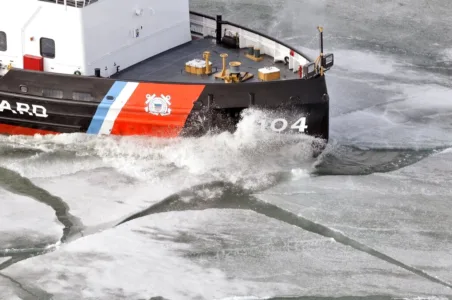
The Mackinaw, commissioned in 2009, is the newest vessel in the Great Lakes fleet and the only heavy icebreaker. Bay-class cutters like the Biscayne Bay of St. Ignace and the Mobile Bay of Sturgeon Bay, Wisconsin were built in the 1970s and ’80s and later underwaent overhauls via the Service Life Extension Program (SLEP).
Last year, Michigan Congresswoman Kristen McDonald Rivet — representative for the eighth district — authored The Great Lakes Icebreaker Act of 2025, which instructs the Coast Guard to analyze the effectiveness of the current icebreaking fleet as well as develop a plan to design and build a new icebreaker for the Great Lakes. The intent is to “protect local economies, jobs, and public safety across the Great Lakes,” read a July 2025 press release.
“Congresswoman McDonald Rivet is a member of the U.S. House Committee on Transportation and Infrastructure, which has jurisdiction over the Coast Guard, maritime and waterborne transportation, and all U.S. waterways. The Congresswoman is also a member of the bipartisan Great Lakes Task Force, which advocates for the economic and environmental well-being of the Great Lakes,” explained the release.
With bipartisan support, Trump signed the Great Lakes Icebreaker Act into law on Dec. 18, 2025 as part of the larger National Defense Authorization Act (NDAA).
The due dates for the Coast Guard to (a) produce a design plan for a new icebreaker and (b) produce a report on the effectiveness of the current icebreaking fleet were March 18 and June 16, 2026.
The Coast Guard has yet to deliver either.
"When the Great Lakes freeze over, we count on the Coast Guard to keep our ships and our entire region's economy moving. Last winter, we saw what happens when we try to get by with an old, inadequate fleet: ships can't move, work is delayed and people worry they could lose their jobs," McDonald Rivet said. "In December, the President signed my bill into law, which mandated the Coast Guard to lay out their plan to update our icebreaking capabilities on the Great Lakes. It's time we got those reports and chart a productive path forward."
The silence from the Coast Guard led her and other members of U.S. Congress to pen a letter to the agency.
"The National Defense Authorization Act for Fiscal Year 2026, and past authorizations, included multiple requirements for public transparency, strategic deployment and new construction of Great Lakes icebreakers, which have yet to be fulfilled. Prioritizing and completing these overdue requirements is a necessary commitment to commerce, national security and safety throughout the Great Lakes region,” reads part of the letter.
The document was addressed to Coast Guard Commandant Admiral Kevin E. Lunday and was signed by Congress members Debbie Dingell, Bill Huizenga, Marcy Kaptur, David P. Joyce, Pete Stauber, Tony Wied, Max L. Miller, Hillary J. Scholten, Haley M. Stevens, Jack Bergman, Rashida Tlaib, Tom Barrett, Shri Thanedar, Glenn Grothman and John W. Mannion.
The LCA and the Great Lakes Maritime Task Force have endorsed the letter.