
Marquette County aviators in WWI
Trending
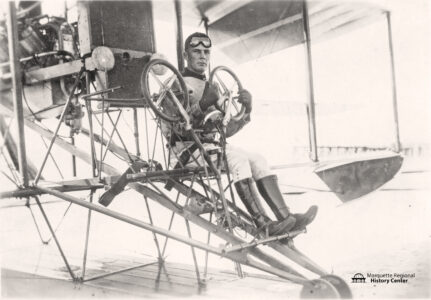
MARQUETTE -- When the Wright brothers made their first momentous flight in December 1903, little did anyone suspect the role their invention would play in World War I just over a decade later. Those early airplanes were extremely basic, made of canvas and wood with open cockpits and only rudimentary instruments.
Without navigational aids it was common to get lost. Pilots would land in random fields to ask for directions or even fly along railway lines hoping to read station names on the platforms. As the war began in 1914, airplanes were just coming into military use.
At first the planes were used mostly for reconnaissance, but aerial warfare quickly evolved as the conflict progressed. Initially pilots traded dirty looks and shook their fists at each other. Then the open cockpits allowed them to throw rocks and other objects at the opposing aircraft.
This escalated as pilots started shooting each other with pistols and rifles. Eventually engineers mounted machine-guns that were synchronized to shoot through the planes’ propellers.
Even training as a pilot was dangerous. Often the first flight was the pilot’s last; of the 14,000 Allied pilots' deaths, more than half were killed in training. Those that survived training still had to face combat on the Western Front. In 1915 the life expectancy for an Allied pilot was only 11 days. The pilots who managed to survive all this became popular heroes and were even portrayed as modern knights.
They were recognized as "aces" after shooting down five or more enemy aircraft during aerial combat. Arguably the most famous and most successful pilot from World War I was Manfred Albrecht Freiherr von Richthofen, the Red Baron. The son of a Prussian nobleman, he surpassed all flying ace records on both sides of the war, earning the respect and admiration of his enemies.
On April 21, 1918, the day after his 80th air combat victory, Richthofen finally met his match. Although accounts differ as to who was actually responsible, he was shot down while flying well behind the Allied lines, probably by someone on the ground.
While they did not gain the legendary status of the Red Baron, several men from Marquette County trained and served as pilots during World War I. Paul Bargh Cooley was a former resident of Ishpeming who moved to Chicago following his high school graduation. After enlisting in August 1917, he completed his pre-flight training at Princeton University in New Jersey before transferring to Park Field, Millington, Tennessee (near Memphis) for flight school.
On Feb. 12, 1918 at 2:20 p.m., Cooley was in a mid-air collision with another plane during training. Both he and the other pilot, Thomas Cicero Rogers of Arkansas, were killed instantly. Although his family had moved to California, Cooley's body was returned to Ishpeming for burial in the family plot.
Prior to his enlistment, Wallace "Shorty" Rowell worked for The Mining Journal. He enlisted with the Aviation Corps, entering ground school in Texas in July 1917 before continuing on to flight school.
Because of his connection with The Mining Journal, his letters home were often printed in the newspaper. After finishing his flying training at Kelly Field in Texas in December 1917, Rowell remained at the aviation school as an instructor.
In July 1918 he was transferred to Bolling Field in Washington, D.C., where he served as the officer in charge of the airfield and hangars until his discharge in February 1919. Rowell returned from the war as a first lieutenant and continued flying in Marquette, offering flights and flying lessons, putting on shows at county fairs and distributing advertising leaflets from the air. He eventually left the Marquette area, working as a traveling salesman in Minnesota.
Marquette native Robert Todd Young was a career naval officer who graduated from the US Naval Academy in 1910. In October 1915 he began his flight training on the USS North Carolina and continued his instruction, between March and September 1916, at the Naval Aeronautic Station, Pensacola, Florida. He became one of the first naval officers to be given an aviator's license and was designated Naval Aviator No. 31.
He reported for duty in September 1916 at the Curtiss Airplane Company, Buffalo, New York, remaining there until December of that year. Next he joined the USS Connecticut, part of a battleship force protecting the Atlantic coast, and was aboard that battleship when the United States entered World War I in April 1917
Despite his aviator's license, Young spent most of the war serving as the gunnery officer on the USS Powhatan transporting American troops to France. In August 1918, he received hydroplane pilots’ certificate No. 257 from the Federation Aeronautique Internationale, the world governing body for air sports.
Young retired from the Navy in 1931 with the rank of Lieutenant Commander and spent the rest of his life in Marquette.