More Michigan college students face food insecurity
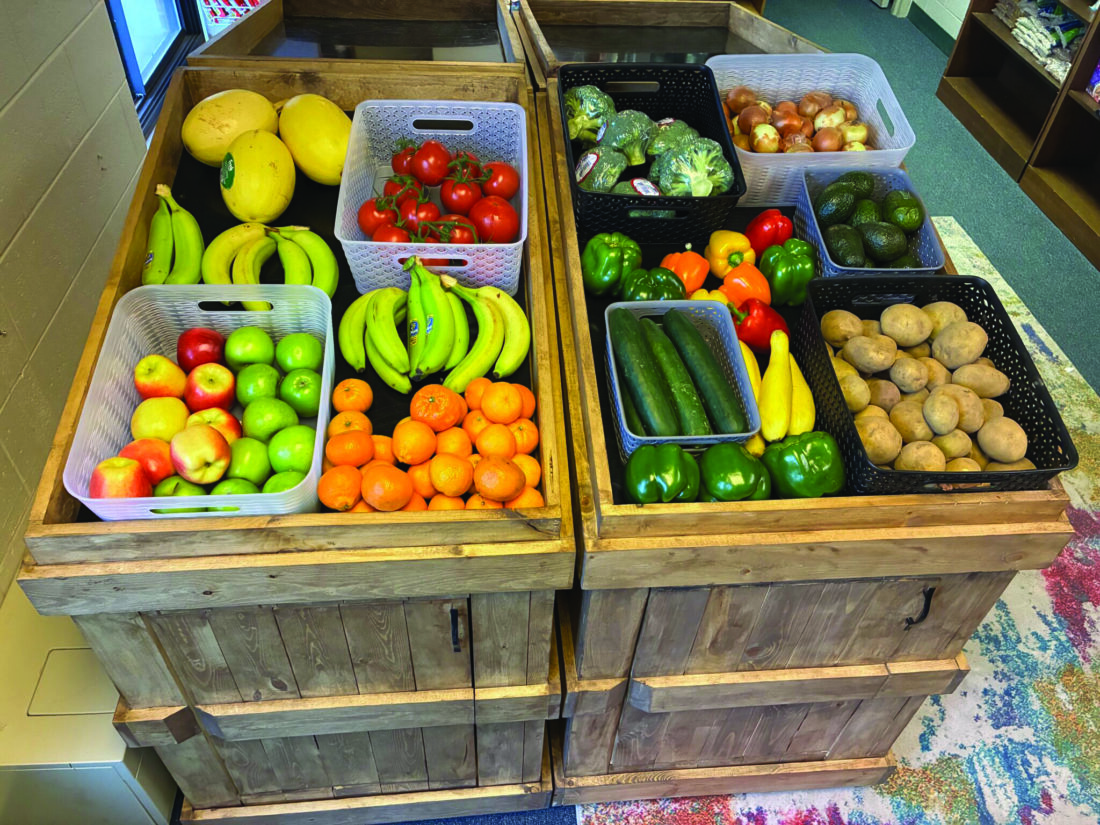
Pictured is produce available at Northern Michigan University’s food pantry. (Photo courtesy of NMU)
MARQUETTE – While historically, those who attended college may have been considered an affluent group, an increasing portion of today’s students face food insecurity.
According to the Department of Lifelong Education, Advancement and Potential Student Basic Needs Task Force, about 20% of undergraduates in Michigan experience food insecurity.
While that number is based on the 2019-20 National Postsecondary Student Aid Study, some universities across the state said they have seen a rise in demand in the five years since.
“Addressing these challenges is not only a moral imperative – it’s an economic one,” MiLEAP said.
“The outdated stereotype of the carefree college student in a dorm room their parents helped furnish fails to capture the reality of Michigan’s diverse student population,” the department said in a report.
According to the national study, 36% of Michigan college students are first-generation college students, 30% are adult learners and 38% are Pell grant participants who have exceptional financial need.
“Our numbers have been increasing pretty steadily,” said Michelle Jacob, who volunteers as a product manager at Northern Michigan University’s student food pantry.
With a total of 2,436 visits in 2025, the food pantry saw a 20% increase in students who used the service from the previous year – the third consecutive year that the number of visits rose.
Central Michigan University saw a similar trend.
There, the demand has increased yearly since fiscal year 2020-21, and the university projects 15,788 visits in the 2025-26 academic year.
While the food pantry saw a slight decline in demand since January, “we are still on pace to have more visits than the previous fiscal year,” supervisor Campbell Geary said.
Wayne State University also saw a significant increase in demand this academic year.
“The national economic issues have significantly impacted our students, and we have found the need to more regularly stock our shelves,” Dean of Students David Strauss said.
While condiments and foods with proteins, as well as personal hygiene and menstrual products are in demand, he said the campus thrift store, where students can receive donated clothing and household items for free, is also popular.
Michigan State University responded to “rising demand” last fall by opening a second food and basic needs distribution site on its East Lansing campus.
While nearly 17,000 participants accessed the program in 2024, according to a MSU press release, “that number is expected to grow significantly” with the expansion.
What’s causing the upward trend?
For Northern Michigan University’s Jacob, it comes down to rising costs.
“I truly believe that a lot of things are just becoming more expensive,” she said.
While wages of students who work part-time aren’t changing, she said things like groceries, housing and transportation are becoming more expensive.
To help offset that, it relies almost entirely on donations, and Jacob said she hopes that the number of students in need is compelling enough for universities to recognize that there is a problem – and a need to support their students.
“They are not going to be successful in the classroom if they are starving,” she said.
While additional staff would be helpful, she said she hopes the state government will continue to fund support.
Last year, Northern Michigan was one of four universities that each received $125,000 through the Hunger-Free Campus Grant initiative, a pilot program to address food insecurity across college campuses.
With the grant, the university purchased two greenhouses and two hydroponics towers to grow fresh produce directly on campus for the food pantry.
“That has helped long-term sustainability, but also to bring some fresh produce,” Jacob said.
While the pilot program ended last year, MiLEAP launched a continuation of its grant initiative in January, opening applications to all higher education institutions in the state.
Funding “will be awarded on a competitive basis, providing up to $100,000 to selected colleges and universities” over a six-month term, the department said.
It’s unclear whether the state’s fiscal year 2027 budget will include money to continue the program.
On Feb. 11, Gov. Gretchen Whitmer presented her budget recommendation, which didn’t include the program but marked the start of negotiations for the next budget that is to be passed by Oct. 1.
Advocacy for continued state funding to address student hunger in higher education is pending in the Legislature.
A bill by Rep. Will Snyder, D-Muskegon, would create a program to designate certain higher education institutions as hunger-free campuses.
The bill includes criteria institutions would need to meet to be eligible for funding, including having a student food pantry, establishing a hunger task force and designating a staff member to inform students about Michigan’s supplemental nutrition assistance program (SNAP).
Cosponsors include Reps. Jason Hoskins, D-Southfield, Carol Glanville, D-Walker and Julie Brixie, D-Okemos.
Mia Murphy, the chief policy officer of the Michigan Association of State Universities, said having an opt-in grant makes sense, but she appreciates that participation would be voluntary.
Because universities would need to implement changes to be considered a hunger-free campus, “that’s not without cost,” she said.
She added that universities could meet student needs through other ways if the proposed program doesn’t work for them.
Although Snyder introduced the bill last year, it hasn’t moved forward in the Education and Workforce Committee.
“The unfortunate thing is that the Legislature seems to be moving at a historically slow pace, ” Snyder said.
Still, Snyder said he is optimistic.
“I’m going to keep fighting for it because I believe in it,” he said.
Murphy said that rather than focusing on one-time funding initiatives – like Snyder’s bill – the state could increase operations funding for public universities, a more reliable source of support.
“One-time funding won’t necessarily make anything sustainable. There has to be an ongoing increase to university finances to be able to afford any sort of investments,” she said.
Regional News
Child dies after Pembine house fire
A second person has died following injuries sustained in a house fire in Marinette County's Town of Pembine. The ...

MDOT hosting webinars for statewide input on Vulnerable Road User Safety Assessment

DNR to hear from citizens

One of two men found guilty in petition signature scandal sentenced
More Michigan college students face food insecurity