Three potential Whitmer successors have notes after final address
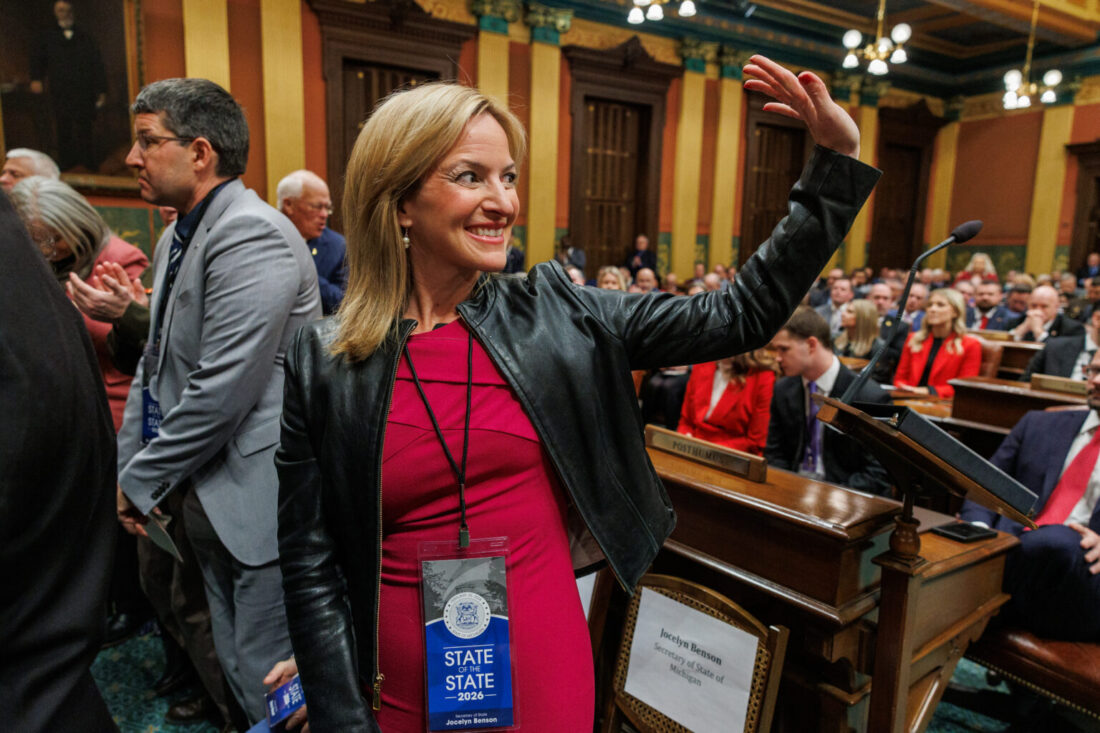
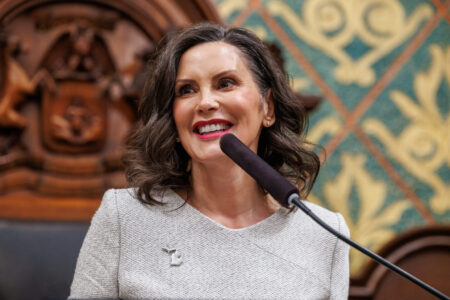
Secretary of State Jocelyn Benson attends Michigan Gov. Gretchen Whitmer's eighth and final State of the State address at the Michigan Capitol in Lansing on Feb. 25.
As Gov. Gretchen Whitmer wrapped her final State of the State address on Wednesday evening, a handful of candidates who may very well be her successor were sitting in the room watching her address.
Gubernatorial hopefuls John James, Jocelyn Benson and Aric Nesbitt were all in the Michigan Senate chamber while Whitmer pitched new plans for early literacy training, expanded K-12 funding, fully-funded and full-day pre-kindergarten options, and plans to address the state’s housing crisis.
At least two of them, Benson and Nesbitt, were there serving in their official capacities as secretary of state and the minority leader of the Michigan Senate, respectively, while James had been invited as a guest of state Rep. Alicia St. Germaine (R-Harrison Township).
James, a sitting congressman from Shelby Township seeking the Republican nomination in the 2026 gubernatorial primary, was among those who spoke to reporters following the address. He did not initially lob criticism against Whitmer, and instead said that she needs to continue focusing on things that bring Michiganders together. As an example, he pointed to the new fighter mission for the Selfridge Air National Guard Base, which James said he worked in conjunction with Whitmer and President Donald Trump to make happen.
James, however, spoke from the perspective of what the future leader of the state might also do to continue work for Michiganders to find common ground in an era of wide divisions over politics and culture.
“The thing about that is Michigan has the supply base, we have the talent, we have the natural resources, but what we lack is the leadership. Right now, despite the rosy picture that was painted for Michiganders today, the fact remains that we’re still 45th out of 50 in education,” James said. “The fact remains that we’re still number two in unemployment. The fact remains that in the city of Detroit, one in two children are still living in poverty, and our children can’t breathe. These are all facts that matter, and they can’t be whitewashed or painted over by what politicians say on the bully pulpit.”
James is positioned as the frontrunner in the GOP primary but faces strong challenges from Nesbitt and former Attorney General Mike Cox. However, he said he was looking forward to potentially making his own policy pitches next year.
That’s where his praise of Whitmer ended and criticism of her new policy pitches started to pile up.
“I’m looking forward to concentrating on four items, academic excellence, economic mobility, public safety, accountable government and healthy families,” James said. “Those are the basics that are going to help make us all, all 10 million, and having that leadership that has been tested from the battlefield to business, and then delivering as a congressman. Those are the types of things that are going to help.”
James said he has a plan for education, and he was pressed on that plan by reporters on Wednesday evening. He said federal government scholarships and money for parents to send their children to “where they will be safest and most successful,” was part of the calculus, a nod to universal school choice and potential further erosion of the public education system spearheaded by Trump’s second administration.
“Whitmer got up there talking about education. Well, she’s the one who got rid of the grading system that held our teachers and our administrators accountable for failing standards. She got rid of the concept of holding kids back who couldn’t read, because our children shouldn’t be penalized. They need a little bit more time to get mastery,” James said. “Bringing that back. The opt-in is very important. These are federal dollars that are available to the state, and Gretchen Wilmer should opt in right now, but if she doesn’t opt in for these federal dollars, then I will do so on day one.”
The opt-in James was referring to was yet another tool of the Trump administration to propagate private schools and give them resources for expenses to be used outside the federal public school education system. The program was part of Trump’s One Big Beautiful Bill Act, which requires states to “opt-in” to receive federal tax credit scholarships that allow parents to spend federal dollars on private schools enrollment.
Benson, who is the frontrunner in a shrinking field on the Democratic side of the gubernatorial front, said she was grateful to see the governor recognize that Michigan needs current and future leaders who will work hard on driving down costs across the board — whether that encompassed medical, housing or education costs.
She also took on James directly in her commentary about Whitmer’s address, noting that the next governor has to work hard on driving medical costs downward.
“One of my potential opponents voted to raise health care premiums, not once, not twice, but three times,” Benson said. “And given the work that I’ve done to be the first candidate for governor to release a plan to increase health care affordability and accessibility statewide, I think that draws a sharp contrast of what we have in terms of visions for the future of our state
On education, Benson said Michigan schools and the dire problem of the state’s literacy scores were due to decades of defunding of schools in Michigan, and over many years where the Republicans either held all or mostly all of the power in Lansing.
“We have led the nation in defunding our schools for the last 30 years,” Benson added. “I’m grateful that, for the last several years, we’ve been able to start moving in the right direction, but we’ve got a lot more work to do if we’re going to ensure our educators are well paid, that we’re addressing the education shortage, and providing wrap around services for educators and paraprofessionals.”
Benson put a fine line under the fact that financial support was essential for that latter group “that shows up every day for our kids,” as well as mental health support and the early literacy training Whitmer mentioned in her annual address.
“Science-based curriculum is the key,” Benson said.
Nesbitt (R-Porter Township) delivered the official Republican response to Whitmer’s address, which was released around the same time the speech began and was pre-recorded on his family farm, complete with musical score.
Nesbitt criticized the governor over the state’s poor literacy scores, an issue Whitmer has made top priority for her final year in office.
“It’s about time,” Nesbitt said, but repeated past criticisms of her decision to sign legislation eliminating Michigan’s third-grade reading law, and the A-F Grading system for schools.
The state can also address housing child care and health care shortages by “getting government out of the way and taking a blowtorch to Whitmer’s bloated bureaucracy and crippling red tape to make Michigan more affordable,” Nesbitt said.
“It’s time to declare Michigan open for business and good-paying jobs once again,” Nesbitt said.
Regional News
Three potential Whitmer successors have notes after final address

I-196 plastic pellet spill cleanup underway in Allegan County

Action awaited on bill to expand MI bottle recycling
Tears, anger at Michigan hearing on bungled tribal boarding school report
Whitmer proposes new methods for early literacy skills, housing reforms to ensure ownership