Supreme Court to decide if birthright citizenship may end
WASHINGTON — The U.S. Supreme Court will hear oral arguments today in a case that could reshape the understanding of who is American by birth.
The case, Trump v. Barbara, challenges President Donald Trump’s executive order that redefines citizenship to exclude children born to parents who either do not have legal status, or hold temporary legal visas.
It has the potential to upend the guarantee of birthright citizenship in effect since a Supreme Court decision in 1898 that extended citizenship to virtually anyone born in the United States. There is a small carveout for children born to foreign diplomats.
The Trump administration petitioned the high court in December after multiple lower courts struck down the executive order, finding it violated the Constitution.
Birthright citizenship has been a longstanding core principle in the United States. Experts have warned that if birthright citizenship were struck down, it would effectively create a class of millions of stateless people.
After oral arguments are heard today, a decision from the Supreme Court is expected before the court’s summer recess begins at the end of the term in late June or early July.
19th-century case
This is not the first time the Trump administration has brought a birthright citizenship case before the Supreme Court.
Last year, after federal judges in Maryland, Massachusetts, New Hampshire and Washington state struck down the president’s executive order, the Trump administration appealed to the Supreme Court, but asked the justices to consider the lower courts’ use of universal injunctions, rather than the merits of birthright citizenship.
The justices took up the case, and in a 6-3 vote divided along ideological lines, the use of universal injunctions was curtailed by the conservative wing of the high court.
After the ruling, immigration advocates and the American Civil Liberties Union filed class action suits, which were successful in blocking the birthright citizenship executive order.
The 1898 case, United States vs. Wong Kim Ark, settled the idea that automatic citizenship was granted to children born on U.S. soil, said Cody Wofsy of the ACLU, a lead attorney in the case.
Ark, born in San Francisco, was denied entry back into the country after visiting China. Officials at the time argued that because his parents were Chinese citizens in the United States on temporary visas at the time of his birth, and therefore were not “subject to the jurisdiction” of the U.S., he was not a citizen. He took the issue to the high court and in 1898 the Supreme Court affirmed that children born in the United States were guaranteed citizenship.
Arguing on behalf of the Trump administration, Solicitor General D. John Sauer has said that the 1898 case is being misinterpreted, and that it meant to only include children born to parents who were granted authorization to be in the U.S.
However, Trump’s executive order would also deny citizenship to children born to parents on temporary visas, such as for work or school.
In 1884, the Supreme Court denied citizenship to John Elk, a Native American man born in Nebraska, who was no longer a member of his tribe and tried to become a naturalized U.S. citizen in order to vote. Congress extended citizenship to all Native Americans in 1924.
Sauer cites the Elk case in his argument that the citizenship clause applies “only to those born of parents with primary allegiance to the United States.” The administration is not arguing that Indigenous people should be denied birthright citizenship.
Torey Dolan, an assistant professor at the University of Wisconsin Law School, said Sauer’s argument wrongly conflates Indigenous people with migrants, despite a long U.S. legal tradition of treating them distinctly.
“American law has always found a way to distinguish Indigenous people from non-Indigenous people in a way that has never been applied to immigrants,” Dolan, an enrolled citizen of the Choctaw Nation of Oklahoma, said.
She noted that in the Declaration of Independence, which includes the grievances of the colonists, one complaint was how British King George III refused to allow for migration into the colonies in order to occupy land stolen from Indigenous tribes.
“This conflation of immigrants and Indigenous people, for the sake of this argument, I think, is pretty egregious, and I think it really obfuscates American history and its colonial history in particular,” she said.
National News
Supreme Court to decide if birthright citizenship may end
WASHINGTON — The U.S. Supreme Court will hear oral arguments today in a case that could reshape the understanding ...
US journalist kidnapped in Baghdad and security forces hunt captors, Iraqi officials say
BAGHDAD (AP) — An American journalist was kidnapped Tuesday in Baghdad and Iraqi security forces are pursuing her ...

Gas prices eclipse $4 a gallon in the US, the highest since 2022
Pioneering female NFL official sues league over her treatment and firing
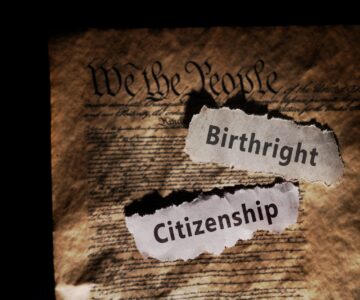
Supreme Court to decide if Trump can end birthright citizenship