As No Kings protests grow, a bigger question looms: What comes next?
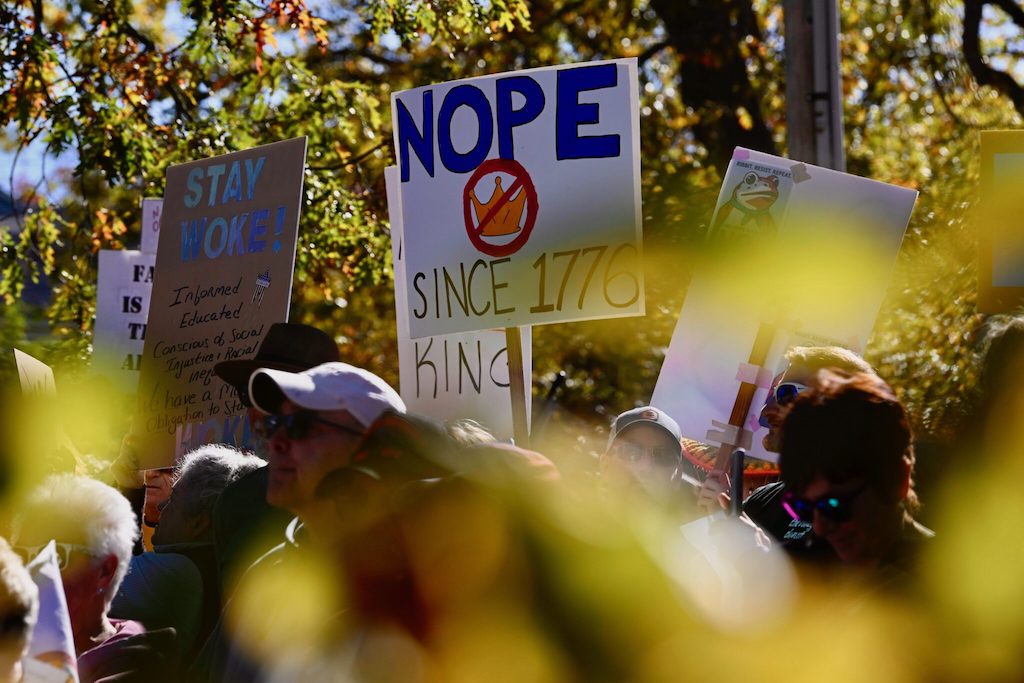
People critical of the policies of the Trump administration rally in Deering Oaks Park in Portland, Maine, as part of the nationwide No Kings protests in October. The movement is gearing up for its biggest day yet as thousands of protests are scheduled across the country on Saturday. (Photo by Jim Neuger/Maine Morning Star)
Thousands of protests are scheduled across the United States on Saturday as part of the “No Kings” movement opposing President Donald Trump’s administration.
Organizers expect millions of people to turn out for this third round of No Kings demonstrations, with more than 3,000 local-level events mapped on the movement’s official website.
Previous No Kings protests, held in June and October of 2025, were among the largest single-day demonstrations in U.S. history, according to Harvard University’s Crowd Counting Consortium, a data project that documents political protests and other demonstrations around the country.
Driving the No Kings movement at the national level are prominent progressive organizations, including Indivisible, 50501 and MoveOn. But demonstrations are organized at the local level by coalitions of hundreds of progressive groups that run the gamut from civil rights organizations to labor unions, religious communities to nonprofits dedicated to issues such as education, climate, gun control and immigration.
“People are angrier. Our numbers are growing and we’re really widening the tent of people that are going to stand up to a consolidation of authoritarian power,” said Hannah Stauss, one of the organizers of New York City’s No Kings protest. “Every time that (Trump) attacks, we get to reach a new section of people that are ready to stand with us.”
Top Republican leaders, after dismissing last year’s No Kings protests as “hate America” rallies backed by “radical leftists,” have remained mostly silent ahead of these latest scheduled protests.
But as the weekend promises massive crowds and spectacle across the nation, political observers and protesters alike wonder whether the demonstrations signal a coming wave of change at the polls, or whether momentum will fizzle after the crowds go home.
Democrats and other progressives are good at mobilizing people for large-scale protests, note some experts, but they’ve been less successful than conservatives in recent years at building the kind of local infrastructure needed to effect sweeping policy changes.
To that end, as No Kings enters its second year, organizers are looking for ways to connect the disparate groups that have united under the No Kings banner. Indivisible and other national organizers have offered training, online tools and other assistance that extends beyond the protests.
“There’s this traditional critique of protests or rallies, that single-day events don’t do much and don’t connect people to action,” said Salvador Espinoza, a board member of Hands Off Central Texas, a progressive nonprofit that’s one of the main organizers of Austin’s No Kings event. “So we consciously took steps to change the shape of how those events are structured, starting with the second No Kings, and now with No Kings 3.”
A sense of momentum
Trump’s approval rating this month is the lowest it’s been since his reelection. His administration is governing amid national and global upheaval that includes an unpopular war with Iran, an immigration crackdown that nearly two-thirds of Americans view as excessive, spiking gas prices and continued fallout related to the Jeffrey Epstein files.
“The No Kings protests are a powerful way to explain that the way President Trump has behaved is just out of step with the way presidents have behaved historically,” said Dan Greenberg, a senior legal fellow at the conservative-leaning Cato Institute.
No Kings is not an organization itself, but the movement’s protests are supported by national progressive groups, such as Indivisible, that solicit donations to provide training, digital tools and marketing help. In 2023, Indivisible received a two-year, $3 million grant from the Open Society Foundations, which funds a variety of groups that support democracy and human rights. It was founded by billionaire philanthropist George Soros, long a bête noire of conservatives.
A nonprofit called Home of the Brave is running a $1 million ad campaign in hundreds of newspapers nationwide to promote the event. Meanwhile, local groups provide their own grassroots-level organizational support, such as event logistics and volunteer coordination.
Past No Kings events have included big-city marches with tens of thousands of attendees as well as small-town demonstrations with just a handful of protesters. They’ve taken place in staunchly Democratic states as well as ruby-red Republican strongholds.
In Fairfield County, Connecticut, this year, a progressive group called REBs is planning a costumed line dance along a four-lane highway in Wilton.
In Austin, Texas, organizers are expecting tens of thousands at a downtown rally that will include live music, art and performances.
And in Red Oak, Iowa, Jenny Horner expects at least 50 people to show up to protest in her small, conservative farming community. Horner is a Spanish teacher and immigrant advocate who’s scheduled to speak at her hometown event.
“I’ve never in my life thought there would be so many issues at any given moment that are horrendous, that are scary, that need addressing,” she said. “But here we are.”
National News

A 14-year-old running for governor is the first teen to get on Vermont’s general election ballot

As No Kings protests grow, a bigger question looms: What comes next?
Costa Rica to accept 25 ‘third country’ deportees from US every week

Georgia could become the first state with weapons detection in all public schools
Jury says Meta guilty of putting profit over safety