Trump ballroom plans progress
Almost twice the size of White House
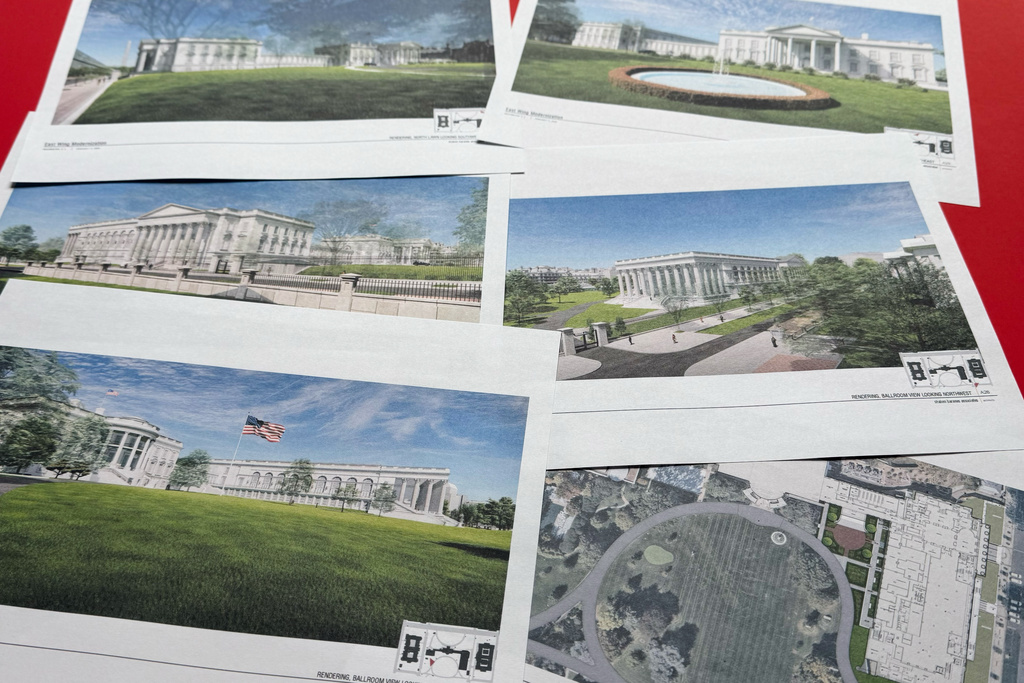
Artist renderings and diagrams of the new White House East Wing and Ballroom, briefly posted on the National Capital Planning Commission's website ahead of a March 5 hearing, are photographed Tuesday. (AP Photo/Jon Elswick)
WASHINGTON (AP) — The U.S. Commission of Fine Arts, a panel made up of President Donald Trump’s appointees, on Thursday approved his proposal to build a ballroom larger than the White House itself where the East Wing once stood.
The seven-member panel is one of two federal agencies that must approve Trump’s plans for the ballroom. The National Capital Planning Commission, which has jurisdiction over construction and major renovation to government buildings in the region, is also reviewing the project.
Members of the fine arts commission originally had been scheduled to discuss and vote on the design concept after a follow-up presentation by the architect, and had planned to vote on final approval at next month’s meeting. But after the 6-0 vote on the design, the panel’s chairman, Rodney Mims Cook Jr., unexpectedly made another motion to vote on final approval.
Six of the seven commissioners — all appointed by the Republican president in January — voted once more in favor. Commissioner James McCrery did not participate in the discussion or the votes because he was the initial architect on the project before Trump replaced him.
The ballroom will be built on the site of the former East Wing, which Trump had demolished in October with little public notice. That drew an outcry from some lawmakers, historians and preservationists who argued that the president should not have taken that step until the two federal agencies and Congress had reviewed and approved the project, and the public had a chance to provide comment.
The 90,000-square-foot ballroom would be nearly twice the size of the White House, which is 55,000-square-feet, and Trump has said it would accommodate about 1,000 people. The East Room, the largest room in the White House, can fit just over 200 people at most.
Members of the public were asked to submit written comment by a Wednesday afternoon deadline. Thomas Luebke, the panel’s secretary, said “over 99%” of the more than 2,000 messages it received in the past week from around the country were in opposition to the project.
Some comments cited concerns about Trump’s decision to unilaterally tear down the East Wing, as well as the lack of transparency about who is paying for the ballroom or how contracts were awarded, Luebke said. Comments in support referenced concerns for the U.S. image on the world stage and the need for a larger entertaining space at the White House.
Trump has defended the ballroom in a recent series of social media posts that included drawings of the building. He said in one January post that most of the material needed to build it had been ordered “and there is no practical or reasonable way to go back. IT IS TOO LATE!”
The commission met Thursday over Zoom and heard from Shalom Baranes, the lead architect, and Rick Parisi, the landscape architect.
Trump has said the ballroom would cost about $400 million and be paid for with private donations. To date, the White House has only released an incomplete list of donors.
A lawsuit against the project is still pending; the National Trust for Historic Preservation (NTHC) has sued in federal court to halt construction.
In voting, the commission “bypassed its obligation to provide serious design review and consider the views of the American people,” stated Carol Quillen, president of the NTHC.
Quillen said that while her organization has always acknowledged the usefulness of a larger White House meeting space, “we remain deeply concerned that the size, location, and massing of this proposal will overwhelm the carefully balanced classical design of the White House, a symbol of our democratic republic.”
At the commission’s January meeting, some members had questioned Baranes, Trump’s architect, about the “immense” design and scale of the project even as they broadly endorsed Trump’s vision.
On Thursday, Cook and other commissioners complimented Baranes for updating the building’s design to remove a large pediment, a triangular structure above the south portico, that they had had objected to because of its size.
Trump quietly named his final two commissioners to the panel in late January. Pamela Hughes Patenaude has a background in housing policy and disaster recovery, and was as a deputy secretary at the Department of Housing and Urban Development in Trump’s first term. Chamberlain Harris is a special assistant to the president and deputy director of Oval Office operations.
The ballroom project is scheduled for additional discussion at a March 5 meeting of the National Capital Planning Commission, which is led by a top White House aide. This panel heard an initial presentation about the project in January.
At the meeting, the White House defended tearing down the East Wing, saying that it was not preservable. Josh Fisher, director of the White House Office of Administration, cited an unstable colonnade, water leakage, mold contamination and other problems.
National News

Trump ballroom plans progress

US hockey star Haley Winn’s three older brothers are her biggest fans online and at the rink
‘Love Story’ is revealing just how much Carolyn Bessette Kennedy’s style has endured

US military boards another oil tanker in Indian Ocean after tracking it from the Caribbean
Soaring coffee prices rewrite some Americans’ daily routines