Rare plant species returns to Great Lakes ecosystem
Thistle found in Delta County
-
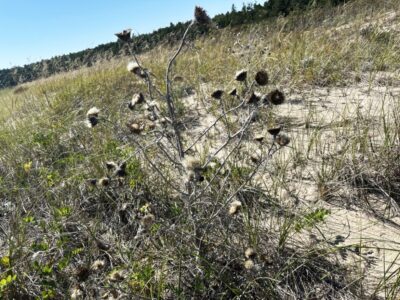
- itcher’s thistle photographed in Great Lakes coastal dune habitat. (Andrew Bowker | U.S. Fish and Wildlife Service)
-

- Noel Pavlovic is an ecologist with the Great Lakes Science Center at the Lake Michigan Ecological Research Station in Indiana. (Courtesy photo)
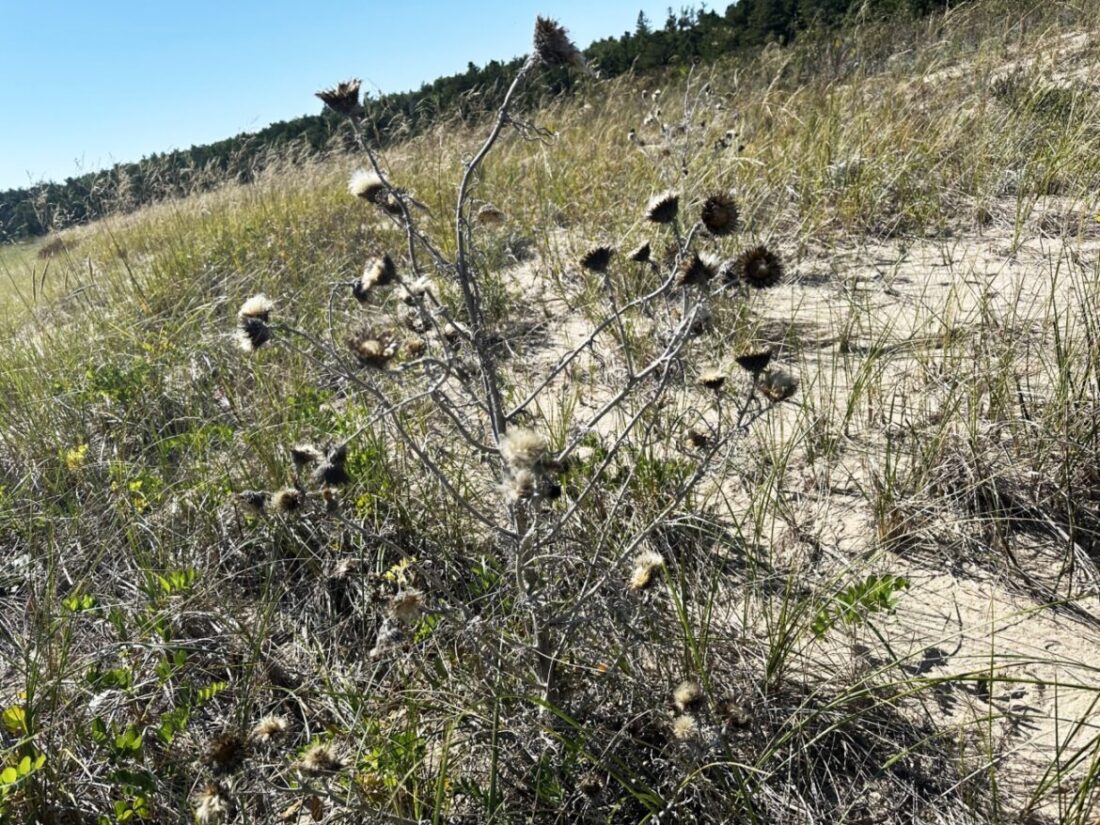
itcher’s thistle photographed in Great Lakes coastal dune habitat. (Andrew Bowker | U.S. Fish and Wildlife Service)
LANSING — More than 30 years ago, a group of scientists planted 4,200 seeds of the rare Pitcher’s thistle in the sandy dunes of the Great Lakes. At the time, no one knew if the new populations would survive.
Today, three decades later, the restored populations are thriving and spreading. This unexpected success became the foundation for a newly published study in Annals of Botany.
The study by U.S. Geological Survey research ecologists Noel Pavlovic and A. Kathryn McEachern, along with conservation scientist Jeremy Fant of the Chicago Botanic Garden, whose genetic research made it possible to view the restoration of the rare plant not only as a field experiment, but as a long-term genetic survival strategy.
Pitcher’s thistle grows only on the Western Great Lakes sand dunes.
To most visitors, it looks like an ordinary wildflower: a spiky, silvery-green plant with cream-to-light-pink flowers.

Noel Pavlovic is an ecologist with the Great Lakes Science Center at the Lake Michigan Ecological Research Station in Indiana. (Courtesy photo)
To scientists, it represents the fragile coastal ecosystems of the region.
Sand mining, residential development and recreational activities have historically been threats to sand dunes which serve as a natural gateway to the shoreline and protect the coast from erosion.
In the late 1980s, Michigan designated areas along the Lake Michigan and Lake Superior shorelines as “critical dune areas” in an effort to protect these ecosystems.
The Michigan Natural Features Inventory lists 12 coastal counties where the plant has been spotted since 2008: Alcona, Alger, Allegan, Alpena, Antrim, Arenac, Benzie, Berrien, Charlevoix, Cheboygan, Chippewa and Delta.
In 1988, it was listed as threatened by the Fish and Wildlife Service.
“In 1988, I was working as a statistician for the National Park Service at Indiana Dunes National Park,” Pavlovic recalled.
“That’s when graduate student McEachern from the University of Wisconsin joined us,” he said.
“She was exploring research topics on dune ecosystems, and our supervisor suggested that we study Pitcher’s thistle, which was about to be listed as a threatened species. I hired a technician, and the three of us began studying this plant together.”
Head shot of Noel Pavlovic. Noel Pavlovic is an ecologist with the Great Lakes Science Center at the Lake Michigan Ecological Research Station in Indiana. Courtesy photo.
Once it was federally listed, a recovery team was established with representatives from federal and state agencies. Pavlovic became the team leader, helping shape the official recovery strategy for the species.
That meant Pavlovic was not only studying the plant – he was actively involved in defining how the government might protect it.
The plant became the focus of McEachern’s dissertation, and she took a job with the National Park Service in California after finishing her doctorate.
“Meanwhile, my colleague, a long-term technician, and I continued monitoring the plants at Indiana Dunes, while McEachern returned nearly every summer to help with field surveys,” Pavlovic said.
In 1994, the team launched a historic reintroduction effort.
They collected 4,200 seeds from 54 maternal lines and planted them at Indiana Dunes National Park across three stages of habitat succession: early sites dominated by bare sand, mid-stage areas with a mix of marram grass and sand, and late successional habitat dominated by little bluestem grass.
“Everything begins at the foredune, where shifting sands are stabilized by marram grass, and Pitcher’s thistle thrives under the same conditions.
“Farther inland,” he continued, “secondary dunes develop as the sand stabilizes, and over time grasses give way to shrubs and eventually forests.
“This gradual transformation is known as ecological succession, and we placed our research plots across these different stages to understand how Pitcher’s thistle responds to changing habitats,” he said.
It wasn’t a large number of seeds. And planting was done only during the first year.
After that, the scientists stepped back and let nature take over.
“Pitcher’s thistle has a very interesting life history,” Pavlovic explained. “Everything starts from seeds.”
“In the first year, a tiny seedling appears. If it survives, the second year it becomes a juvenile plant. Over the next few years it continues to grow.”
“It can flower anywhere between 3 and 8 years of age — and then it dies. Unlike many perennials, it only blooms once. It has a single chance to reproduce,” Pavlovic said.
The populations were monitored for more than 30 years, with genetic sampling of both native and reintroduced populations in 2009.
“The populations at Indiana Dunes were small, scattered and genetically vulnerable. We already knew from earlier studies that genetic diversity was especially low in southern Lake Michigan. That’s why we decided to mix seeds from different local populations,” Pavlovic said.
High seedling mortality, limited seed numbers and the risk of losing genetic diversity made failure a real possibility.
“We never expected these populations to survive this long,” he said.
“We used just 4,200 seeds, and seedling mortality was very high. We assumed genetic diversity would collapse. But it didn’t. The plants survived, and the populations began expanding. It’s truly remarkable.”
The two surviving populations, out of three, also showed higher genetic diversity than native populations, showing seed mixing was effective.
“These dunes are home to many unique species, and Pitcher’s thistle is symbolic of these ecosystems,” Pavlovic said.
“Its flowers provide essential nectar for pollinators, and its seeds feed birds like American goldfinches. Many dune plants were also used by Indigenous peoples for food, dyes and crafts.”
“This isn’t just about saving one rare flower — it’s about preserving an entire living landscape,” Pavlovic said.
———
Kyrmyzy Turebayeva writes for Great Lakes Echo. This story was provided by Capital News Service at Michigan State University.
Michigan News
Alpena prepares for Ice Fest

Michigan Democrats approved to make case for early 2028 presidential primary

Family engagement beneficial for student success
Rare plant species returns to Great Lakes ecosystem
Michigan quietly kills effort to restructure mental health care system
This story was originally published by Bridge Michigan, a nonprofit and nonpartisan news organization. Visit the ...