Former Calvin University professor’s discrimination lawsuit will head to Michigan Supreme Court
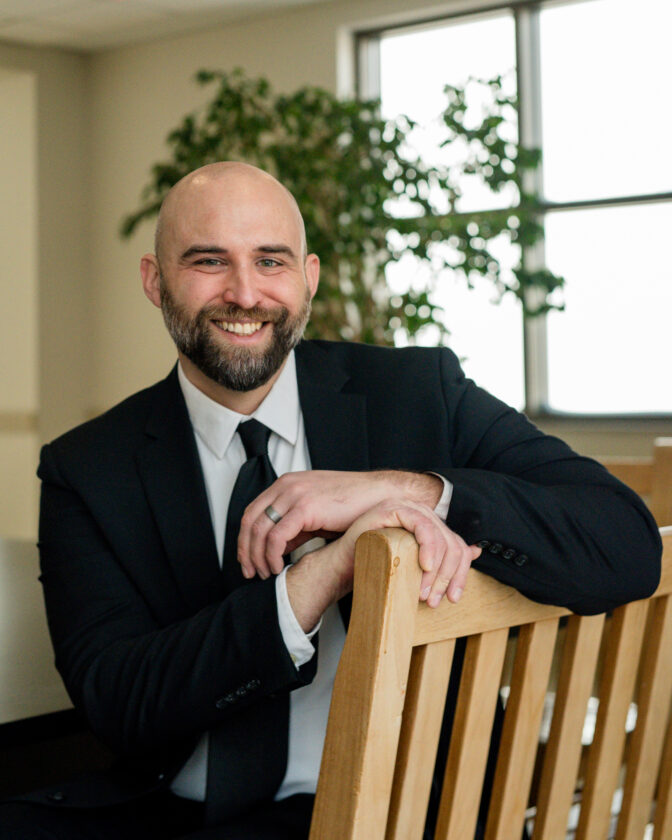
Joseph Kuilema, a professor in Grand Valley State University’s School of Social Work, is suing his former employer, Calvin University. (Courtesy of Joseph Kuilema)
After Joseph Kuilema, now a professor of social work at Grand Valley State University, was fired in 2022 from his post at the private Christian college Calvin University for officiating a same-sex wedding, he sued Calvin, where he had worked since 2008, for both retaliation and associational discrimination. Now, the Michigan Supreme Court will decide if that associational discrimination claim — the fact that he was fired over his association with LGBTQ+ individuals — can be heard further in court.
“The wedding that I officiated was for a former student who was marrying his partner, and they asked me to facilitate, and I obviously was honored by that,” Kuilema told the Michigan Advance. “It never really occurred to me that this would be a problem for Calvin, because it was something I was doing in my personal life, and it was a non religious wedding.”
The associational discrimination claim is fairly novel in Michigan — while there are cases within the state that have ruled in favor of claimants of associational discrimination on the basis of race, none have ever dealt with sex-based discrimination.
GET THE MORNING HEADLINES.
The Court of Appeals, in their ruling, argued that, because the decision to fire Kuilema had no bearing on his own sex — it would have been the same if he were a woman or a man — his argument of associational discrimination is invalid.
“Kuilema’s sex is irrelevant to Calvin University’s decision to terminate his employment. The university’s decision to terminate his employment was based upon his decision to officiate a same-sex wedding,” the appellate court’s decision read. “Based upon the allegations in the complaint, the discriminatory action would have occurred regardless of Kuilema’s sex.”
But Charissa Huang, one of Kuilema’s lawyers, argued that if the question was about discrimination based on Kuilema’s own sex, it would be just a discrimination claim, not associational discrimination.
“Here, the discriminatory animus was directed toward the couple for whom Kuilema officiated the wedding,” the response to that ruling by Kuilema’s lawyers reads. “Kuilema’s officiation of the wedding was deemed to be ‘controversial’ by the University because it was an LGBTQ+ wedding, even though it was a non-religious civil ceremony.”
“If the sex of the other University employee in the couple were different, such that the University perceived that Kuilema had officiated a heterosexual wedding, the wedding would not have been deemed ‘controversial,’ and there would have been no ‘investigation’ by the University about the wedding which led to the effective termination of his employment,” that response continues.
Kuilema, who was voted as the university’s professor of the year in 2019, calls himself a “child of Calvin” — his parents attended the school and met there, as did his siblings, his wife and Kuilema himself. When he took the job there in 2008, he assumed it would be his whole career.
“When I was hired at Calvin, I told them, ‘I think differently than the official position on LGBTQ issues’,” he said. “The person who hired me at the time was like, ‘No problem, lots of people in that boat, you’re going to be fine.’ And then 14 years later, it turned out to be a big problem.”
“They tried to paint it as me deliberately doing this activist thing, which was kind of silly, honestly, because it was just this personal thing,” Kuilema, who now teaches at Grand Valley State University, said.
Calvin, on the other hand, is standing firm in its decisions.
“The Calvin University community has been well served throughout its 150-year history by having diverse viewpoints among its faculty,” John Zimmerman, Calvin University’s director of communications, wrote in a statement. “While there is room for personal disagreement with CRC doctrine, the university has clear expectations for employees regarding teaching, scholarship, and personal conduct, and follows established processes to review alleged violations of those expectations and to determine appropriate responses.”
Zimmerman added that the university had no further comment on active litigation.
Kuilema sees this case as a broader question on whether private, religious institutions in Michigan and nationwide are able to discriminate against members of the LGBTQ+ community.
“This is about something that’s happening at a school that’s receiving considerable amounts of tax dollars from you, from me, from members of the queer community, members of no faith. And if we’re all going to subsidize that project, I think we as Americans have sort of this patriotic duty to think about what we’re going to allow and what we’re not going to allow,” he said. “If you don’t want to play by the rules, stop taking all that federal money. I don’t think Calvin’s going to do that. They want to have their cake and eat it too. They want to take all the money and continue to discriminate.”
Kuilema’s claims of associational discrimination were accompanied by claims of retaliation, because he had been in unrelated disputes with several of the people on the committee that made the decision to terminate him over what Kuilema called racism on campus and the decision to show racist content in classes.
Those claims of retaliation will go to discovery and are not part of the question before the Supreme Court, but are stayed until the top court makes its decision on the associational discrimination claims. Oral arguments for the case have not yet been scheduled.
Michigan News

Assaults on prison staff have increased in Michigan
Michigan’s school counselors spread thin
Former Calvin University professor’s discrimination lawsuit will head to Michigan Supreme Court
Michigan athletes go for gold in Winter Olympics; here’s who and when to watch

How much lottery ticket cash ends up in Michigan classrooms? We did the math