Disputed data, familiar claims: Michigan officials push back on 2024 election doubts
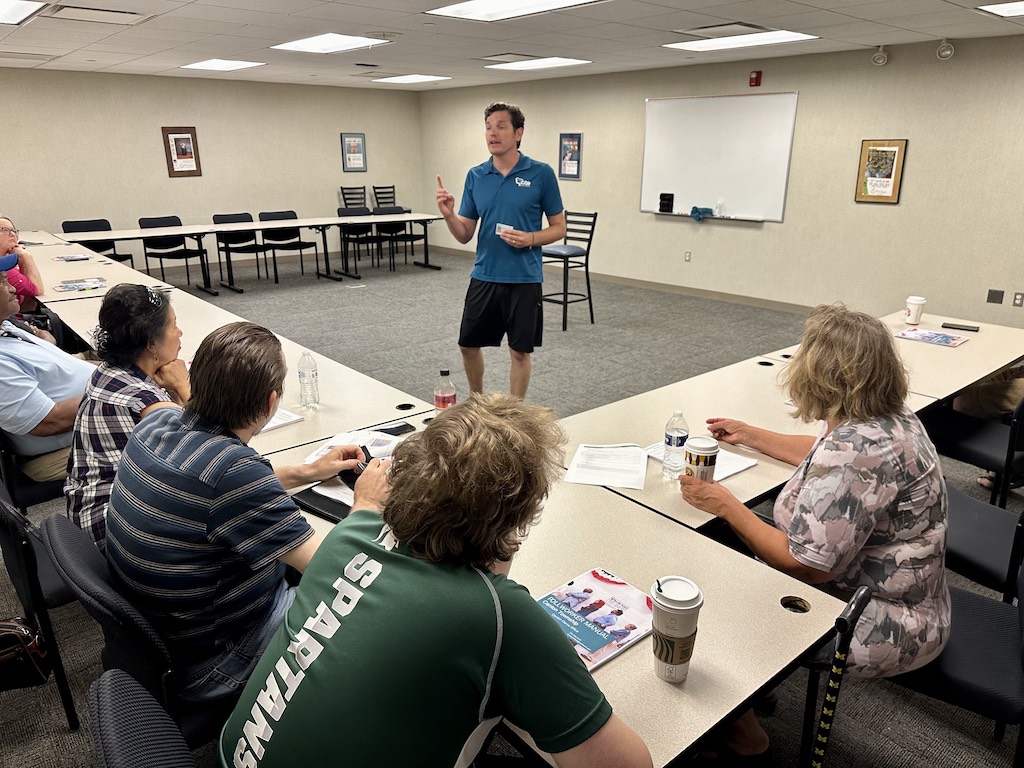
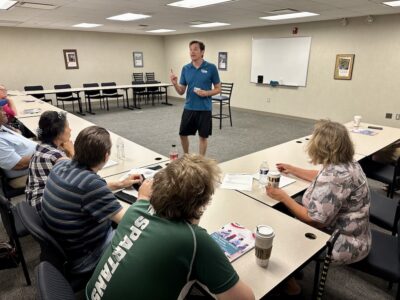
Township clerk Michael Siegrist, shown training a group of poll workers in Canton Township, Mich. (Matt Vasilogambros | Stateline)
As Michigan prepares for what’s sure to be a contentious midterm election cycle, experts are warning that skepticism of election results becoming a bipartisan interest could have damaging consequences for the state of American democracy.
It comes as the Election Truth Alliance, a nonpartisan group led by three volunteer researchers and data analysts, released a report examining and casting doubt on the results of the 2024 election in Wayne County.
According to the report, voting data in most of Wayne County follows a trend also seen in other swing states: Precincts with higher turnout also saw Republicans win a higher vote share.
“It almost seemed systematic, meaning it didn’t look like what you would expect a little bit more of the chaotic human voting behavior to look like,” Executive Director of Advocacy and Public Engagement Nathan Taylor said. “It looked almost like an algorithm, or almost like computer generated results for the data.”
Taylor said the trend could be the result of vote stuffing or vote switching.
“If there was a successful compromise of some of the voting infrastructure, that would allow you to potentially go in and make changes to the voting data in a behavior like what we’re seeing,” Taylor said. “Algorithmic, taking votes from one candidate, giving them to the other, deleting votes or even adding in votes.”
But he said voting patterns in Detroit, the largest city in Wayne County, didn’t exhibit what he called statistical election red flags.
Election officials, scholars say analysis lacks understanding of voter behavior
Canton Township Clerk Michael Siegrist said the outcome of the 2024 election is unsurprising if you factor in socioeconomic factors that he said the ETA report largely ignores.
Namely, he said Democratic turnout was muted because of voter frustration with President Joe Biden’s handling of the conflict in Gaza. Wayne County, outside of Detroit, has the largest concentration of Arab American voters in the country, Siegrist said.
“What’s problematic about this report is it doesn’t factor in anything we know about human beings,” Siegrist said. “It’s going from A to Z, without understanding B through Y.”
Siegrist said Arab American voters and young voters were both more likely to vote in person, while older voters, who may be more partisan and committed to a particular candidate, were more likely to vote absentee.
He believes the report falls apart because it tries to use objective statistical analysis to explain subjective human behavior.
“I’ve seen these things before where people who maybe are a little too smart for their own good kind of work themselves up into using statistical analysis models that work for, like, mass production of grommets … that don’t make sense when you’re dealing with actual voters who behave based on social cues and political cues,” Siegrist said.
He said the report reminded him of unfounded claims of widespread voter fraud in the 2020 presidential election made by President Donald Trump and his Republican supporters.
Stanford political science professor Justin Grimmer said a heat map in the ETA’s report that shows the correlation between voter turnout and support for a candidate is almost identical to charts that were made after the 2020 election.
“That exact heat map, people produced for the 2020 election to allege that something was amiss – and, of all places, also in Wayne County, but obviously in the other direction,” Grimmer said.
He said the analyses of voting data in both elections closely mirror one another.
“Even though it’s people from two different sides of the aisle making these allegations, what’s remarkable is the similarity in the types of claims, based on aggregate vote returns or other poorly applied statistical analyses,” Grimmer said. “They reach the conclusion that something is amiss, when it’s not really supported by the analysis.”
A more credible report, Grimmer said, would begin by laying out standards that had previously been successful at identifying voter fraud and then testing the data against those standards.
Instead, he said the report appears to be looking for evidence to support a predetermined conclusion.
“It’s motivated by this baseline skepticism, and then you have these sorts of bad statistical analyses happening,” Grimmer said.
But Taylor said that’s by design. He said statistical patterns alone don’t constitute proof of fraud. Instead, the report serves as a starting point to begin investigating more closely, Taylor said.
“The types of analysis and investigations the ETA has been doing is evidential at best,” Taylor said. “It’s not proof of anything. Really the only way to absolutely know if there was a compromise of our results in the 2024 election is to actually look at the paper trail.”
Grimmer said the approach produces “foggy” claims of election manipulation that become harder to refute since baseline questions go unanswered – and unasked.
“It looks, on its face, to be rigorous, and, as a result, because this apparent rigor aligns with the skepticism that somebody else may have – it’s very hard to lose an election – they then use this to say this is evidence that something untoward happened, when it’s definitely not,” Grimmer said.
Michigan News
Firm returns $4.8M to Michigan amid Clare health park embezzlement case

U of M economist: Michigan getting poorer for lack of knowledge jobs
Lawmakers, including from Michigan, visit Minnesota for inspiration — and to warn the nation
Disputed data, familiar claims: Michigan officials push back on 2024 election doubts
Michigan tribes warn members about ICE stops