West Michigan sees signs that economic momentum slowing
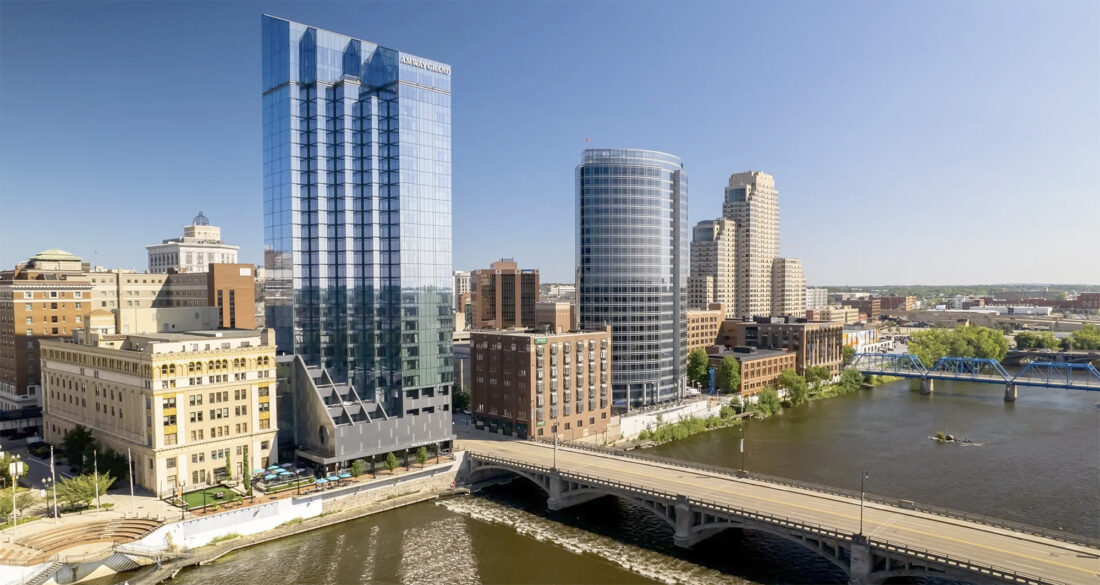
Data shows the Grand Rapids region continues to be a leader in growth, but there are signs of a slowdown. (Shutterstock photo via Bridge Michigan)
West Michigan remains a leader in job and population growth across Michigan, but there are signs momentum has slowed amid staffing challenges, tariffs and the rise of artificial intelligence.
Forty-six percent of Grand Rapids-area companies said in 2025 they were planning to expand, down from 52% the year before, according to data presented Thursday at an event hosted by economic development firm The Right Place.
Forty-three percent of businesses said they were planning to hire, down from 45%.
Population growth in the region slowed from nearly 1% in 2024 to 0.4% in 2025, while the number of jobs in the region has remained mostly flat at around 600,000 for the last three years, the data showed.
“The economy overall has kind of plateaued” after climbing out of the coronavirus pandemic, Randy Thelen, president and CEO of The Right Place, told Bridge Michigan in an interview. “The growth is not quite where we’d like to see it.”
While the heads of regional companies in 2023 said their biggest obstacle was finding talent, they’ve said sales were a challenge the last two years. Essentially, companies are now fighting for a share of the market instead of fighting for a slice of a growing pie, Thelen said.
But companies still worry about finding employees with the right kinds of skills in an increasingly tech-driven economy, Andy Johnston, senior vice president of strategic initiatives at the Grand Rapids Chamber, told Bridge Michigan in a separate interview.
“They’re not just looking for bodies,” Johnston said. “They’re looking for a little bit more than that right now.”
As President Donald Trump returned to office, Grand Rapids-area companies were concerned early in the year about the impact of tariffs on their bottom lines, Johnston said, but “the business community has accepted that” as the year ends.
As it has in almost every market, the rise of artificial intelligence has also disrupted portions of the Grand Rapids region. In October, major financial services company Acrisure announced it would lay off 400 people, including about 200 in west Michigan, because it had automated some of its work with AI.
Thelen said AI didn’t concern him because, as happened with previous technological advancements, employees will find different ways to use their skills. There are fewer travel agents today as people book their trips on apps, but the economy still added jobs after that shift, he said.
“A moment of transition can be a challenge,” Thelen said, “but long-term, the economy will find a way.”
Despite the slowdown signs, the Grand Rapids region remains a leader for economic development around Michigan and the country.
The Grand Rapids area’s population growth remained on-par with the national rate and was more than double the statewide rate of less than 0.2%, according to The Right Place’s latest State of the Region report. The area’s growth ranked 15th among 20 growing metro regions around the country against which The Right Place compares Grand Rapids.
Key, Thelen said: Compared to those 20 growing markets, Grand Rapids ranked fifth in adding 25- to 34-year-olds, with a more than 14% increase this year in the number of younger workers.
“That helps signal to employers … there’s going to be an available workforce going forward,” Thelen said.
Grand Rapids has set its sights on growing the share of its workforce in tech jobs, and the region ranked 10th among those 20 benchmark metros, with 6.5% of its workforce in tech. Ann Arbor and Detroit ranked fourth and fifth, respectively.
In overall job growth, Grand Rapids ranked 12th among the 20 benchmark regions. The Lansing region ranked third, though state forecasts say west Michigan will exceed the Lansing region in job growth long-term.
The Grand Rapids region’s industrial vacancy rate stands at about 3%, compared to nearly 8% nationally, and its office vacancy rate is 13%, compared to about 19% nationally.
And the region is largely ahead of the game on The Right Place’s strategic plan, according to Thursday’s presentation.
While job growth has been essentially flat for three years, the region added or retained about 4,153 jobs over the last three years, compared to its 4,000-job goal. The more than $844 million in capital investment topped its $550 million goal, its more than $487 million in community development clobbered its $100 million goal, and the average hourly wage was $30.90, well above the $26.50 goal.
“What we like to say is that our momentum is not assured,” said Johnston, of the chamber. “Do I think (growth) is sustainable? It is if we can continue to work on it.”
———
This story was originally published by Bridge Michigan, a nonprofit and nonpartisan news organization online bridgemi.com. It was distributed through a partnership with The Associated Press.
Business News
US stocks hold in place on eve of Federal Reserve meeting
West Michigan sees signs that economic momentum slowing
Elle Jay Studio promotes mental wellness with physical treatments
Netflix to acquire Warner Bros. Discovery for $72 billion
Wall Street rises to the edge of its all-time high