
Partnership plants seeds for forestry, agriculture careers
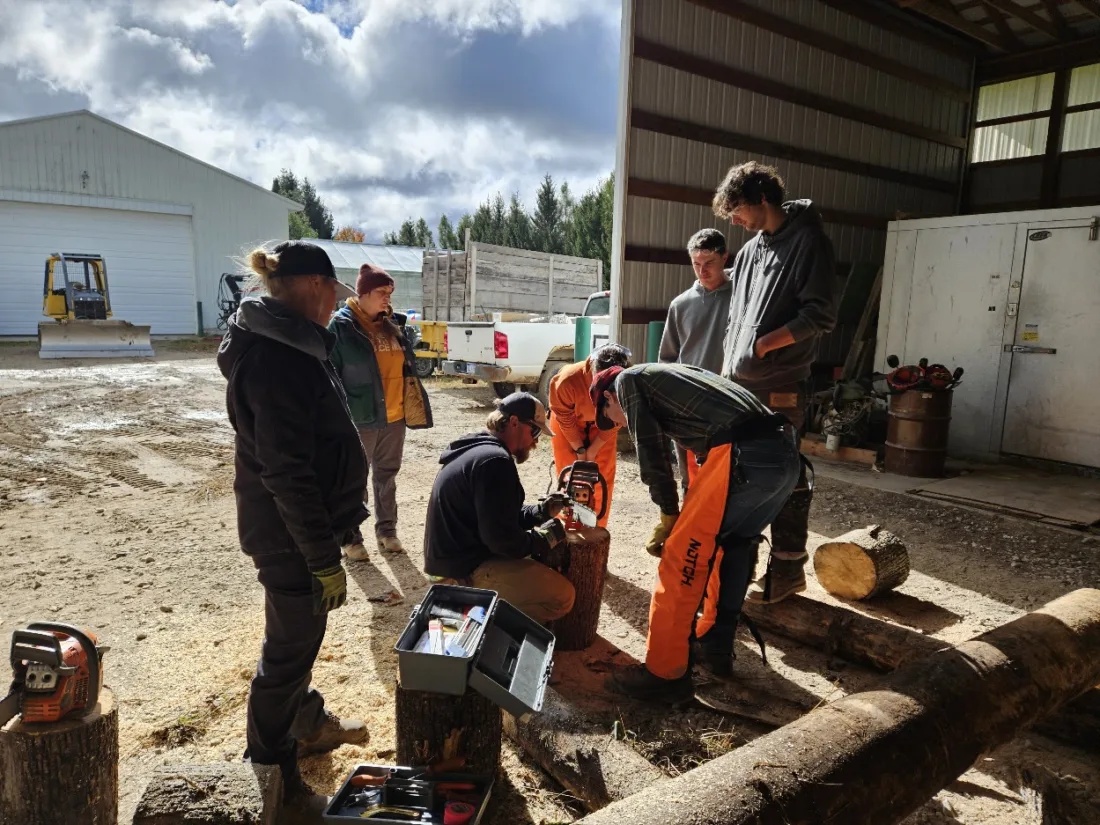
Students in the FOR 117 Natural Resources Equipment and Worker Safety class through the Michigan State University (MSU) Institute of Agricultural Technology (IAT) Forest Technology program at Bay College are taught how to sharpen the chain of a chainsaw. MSU IAT Forestry Instructor Winona Grieshop can be seen instructing, while MSU Forestry Innovation Center Operations Forester Tyler Tankersley demonstrates the lesson. From left to right: Kristin Koth, Grieshop and Tankersley, Ali Maloney, Daniel June, Christopher Gavlek and Aaron Beardsley.
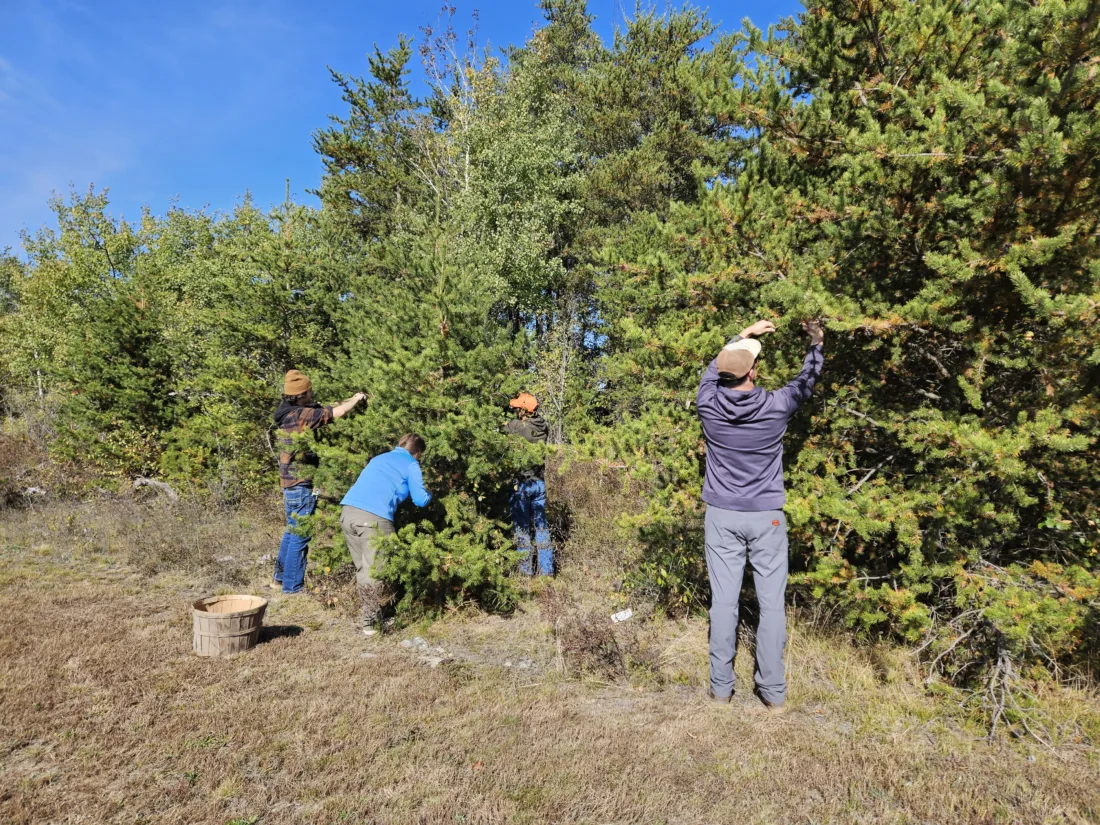
Students in the Michigan State University Institute of Agricultural Technology Forest Technology program at Bay College collect Jack Pine cones as part of a program hosted by the U.S. Forest service to help reforest Jack Pine stands in Michigan. (Photo courtesy of Bay College)
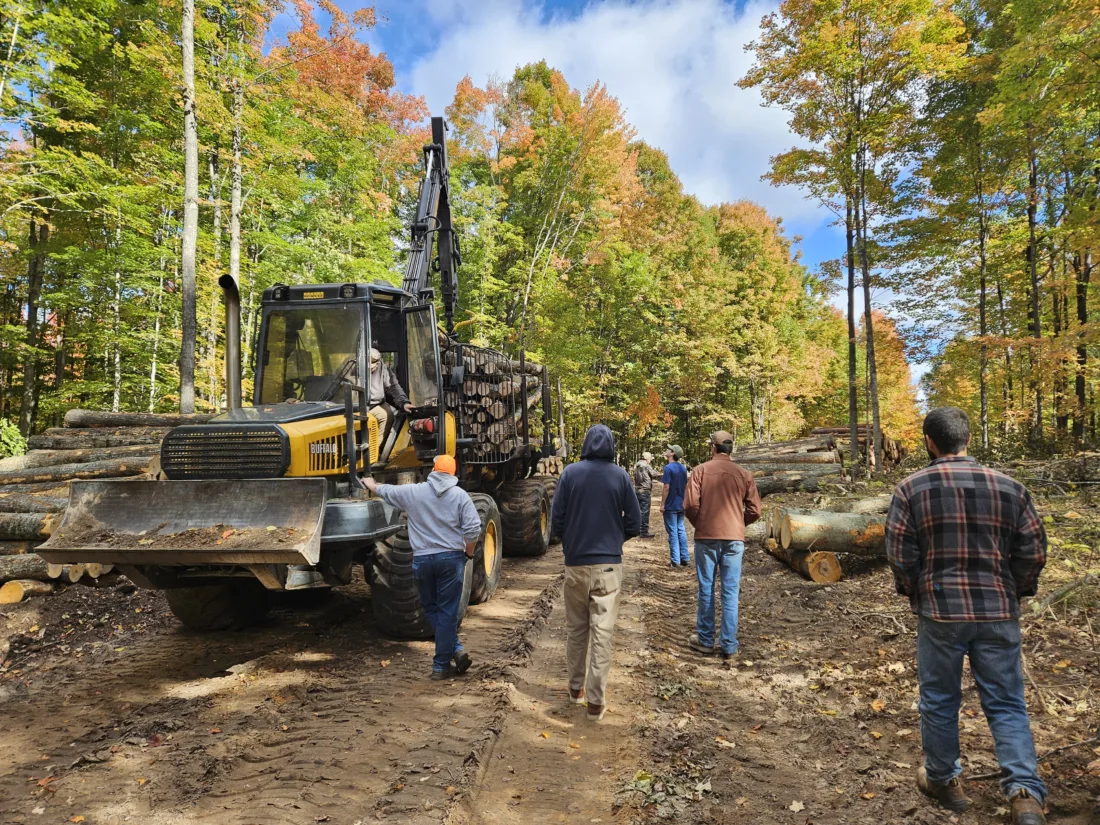
The FOR 115 Field Explorations in Topics of Forest Technology class — as part of Bay College's partnership with the Michigan State University Institute of Agricultural Technology — takes a tour with Great Lakes Lyme Timber at an active logging site. (Photo courtesy of Bay College)
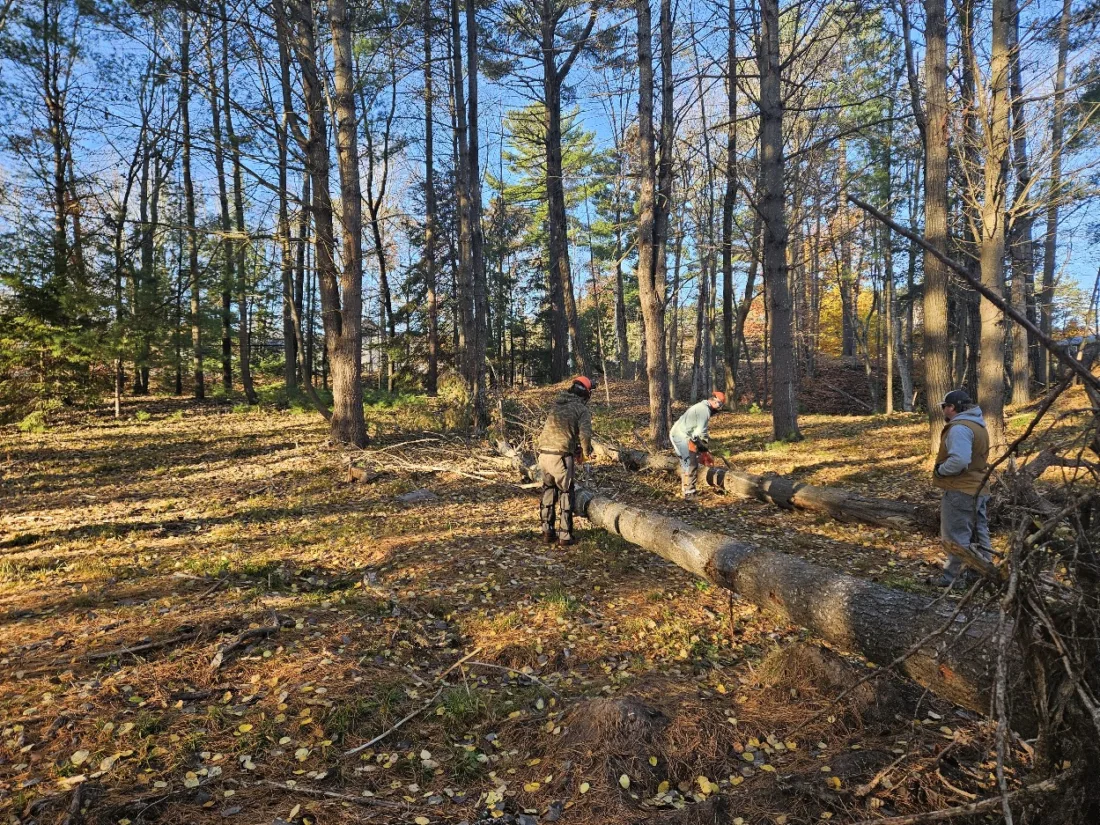
Local students delimb trees that fell in the windstorm earlier this year. After delimbing the trees, they cut the wood into usable sections to be processed into eight to 12 feet boards. This was part of the FOR 117 Safety course through the Michigan State University Institute of Agricultural Technology Forest Technology program at Bay College. (Photo courtesy of Bay College)
Students in the FOR 117 Natural Resources Equipment and Worker Safety class through the Michigan State University (MSU) Institute of Agricultural Technology (IAT) Forest Technology program at Bay College are taught how to sharpen the chain of a chainsaw. MSU IAT Forestry Instructor Winona Grieshop can be seen instructing, while MSU Forestry Innovation Center Operations Forester Tyler Tankersley demonstrates the lesson. From left to right: Kristin Koth, Grieshop and Tankersley, Ali Maloney, Daniel June, Christopher Gavlek and Aaron Beardsley.
Students in the Michigan State University Institute of Agricultural Technology Forest Technology program at Bay College collect Jack Pine cones as part of a program hosted by the U.S. Forest service to help reforest Jack Pine stands in Michigan. (Photo courtesy of Bay College)
The FOR 115 Field Explorations in Topics of Forest Technology class — as part of Bay College's partnership with the Michigan State University Institute of Agricultural Technology — takes a tour with Great Lakes Lyme Timber at an active logging site. (Photo courtesy of Bay College)
Local students delimb trees that fell in the windstorm earlier this year. After delimbing the trees, they cut the wood into usable sections to be processed into eight to 12 feet boards. This was part of the FOR 117 Safety course through the Michigan State University Institute of Agricultural Technology Forest Technology program at Bay College. (Photo courtesy of Bay College)
Trending
ESCANABA -- A partnership between Bay College and Michigan State University (MSU) is creating hands-on learning opportunities for students interested in forestry and agriculture, with enrollment attracting both young adults and those returning to the classroom later in life.
Through the partnership, Bay College works with the MSU Institute of Agricultural Technology (IAT) to offer dual-enrollment certificate and associate degree programs in Agricultural Operations and Forest Technology.
The MSU Forestry Innovation Center (FIC) -- a 1,745-acre research facility in Escanaba -- plays a critical role in developing students' skills, as the center hosts classes and labs to provide hands-on learning opportunities for students in both MSU IAT programs.
The partnership was initially launched with the help of a $749,000 Higher Education Challenge grant from the U.S. Department of Agriculture’s National Institute of Food and Agriculture.
Jesse Randall, director of the MSU FIC, said the MSU IAT Forest Technology program began with Justin Kunkle, who worked in the forestry department at MSU. Kunkle -- who now works as the assistant director for IAT -- Randall and a team submitted the higher education challenge grant and received three years of funding to start the process.
"We interacted with the broad forest industry to set the curriculum and detail the hands-on skills that students in the program would need," Randall added. "It was clear that the students needed a place that offered classroom and field experience in close proximity to Bay College. The FIC met all the criteria, and we have a mission as the land grant institution in the state of Michigan to research, educate and move the state forward."
Jessica Van Slooten, dean of arts, sciences and teaching and learning at Bay College, said the partnership benefits all three institutions while expanding educational opportunities for students pursuing careers in forestry and agriculture.
"From Bay’s perspective, this is a really great way that we can build on our own general education courses, which for the most part are the foundation of this program," said Van Slooten.
While Bay College provides general education and specialized coursework, MSU contributes discipline-specific forestry instruction.
"It’s a really great pairing of the expertise of our faculty and staff," Van Slooten added. "The (FIC) has been really helpful and accommodating in terms of offering our wildland and rural fire control class there. We’ve had a really good partnership with them, both in terms of helping host the class as well as providing a place for the students to really see research at work."
Taylor Shay joined Bay College in early July as coordinator of the Forestry Technology and Agricultural Operations programs, overseeing student support, instruction and recruitment.
Since joining the college, Shay said students have participated in several hands-on learning opportunities, including heavy equipment safety and chainsaw training, as well as field activities and labs at the MSU FIC.
In addition to hosting classes and labs, the MSU FIC hires summer interns, many of whom have come from the MSU IAT programs at Bay College.
"(The center) provides so many open-door learning opportunities. They are an incredible partner. We could not have the program be as hands-on as we do without them," Shay added.
There are currently six students enrolled in the Forest Technology program, including one who participates remotely. Students range in age from 18 to 25. Three students are currently enrolled in the Agriculture Operations program.
"I have great students. They have been absolutely wonderful," Shay said. "They have jumped right into hands-on learning."
Three additional students are expected to join the Forest Technology program in the spring, expanding the age range to between 18 and 65.
Shay said the programs have attracted interest from people at various stages of life, including retirees interested in learning more about forest management and individuals who already hold bachelor’s degrees but want to expand their qualifications and make them a more desirable candidate in different industries.
According to Shay, her students appreciate the small class sizes and enjoy the various learning experiences they are provided, which they may not get at a four-year university.
Graduates of the programs can pursue a variety of career paths, including wildland fire services, logging, forest management and field technician positions. Other opportunities include working as a forester for conservation districts or private consulting firms.
For one graduate, those opportunities are already translating into employment at the facility where they received their training.
Kristin Koth, a graduate of the MSU IAT Forest Technology program at Bay College, now works as a research technician at the MSU FIC in Escanaba. She is the first graduate of the program to be hired full-time.
Koth initially joined the center as a summer intern before being hired for her current position. Her two-and-a-half-year position is partially funded through MSU AgBio Research and the center’s research grants, according to Randall.
"Kristin impressed all of us here at the FIC during her classwork, her ability and knowledge on and around equipment, but also her attitude and willingness to learn," Randall said.
Randall said Koth has surveyed roughly 1,000 acres of timber. This winter, she is expected to work through the collected data and help establish a schedule for timber sales over the next five years in stands containing overmature trees.
In her current role, Koth also collects data for various research projects at the center, evaluates plantations, maintains the center’s Christmas tree plantations and helps care for its 30-acre sugarbush.
Earlier this year, Koth assisted with storm cleanup, utilizing the chainsaw and heavy equipment skills she developed through the program.
Koth said she was initially drawn to the Forest Technology program because she enjoys spending time outdoors. After graduating in the spring, she was able to put the skills and experience she gained through the program directly to use in her position at the center.
“We had days in the program where we were out evaluating trees and their overall health, marking timber, taking forest inventory of stands, observing multiple active logging sites plus meeting and talking with the loggers and foresters in charge of the project… tree identification and learning to properly identify plants was also a huge part of the program," Koth said.
Koth put her plant identification skills into use as she collected forest inventory at the 5700-acre Dunbar Forest in Sault Ste. Marie, which the MSU Forest Biomass Innovation Center (FBIC) oversees.
"If you do not know how to properly identify trees, you won’t be able to properly record that data for future timber sales or management plan," Koth said. "Learning and knowing how to properly identify trees and plants is a critical part of (being) in the field of forestry."
Additionally, Koth said the hands-on instruction helped her develop confidence using equipment that can initially be intimidating.
"Being able to feel comfortable operating heavy equipment and chainsaws is something that I think a lot of people do struggle with at first -- I know I did, but the program allowed me to become comfortable and confident without much stress because of the hands-on guidance I had," Koth added.
Public outreach is a significant part of Koth’s position. The center serves as one of the stops for cruise ships visiting Escanaba, while events such as Food Plot Field Day in September and Maple Weekend in March bring additional visitors.
Koth was able to practice networking while studying in the Forest Technology program when students attended both the Great Lakes Logging Expo and Michigan Society of American Foresters meetings.
Randall said Koth’s success has encouraged the center to continue building connections with Bay College students in the MSU IAT programs. The FIC has already identified two additional students as potential summer interns and plans to encourage them to apply before winter break.
"We can assist in the training of the most critical skills, and when employed, those students can showcase not only their skills but also our facility to their new employers," Randall said. "It’s refreshing to have new, interested, engaged students just starting in their forestry careers around the center."
Koth said she plans to continue working at the FIC rather than continuing her education, as she can gain hands-on experience locally and stay in the workforce.
"I hope this career allows me to continue working on all sides of forestry, research, outreach and field work," Koth concluded.
Enrollment information for the MSU IAT is available on the IAT Admissions website, https://www.canr.msu.edu/iat/apply/. Information to enroll at Bay College is available at the college’s website, www.baycollege.edu.
Those interested in the programs and need assistance can reach Shay by calling 906-217-4196.
------
Sophie Vogelmann can be reached at 906-786-2021 or svogelmann@dailypress.net.