
Escanaba City Council rejects rezoning for proposed homeless shelter
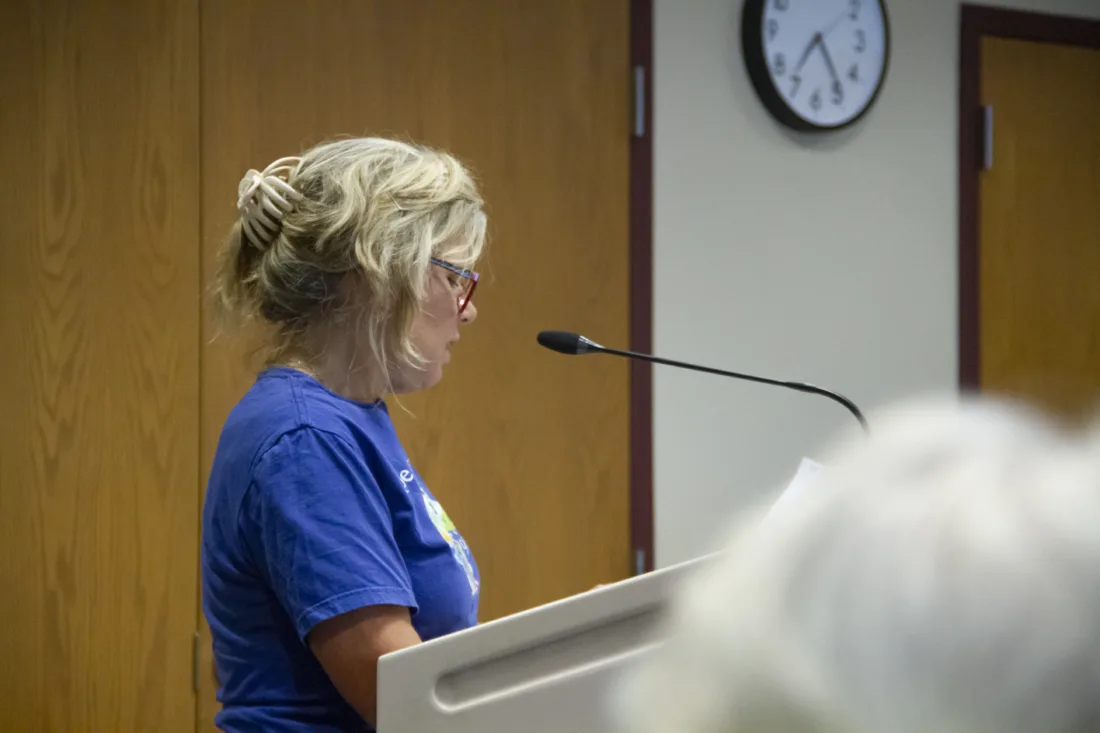
Laurie Kaski-Hammar, the driving force behind Hope on the Horizon, explains her vision for a rehabilitative shelter in Escanaba for people transitioning to employment and affording a place to live. (R. R. Branstrom | Daily Press)
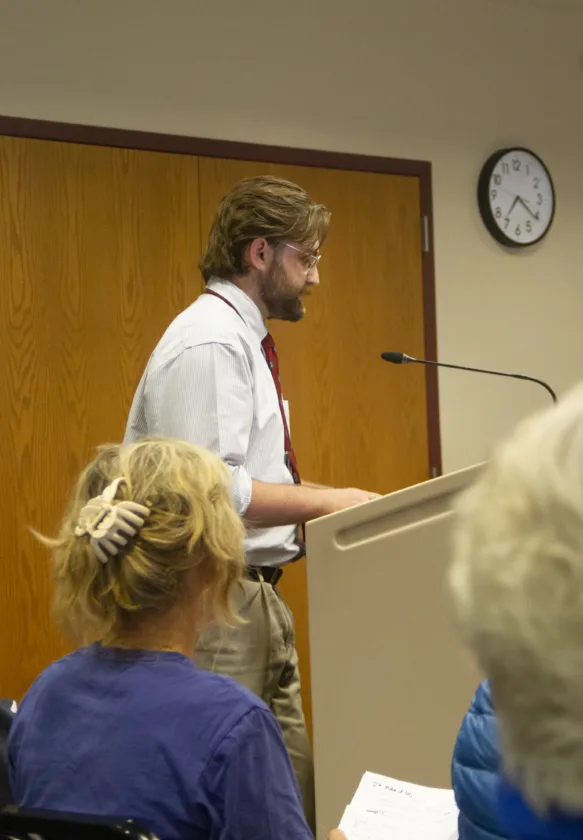
City of Escanaba Planning and Zoning Administrator introduces a contentious topic — proposal for a rezoning of 113 S. 10th St. — and tells City Council that the Planning Commission recommended denial. (R. R. Branstrom | Daily Press)
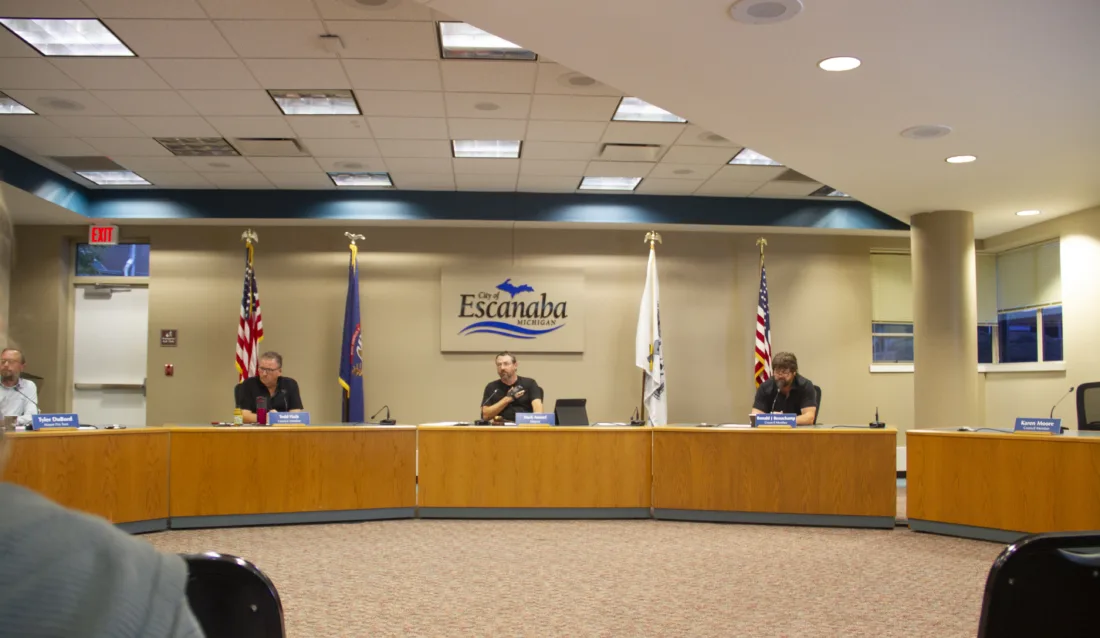
Escanaba City Council Members Tyler Dubord, Todd Flath, Mark Ammela dn Ron Beauchamp hear citizen comments about homelessness in Escanaba. Council Member Moore was not in attendance. (R. R. Branstrom | Daily Press)
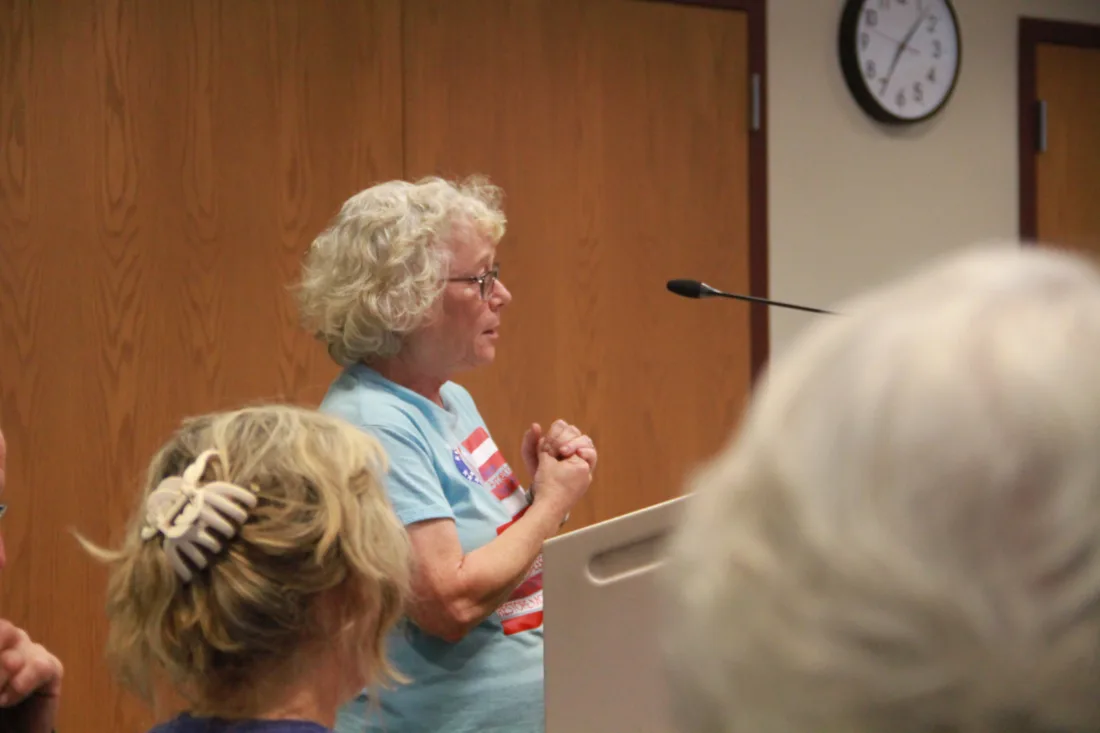
Leah Bellinger spoke to Escanaba City Council, asking them to approve a rezoning (from E to C) to allow a transitional shelter to open in an area that is currently commercial. (R. R. Branstrom)
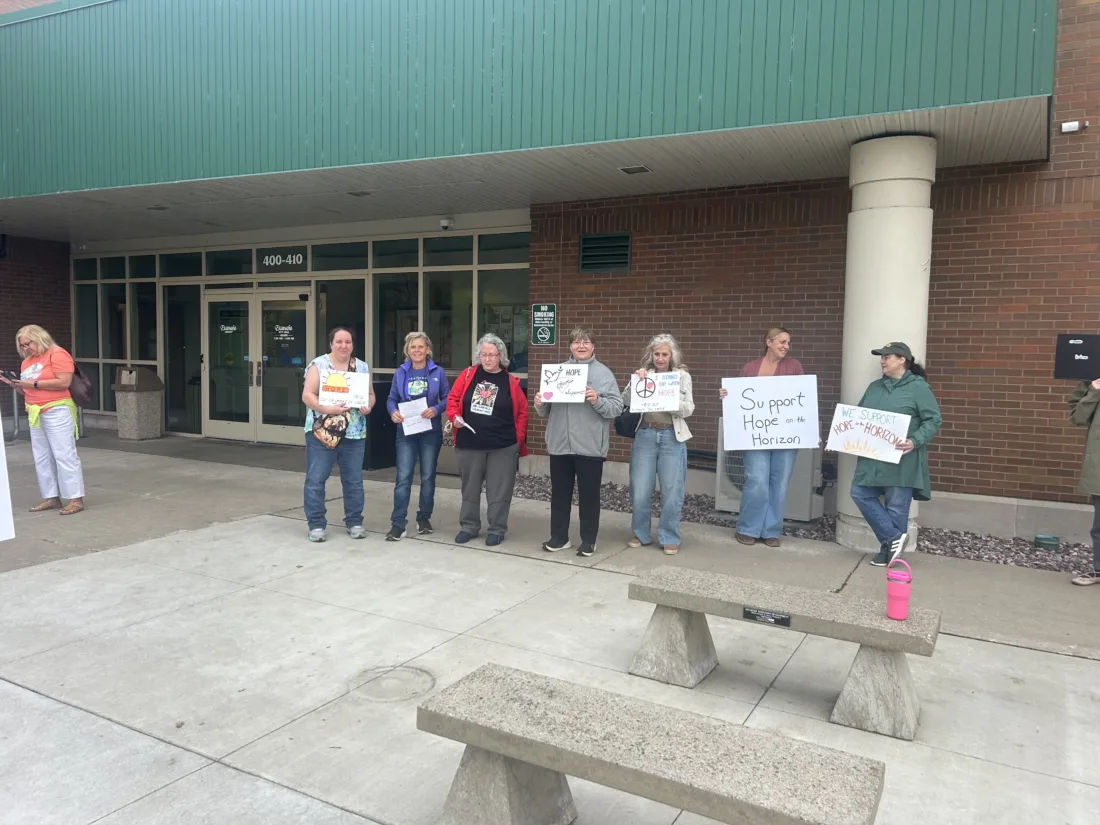
Some members of the community in attendance a the meeting arrived early with signs to show their support for the rezoning. (Liam Houston | Daily Press)
Laurie Kaski-Hammar, the driving force behind Hope on the Horizon, explains her vision for a rehabilitative shelter in Escanaba for people transitioning to employment and affording a place to live. (R. R. Branstrom | Daily Press)
City of Escanaba Planning and Zoning Administrator introduces a contentious topic — proposal for a rezoning of 113 S. 10th St. — and tells City Council that the Planning Commission recommended denial. (R. R. Branstrom | Daily Press)
Escanaba City Council Members Tyler Dubord, Todd Flath, Mark Ammela dn Ron Beauchamp hear citizen comments about homelessness in Escanaba. Council Member Moore was not in attendance. (R. R. Branstrom | Daily Press)
Leah Bellinger spoke to Escanaba City Council, asking them to approve a rezoning (from E to C) to allow a transitional shelter to open in an area that is currently commercial. (R. R. Branstrom)
Some members of the community in attendance a the meeting arrived early with signs to show their support for the rezoning. (Liam Houston | Daily Press)
Trending
ESCANABA -- The Escanaba City Council unanimously denied an amendment to an ordinance Thursday that would have rezoned 113 S. 10th St. for a homeless shelter.
If approved, the ordinance amendment would have changed the zoning designation of 113 S. 10th St. -- formerly occupied by Bertrands and Bittner Engineering -- from the existing Commercial ‘E’ district to the Residence (Multifamily) ‘C’ district to allow “Hope on the Horizon” -- an organization awaiting paperwork to become a 501(c)(3) nonprofit -- to establish a homeless shelter.
Almost two dozen community members approached the podium to speak on the issue during public comment and the designated public hearing, either in support of or against the rezoning ordinance.
According to Planning and Zoning Administrator Joey Walker, Hope on the Horizon’s intent was to establish transitional housing, which is defined in the zoning ordinance as a facility operated by a government or nonprofit agency providing interim sleeping and bath accommodations, interim eating and cooking facilities, and professional services to assist individuals or families in locating permanent housing.
Transitional housing is allowed by right in the Residence ‘C’ district.
In August, the planning commission unanimously voted to recommend denial of the rezoning, citing that a shelter in the commercial district was not in accordance with the city’s master plan.
Walker stated the planning commission found the proposal from Hope on the Horizon “did not meet the standards laid out in section 103.4.33 as whether the request should be granted.”
Leah Bellinger, of Gladstone, addressed the council during public comment -- prior to the rezoning ordinance’s public hearing -- in support of the rezoning for the proposed shelter. Bellinger noted the building at issue has been vacant for more than nine years, and there does not appear to be any commercial interest in the building.
“Additionally, there are at least 10 other vacant commercial buildings within a three-block radius of that building, so rezoning it to multifamily will not harm the downtown Escanaba area or the vision the DDA has for Escanaba,” Bellinger said. “The master plan does include a statement that there is a plan to accommodate homeless people, but the plan doesn’t include a location or a specific plan for how to help homeless people.”
Bellinger also gave examples of locals who could potentially benefit from a shelter like Hope on the Horizon, including those who worked at Mo’s Pub, The Stonehouse and the House of Ludington and were out of work after those establishments either burned to the ground or sustained fire damage.
Naomi Green, an Escanaba resident, also spoke during public comment, telling council members she has been homeless herself.
"I'm here to tell you that indifference kills,” Green said. “24 plus lives on any given day might be saved from suffering or being victimized or dying - most likely from exposure up here - but the homeless here… they exist. If you don’t know already, ask Community Action.”
Another Escanaba resident, Lydia Dutella, told the council she, too, used to be homeless and lived in a homeless shelter.
“I want all of you to look at how I’m dressed right now. You would have never imagined that I used to be homeless. I used to live in a homeless shelter. They’re not all evil people. Many come with many backgrounds,” Dutella said.
Val Heamstra, an Escanaba resident, spoke in support of the rezoning ordinance for the proposed homeless shelter. As a retired family practice doctor who worked in community health clinics in Boston and New York, Heamstra said she witnessed many homeless patients during her time in the medical field.
“Who were these people who were homeless? Anyone who has fallen on hard times - families whose house burned down, the elderly whose medical bills exceed their bank balances, anyone whose alcohol or drug use has exasperated their family to the point that they were kicked out,” Heamstra said.
Heamstra recalled cold winter nights when she and a small crew on a Boston Medical Center bus would venture into parts of the city where those without homes were living to provide medical examinations, some medications, warm coffee, soup and blankets.
“A job can turn things around, and many homeless (people) are looking for one. But it’s hard to get a job when you need a shower, your clothes need to be washed or your shoes stink,” Heamstra added. “To act as if we can ignore that problem (homelessness) is not going to make it go away. The need for a shelter in Escanaba is greater than ever with climbing prices for food and gas and housing.”
One Escanaba resident, who only identified herself as Robin, approached the podium to express concerns over the location of the proposed homeless shelter, noting the marijuana stores that are close by.
“I think that the location is not good. There’s too many temptations within that area,” Robin said. “Where are they transitioning from? I mean, it’s called transitional housing, but we don’t know where did they come from, and where are they going?… I’d just hate to see us getting a ghetto in Escanaba.”
Bonnie Hakala, of Escanaba, spoke Thursday evening, saying, “I’d like to say that we all want to help people, and let’s look at our city and what we already have in place. We have a lot of Section 8 housing that is available all over Escanaba… Do we need more of the same type of thing? Or are we getting a little heavy in that department?”
Hakala explicitly told the council she was against the rezoning ordinance.
“I think looking at it and the whole picture, there may be other communities that need help, and they should look into that help, but I don’t know that we’re going to be the community to take in all the homeless people,” Hakala added.
When the council began the public hearing, applicant Laurie Kaski-Hammer with Hope on the Horizon spoke. Kaski-Hammer said she and others visited “Dorothy’s Haven of Hope,” a homeless shelter/transitional facility, in Marinette this past weekend.
The Marinette facility is based in a three-story multifamily building in a residential neighborhood, Kaski-Hammer noted.
Kaski-Hammer also defined what exactly “transitional” means in the context of a facility, saying, “Transitional means transitioning from unhoused, not being able to pay for your home and having a stable job through education training to develop your own personal skills where you can own your own job and have your own job to maintain yourself with self-sufficiency.”
According to Kaski-Hammer, Dorothy’s Haven of Hope screens its residents for drugs and alcohol and has no tolerance for either. There is also a rule against swearing.
After applicants move through four different phases within Dorothy’s Haven of Hope, they can move into one of the facility’s duplexes for six months up to one year and rent it for $400 per month.
“Our goal is to be more of the high-barrier pass-through - more than just a bed. It will be a facility. It is not for everyone that is unhoused; it is for those who want a hand up, not a handout - those who want to stand up but need guidance,” Kaski-Hammer added.
While Escanaba Downtown Development Authority (DDA) Director Craig Woerpel said the DDA Board has not taken a position on the rezoning issue, he told the council it is important to keep the downtown district intact.
Woerpel said, “Is there a need to offer services to people that are experiencing homelessness? Of course. Is there a need to develop a thriving business community? Yes. The question is how to address both issues while preserving the city’s long-term planning goals. But the answer is not removing a portion of the commercial district, regardless of what that alternate use might be.”
An Escanaba resident named Liz Schlanvolt, who reportedly lives directly across from the proposed facility site, told council members she was against the proposed rezoning ordinance for Hope on the Horizon.
While Schlanvolt spoke in opposition of the rezoning ordinance, she noted she would have wound up being homeless as a young mother in college if it weren’t for the help of family members.
“I am against this, because I do not feel that they have an organized plan in place to ensure the safety of everyone; my family, my neighbors, the local businesses and the residents or citizens that they hope to house,” Schlanvolt said. “I do not feel that there’s been enough consistency in the explanations that have been offered or the plan that they have proposed.”
Although council members denied the rezoning ordinance, they did reportedly suggest Hope on the Horizon look for a viable building already in the Residence ‘C’ district.
——
Sophie Vogelmann can be reached at 906-786-2021, ext. 148, or svogelmann@dailypress.net.