
DNR confirms CWD in Marinette County
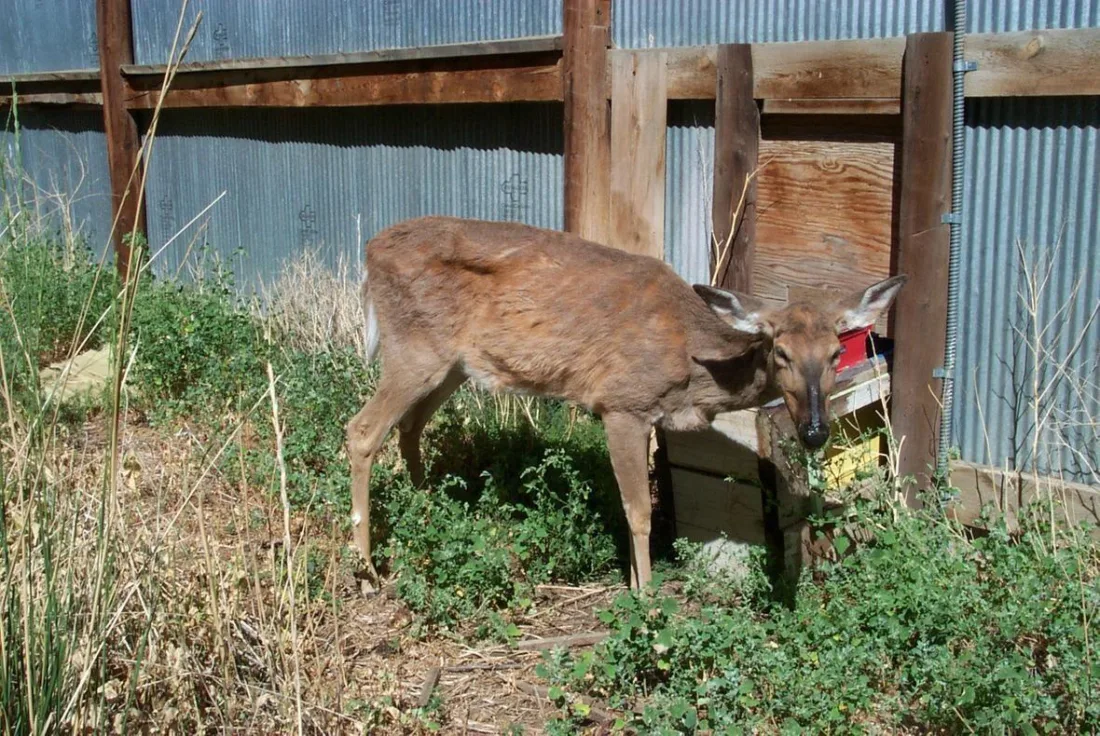
A white-tailed deer with chronic wasting disease. (Photo courtesy of Terry Kreeger, Wyoming Game and Fish and Chronic Wasting Disease Alliance)
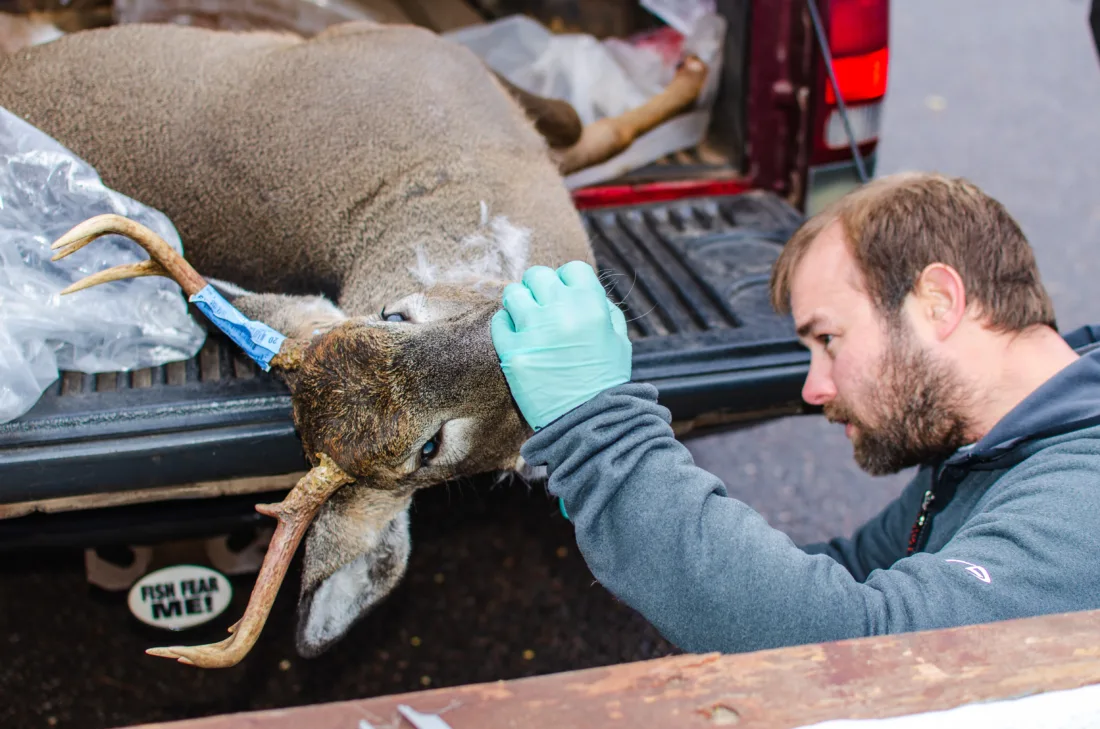
_DSC5451 Michigan Department of Natural Resources wildlife assistant Mark Bash extracts lymph nodes from a buck for chronic wasting disease testing at the DNR's Marquette deer check station. Deer check lymph node extraction.
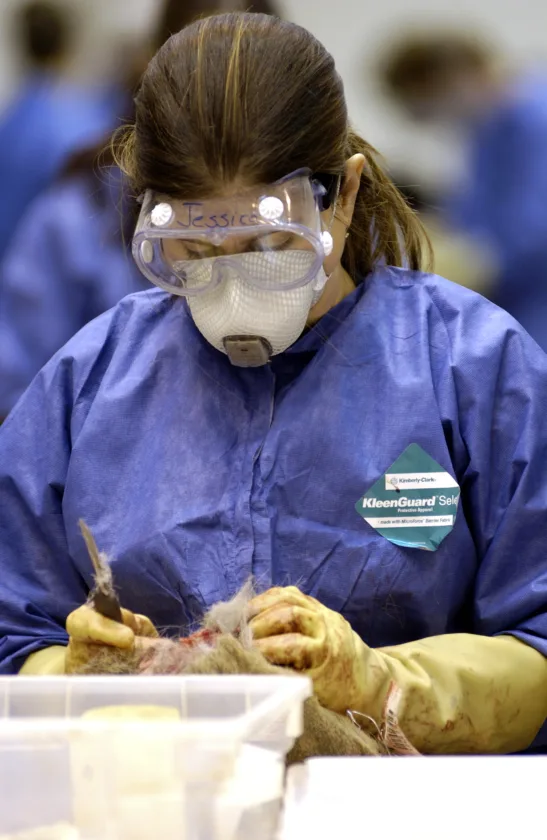
Testing for bovine tuberculosis and chronic wasting disease is conducted on a deer. (Photo courtesy of the Michigan Department of Natural Resources)
A white-tailed deer with chronic wasting disease. (Photo courtesy of Terry Kreeger, Wyoming Game and Fish and Chronic Wasting Disease Alliance)
_DSC5451 Michigan Department of Natural Resources wildlife assistant Mark Bash extracts lymph nodes from a buck for chronic wasting disease testing at the DNR's Marquette deer check station. Deer check lymph node extraction.
Testing for bovine tuberculosis and chronic wasting disease is conducted on a deer. (Photo courtesy of the Michigan Department of Natural Resources)
Trending
MARINETTE COUNTY, Wis. - The Wisconsin Department of Natural Resources (WDNR) has confirmed the first positive test result for chronic wasting disease (CWD) in a wild deer in Marinette County near Peshtigo.
On Thursday, the WDNR reported the disease was detected in a three-year-old adult buck, who was humanely dispatched due to signs of illness.
CWD is a fatal, infectious nervous system disease of deer, moose, elk and reindeer/caribou. The disease belongs to the family of diseases known as transmissible spongiform encephalopathies or prion diseases.
Once CWD is established in an area, the CWD prions stay in soil and water for years, according to the Center for Disease Control (CDC). The center expects the disease to continue to spread.
As a result of the recent detection, the WDNR has implemented a three-year extension on the current feeding and baiting ban in Marinette. The expiration date will be extended further with any additional detections anywhere in the county, according to the department.
The existing baiting and feeding bans in adjacent counties are reportedly not impacted by the detection in Marinette County.
State law requires the WDNR to enact a three-year baiting and feeding ban in counties where CWD has been detected, as well as a two-year ban in adjoining counties within 10 miles of a CWD detection.
If additional CWD cases are found during the lifetime of a baiting and feeding ban, the ban will renew for an additional two or three years with each new positive test result as they are confirmed.
The WDNR said baiting or feeding deer encourages them to congregate unnaturally around a shared food source where infected deer can spread CWD through direct contact with healthy deer or indirectly by leaving behind infectious prions in their saliva, blood, feces and urine.
CWD has spread to animals in 36 states in the continental United States since it was reported in the 1960s, the CDC reported.
The WDNR began monitoring the state’s wild white-tailed deer population for CWD in 1999, and the first positive test results for the disease in the state were found in 2002.
According to the Michigan DNR (MDNR), the first finding of CWD in Michigan was detected in 2015. There has only ever been one positive detection of CWD in the Upper Peninsula, which was found in Dickinson County.
The area in Michigan with the most detections is Montcalm County downstate, recording 203 positive CWD detections.
Whie the disease easily spreads amongst susceptible mammal populations, it does not appear to naturally infect cows, other livestock or pets, according to the CDC.
To date, there is no strong evidence that CWD infects people, though the CDC said studies show caution and additional research are warranted.
Scientists are conducting studies to learn more about the potential risk to people who hunt or eat deer or elk meat -- for example, by determining if they are diagnosed with prion diseases more often than people who do not.
"Since it may take years to decades for symptoms to appear, we won’t know the results for some time," said the CDC.
There are no vaccines or treatments for animals infected with CWD.
CWD sampling is available throughout Wisconsin and Michigan for hunters who want to know the status of the deer they harvested.
The WDNR noted samples from certain parts of the state -- the CWD priority areas -- are particularly important to the department's understanding of where CWD is and is not in the state.
Hunters who harvest deer in the priority areas in Wisconsin are encouraged to submit a CWD sample. A DNR CWD Sampling Needs map for Wisconsin showing priority areas is available on the WDNR's CWD Sampling webpage.
Additionally, CWD sampling locations can be found on the WDNR's CWD Sampling webpage.
For more information on CWD, as well as baiting and feeding regulations, visit the WDNR's CWD webpage and Baiting and Feeding webpage.
The WDNR also encourages the public to notify the department if a deer is exhibiting signs of CWD or if sick or dead deer or multiple dead deer in any one area are found.
To report sightings in Wisconsin, contact the DNR Wildlife Hotline by emailing DNRWildlifeSwitchboard@wisconsin.gov or calling 608-267-0866 and including the number of deer spotted, if the deer were sick or dead, the specific location of where the deer was seen -- including the county -- and the caller's contact information.
Locations of submission sites in Michigan where hunters can test their harvest for CWD can be found on the MDNR's Disease sample collection sites webpage.
Michigan residents are also encouraged to report sightings of any deer acting abnormally at Michigan.gov/EyesInTheField. Those making a report should include information about the location, number and condition of the animals observed.
Contact the MDNR Wildlife Health Section at 517-336-5030 with questions. Visit Michigan.gov/CWD for more information on CWD.
Clinical signs of CWD include:
-- No fear of humans.
-- Teeth grinding.
-- Notable weakness.
-- Drooping of head and ears.
-- Excessive thirst.
-- Difficulty swallowing.
-- Walking in set patterns.
-- Nervousness.
-- Loss of coordination.
-- Excessive salivation.
-- Diminished tone of facial muscles.
-- Excessive urination.
-- Severe emaciation and dehydration.
-- Inability to stand.
------
Sophie Vogelmann can be reached at 906-786-2021 or svogelmann@dailypress.net.