
O’Connor, Gladstone in court
Trending
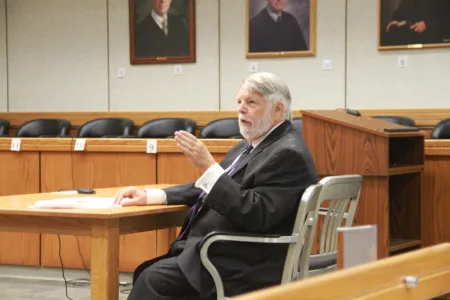
ESCANABA -- Last week, plaintiff Michael O'Connor appeared in Delta County 47th Circuit Court in regard to five lawsuits currently pending against the City of Gladstone. After some short discussion, Judge Brian D. Rahilly said that he would review the materials before issuing a written decision at a later point.
The lawsuits allege that the City of Gladstone is breaking the law and its own charter.
"The charter is a document that really is our city’s constitution, and I feel any citizen should be able to basically say, 'this is our constitution. I live in the city, and the city should follow the constitution, just like the state of Michigan has to follow the Michigan constitution, and we follow the U.S. constitution,'" O'Connor said to the court.
The session had been called because the defense (the city) made motion for a summary disposition -- meaning they were asking the judge to drop the cases.
“All five of these cases share a similar theme, which is that Mr. O’Connor seems to think he can run the City of Gladstone better than the people who’ve been elected to run it,” said Miller Canfield attorney Elizabeth Munoz-Smith, representing the City of Gladstone’s various parties. “His disagreement with the city operations does not give him a cause of action in any of the five cases.”
The suits can be classified into two categories, she said: “Two of them are requesting a writ of mandamus, and three of them are requesting declaratory and injunctive relief.”
The first case bring up the city’s meeting times, because the commission meetings are held at 6 p.m. while a reference to 7:30 p.m. is made in the city charter.
“They refuse to acknowledge that they have to follow any of the city charter requirements,” O’Connor told the court. “…I have repeatedly asked them to look into this and follow the rule, and they have denied it.”
The second involves what O’Connor says is a lack of required transparency in regards to utility costs. Gladstone’s charter states that the city must maintain accounts for each city-owned public utility that “shall show the actual cost to the city of each public utility owned, the cost of all extensions, additions and improvements, all expenses of maintenance, the amounts set aside for sinking fund purposes, and in the case of city operation, all operating expenses of every description” and that “the commission shall annually cause to be made and printed for public distribution a report showing the financial results.” The city’s position is that its release of an annual audit meets the obligations, but O’Connor disagrees.
In both of those cases, the plaintiff seeks a write of mandamus, which “is an order from a court to an inferior government official ordering the government official to properly fulfill their official duties or correct an abuse of discretion,” according to Cornell Law. The U.S. Department of Justice states that “mandamus is an extraordinary remedy, which should only be used in exceptional circumstances of peculiar emergency or public importance.”
As such, “it’s a very high bar for Mr. O’Connor to meet here. And as a matter of law, he has not met his burden in either of these two cases to identify any of the required elements” for writs of mandamus to be the proper solution, argued Munoz-Smith.
The final three cases addressed last week by Judge Rahilly are about the City of Gladstone using funds from the electric utility to replace aging power transformers that supply power to the city, using funds from the water utility to pay for the cost of replacing an aging water intake pipeline and the related infrastructure that supplies water to the city, and collecting tax through Public Act 33 to fund police and fire. All have been done; O’Connor wants it to stop.
“In those three cases, Mr. O’Connor asks the court to interpret the city charter in a way that would conflict with state law,” said Munoz-Smith.
Public Act 33 was a hot topic in Gladstone when it first arose in 2024. After citizens were upset that they had not been given a chance to vote on the city-wide levy, the majority voted in favor of a proposal drafted by O’Connor to remove the city’s power to collect special assessments.
Though the city’s lawyers say Public Act 33 is still allowed because the authority is granted by the State of Michigan, O’Connor disagrees. “The police and fire is a special assessment. It’s an ad valorem instead of a benefit-based special assessment,” he said. “(The city) has basically said, ‘well, we’re not going to adhere to what the citizens want.'”
One major thing the court must consider before issuing any resolutions is whether plaintiff O’Connor has standing in the case — if he personally has been harmed greater than the general populace of Gladstone.
“The court will take the matter into advisement, review the materials again, and issue a written decision as quickly as I can,” said Judge Rahilly last week.
Though Judge John Economopoulos usually presides over the 47th Circuit Court, he had a conflict of interest and was recused.
O’Connor has already filed another lawsuit against the City of Gladstone, the sixth this year, and said he intends to follow through on a couple more.