
Michigan health officials urge families to vaccinate before the new school year
U.S. measles cases hit a 35-year high
Trending
LANSING -- As families prepare for the start of the school year, Michigan health officials are urging parents to make sure their children’s vaccinations are up to date amid a nationwide surge in measles and continued circulation of other vaccine-preventable diseases.
According to the State of Michigan Chief Medical Executive Dr. Natasha Bagdasarian, the United States is experiencing its worst year of measles cases since 1991. The number of cases reported just over halfway through 2026 has already surpassed the total reported in all of 2025.
As of Thursday, the U.S. had reported 2,321 measles cases nationwide, according to the Johns Hopkins University measles tracker.
Despite repeated public health campaigns promoting routine childhood vaccinations, Michigan’s statewide school vaccine waiver rate rose to 6.2% in 2024, the highest since 2013, according to MDHHS.
Nearly all of those waivers were nonmedical, the agency reported. Of all waivers, 57.4% were granted for philosophical reasons, 39% for religious reasons and 3.5% for medical exemptions.
According to the Delta County quarterly immunization report card released in March 2026, 71.2% of Delta County children ages 19 to 35 months had received the full series of seven recommended childhood vaccinations, compared with 65.4% statewide and 73.8% nationally.
Amid declining vaccination rates, I Vaccinate -- a child immunization campaign of the Michigan Department of Health and Human Services (MDHHS) and the Franny Strong Foundation -- hosted a virtual media roundtable Thursday to discuss vaccination trends, data and the importance of staying up to date on recommended immunizations.
"Schools are reopening very shortly. We've got some Michigan classrooms reopening as early as August 17, and this is really the time we've got to start thinking about vaccinations and those back-to-school things," Bagdasarian said.
Gladstone Area Public Schools will be returning Aug. 24, while Escanaba Area Public Schools will welcome students back Aug. 26.
Parents can review their own school's immunization and waiver data on the MDHHS website before the school year begins. The site currently reflects 2024 data, with 2025 school-year figures expected soon.
So far this year, Michigan has reported two measles outbreaks, defined as three or more related cases. One occurred in Washtenaw County in March, and another in Ottawa County in May.
Michigan had confirmed 14 measles cases as of Thursday, including 11 linked to the two outbreaks, representing 78% of the state’s total cases.
Unvaccinated individuals are highly likely to contract measles if exposed to the measles virus. According to the Centers for Disease Control and Prevention, up to nine out of 10 unvaccinated people close to an infected person will catch it, and the virus can linger in the air for up to two hours after an infected person leaves a room.
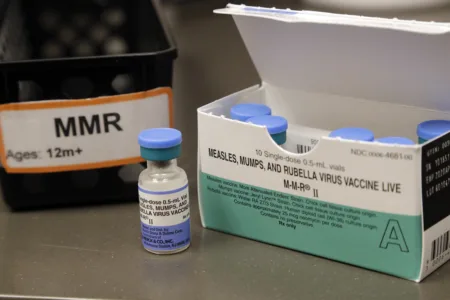
"The MMR (measles, mumps and rubella) vaccine remains our best defense, and two doses of MMR offer 97% protection against measles," Bagdasarian said in response to the Washtenaw County outbreak.
In addition, Bagdasarian warned that flu season is just around the corner. Last flu season, Michigan recorded over 8,000 flu-related hospitalizations, including nearly 1,000 involving children under the age of five. The state also reported 11 pediatric flu deaths.
"This is something that is tragic and something that we can work towards preventing," Bagdasarian said.
She also highlighted the resurgence of pertussis, commonly known as whooping cough. Michigan recorded more than 1,000 cases in 2025, many involving children under the age of two.
Severe complications from pertussis are common in infants. One in three babies who contract the disease requires hospitalization, one in five develops pneumonia and some experience seizures or brain swelling.
"I really want us to think about what is our responsibility to our kids, our grandkids, elderly members of our family who could be in those high-risk categories," Bagdasarian said.
MDHHS recommends families follow the American Academy of Pediatrics’ Recommended Child and Adolescent Immunization Schedule, which is based on decades of research and scientific data.
The routine vaccination schedule calls for the first dose to be administered between 12 and 15 months of age, followed by a second dose between ages 4 and 6. According to MDHHS, two doses offers 97% protection against measles.
Because people with measles can transmit the virus before they experience symptoms, MDHHS recommends early vaccination for infants ages six through 11 months.
Rachel VanDenBrink, a registered nurse and school nurse from Grand Rapids, also attended the roundtable. She said she spoke on behalf of school nurses across Michigan who care for students with chronic and complex medical conditions.
"When you look at the public health data… it's easy to hear those numbers, but as school nurses, we see the real human faces behind that data in our school communities," VanDenBrink said.
Students with conditions such as severe asthma or compromised immune systems to tracheostomies or ventilators can face serious health risks from illnesses that others may consider mild, VanDenBrink said. Those illnesses can then disrupt learning and academic progress.
"The most heartbreaking part is that many of these disruptions are preventable with timely vaccinations," VanDenBrink added. "When families choose to vaccinate, that impact reaches far beyond a single shot."
Because measles is highly contagious, health officials encourage parents to recognize the early signs of the disease.
Measles symptoms typically appear seven to 14 days after contact with the virus and begin with:
-- High fever (may spike to more than 104 degrees)
-- Cough
-- Runny nose (coryza)
-- Red, watery eyes (conjunctivitis)
Tiny white spots, known as Koplik spots, may also appear inside the mouth two to three days after symptoms begin.
A measles rash typically develops three to five days after the first symptoms. It usually begins as flat red spots on the face at the hairline before spreading downward to the neck, trunk, arms, legs and feet.
Small, raised bumps may appear on top of the flat red spots, and the rash may become more widespread as the spots merge. Fever may also rise above 104 degrees once the rash appears.
Measles can cause serious health complications, especially in children younger than 5 years of age. Common complications include ear infections and diarrhea, while more serious complications include pneumonia and encephalitis.
Bagdasarian encouraged families to review immunization records for every household member before the school year begins to identify any missed doses.
Records can be obtained through a child’s pediatrician or family physician, a local health department or by submitting a request through the Michigan Care Improvement Registry at mcir.org/public.
------
Sophie Vogelmann can be reached at 906-786-2021 or svogelmann@dailypress.net.