
Gilchrist speaks at U.P. State Fair
Trending
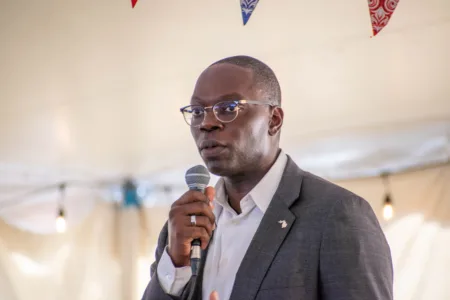
ESCANABA -- Lieutenant Governor Garlin Gilchrist II, the Democratic candidate for Michigan Secretary of State in the upcoming November election, spoke at a special luncheon on Thursday. The event was hosted as part of the Upper Peninsula State Fair's Honored Citizens Day events in Escanaba. This year marked Gilchrist’s third appearance and address at the fair luncheon.
"One of the biggest and most meaningful honors of serving as your lieutenant governor for the last seven and a half years has been the opportunity to experience, to meet, to spend time with, and to learn from the people of the many amazing and broad communities across the Upper Peninsula," Gilchrist said.
In his address during the luncheon, Gilchrist highlighted recent achievements in the State legislature, spoke on a wide range of present concerns in the Upper Peninsula and answered questions submitted by attendees.
Gilchrist first talked about the achievements that he has helped to enact in the state. First highlighted was the expansions in childcare access across the U.P.
"We have worked to expand access to [childcare] across the U.P. in a way that hasn't been done in a generation. We've opened up more new centers, we have more new professionals and there are more new slots [than] we've ever had. But we know there is more to come," Gilchrist said.
Gilchrist further spoke of Michigan being on a path for every child to go through a childcare experience and have pre-K education available to every household in Michigan, thanking those that have worked and advocated to make it possible. Gilchrist claimed that this path will help Michigan's education outcomes, improve literacy rates, stabilize families and lay a foundation for the future.
Gilchrist also thanked the legislature and those that advocated for making sure that every kid in Michigan has breakfast and lunch provided to them every day in school.
"It’s about helping them be able to be their best in the classroom," Gilchrist said.
Turning to higher education, Gilchrist shared his ongoing goals to make college more affordable for Michiganders.
"We are working to make higher education more affordable for everyone here in Michigan through things like our Michigan Achievement Scholarship, programs like Michigan Reconnect that was supported on a bipartisan basis starting six years ago, and as someone who only was able to go to the University of Michigan because of a scholarship, I know the difference that can make in someone's life trajectory." Gilchrist continued, talking about his desire for Michiganders of all ages seeking to pursue higher education to know that the U.P. is a great place to get educated and take the first steps towards a career, with many great institutions.
Addressing regional healthcare, Gilchrist stated that Upper Peninsula residents deserve complete access to medical services. However, he warned that federal budget cuts frequently make it difficult for state-level clinics to operate or offer specific treatments. He affirmed that the state is actively working to shield residents from these funding drops so communities can thrive. Throughout his speech, he praised local healthcare workers, caregivers, veterans, and advocates for driving positive change.
After Gilchrist's initial address, questions from attendees were read aloud to him for comment. Of these questions, a few stood out.
One attendee asked Gilchrist what his position on data centers in the U.P. was. To which Gilchrist assured that he understood better than any current official -- due to his software development background -- what AI is, and what the issue of data centers entails. He described the state of data center development in Michigan as, "perhaps one of the ugliest examples of corporate bullying that we've seen." He described how companies will thrust themselves onto a community even when elected representatives vote against them, and even as people in affected communities stand up and speak out.
"I don't think that they should have a say in what happens in our community," Gilchrist said. "I think we should have a say in what happens in our communities."
Gilchrist further noted that these sentiments come before any consideration of the potential impact data centers can have as far as environmental impacts, utility rates and noise levels associated with data centers. Gilchrist stated that Michigan has a unique opportunity to set better development standards for the tech industry.
The second major topic brought up by audience questions was state elections, specifically voting access. The lieutenant governor was asked what can be done to ensure vote by mail stays available.
Gilchrist answered by stating that half of current voters in Michigan choose to vote by mail. He also said that come this November, that number could be closer to 60% of voters. He explained that Michigan voters continue to "vote with their feet, so to speak" on this issue. According to Gilchrist, the fact that so many voters continue to choose to cast their ballot through the mail, shows the desire from Michigan citizens to keep this option intact and accessible.
He acknowledged that mail-in voting has faced heavy political opposition. “It's been under assault from a president that has attacked it directly and explicitly,” Gilchrist said. “But here in Michigan, just like every other state, we retain the authority given to us by the Constitution to determine the ways that people can vote in the state of Michigan.” He argued that if the option of voting by mail works so well for so many, the state should make it accessible, effective and safe.
The audience also asked about accessible voting machines. At many polling places there are specialized voting machines designed to assist those with different types and levels of ability. Gilchrist expressed that the availability of these machines is incredibly important, calling it a matter of civil rights. He stated that if an individual who is eligible and registered to vote shows up in person to cast their ballot -- who happens to be hard of hearing or has low mobility -- they should have the adequate tools available to do so. He described any instance where a person cannot vote due to a lack of equipment as a direct failure of democracy.
"I want this democracy to be successful, so I'll make sure that we have those resources."
Finally, an attendee asked why he chose to run for Secretary of State rather than Governor. Gilchrist explained that the Secretary of State is a vital position at a currently urgent and important time. He described how the secretary of state office is significant for its relationship with nearly every Michigander. He noted that almost everyone first starts interacting with the secretary of state office as early as 14 when they can get their Level 1 Learner’s License, and that that relationship continues long afterward.
"It is important, therefore, that someone steps in and serves you well, respects your time so [the secretary of state office] can conveniently deliver 21st century services," Gilchrist said, adding in a comment that he wants Michiganders to have the option of a digital drivers license, ensuring that losing a physical wallet does not mean losing your identification.