
Report highlights EAPS’ post-COVID academic progress
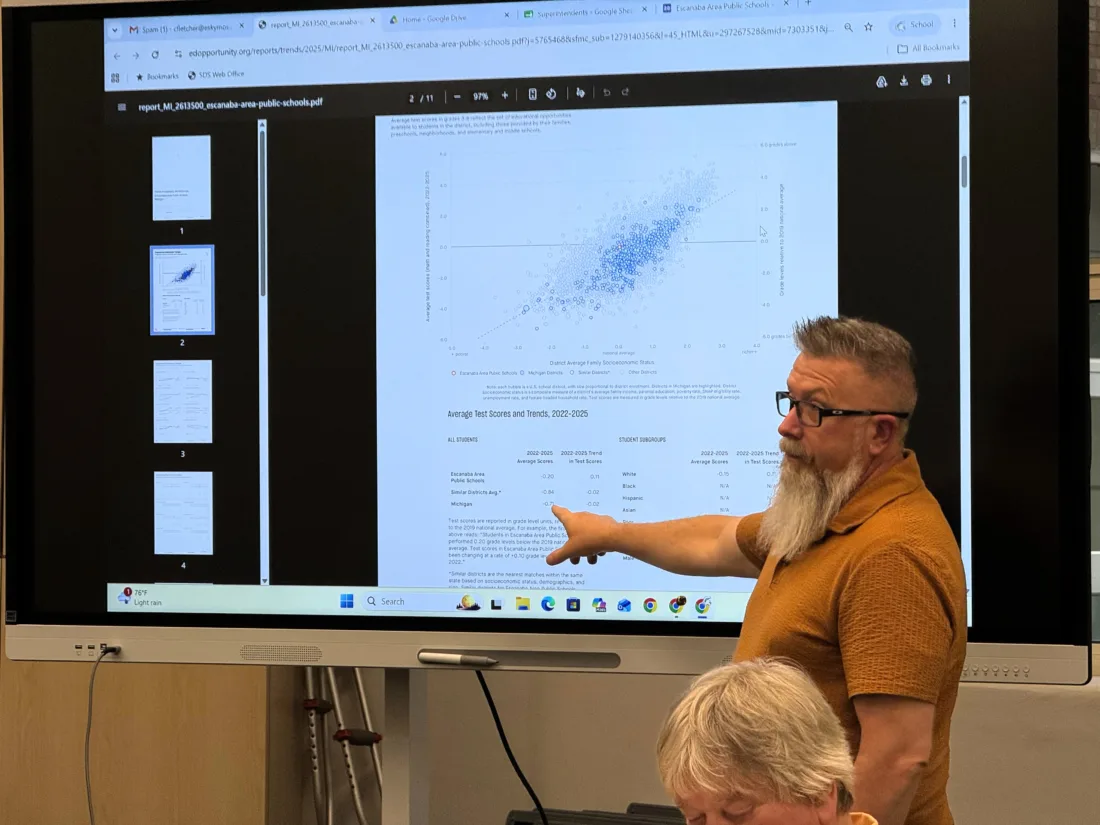
Escanaba Area Public Schools Superintendent Coby Fletcher presents post COVID-19 academic trends in the Escanaba school district compared to the state and nation at the Escanaba Area Public Schools Board of Education regular meeting Monday. (Sophie Vogelmann | Daily Press)
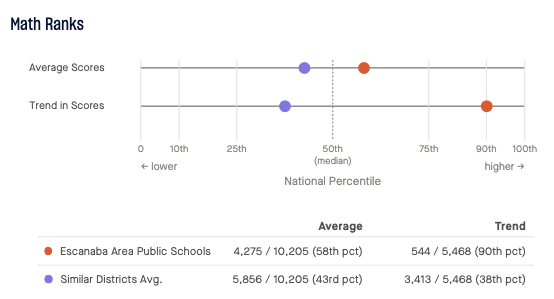
Academic performance rankings for math from 2022 to 2025 for Escanaba Area Public Schools relative to other districts in the U.S. (Data courtesy of Stanford Education Data Archive)
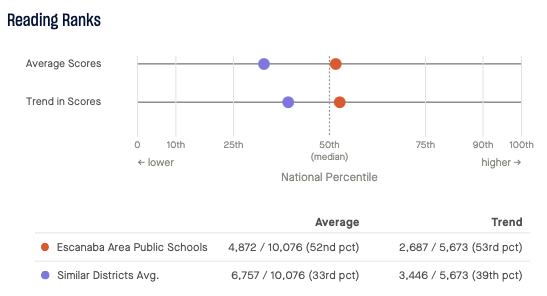
Academic performance rankings for reading from 2022 to 2025 for Escanaba Area Public Schools relative to other districts in the U.S. (Data courtesy of Stanford Education Data Archive)
Escanaba Area Public Schools Superintendent Coby Fletcher presents post COVID-19 academic trends in the Escanaba school district compared to the state and nation at the Escanaba Area Public Schools Board of Education regular meeting Monday. (Sophie Vogelmann | Daily Press)
Academic performance rankings for math from 2022 to 2025 for Escanaba Area Public Schools relative to other districts in the U.S. (Data courtesy of Stanford Education Data Archive)
Academic performance rankings for reading from 2022 to 2025 for Escanaba Area Public Schools relative to other districts in the U.S. (Data courtesy of Stanford Education Data Archive)
Trending
ESCANABA -- Escanaba Area Public Schools (EAPS) Superintendent Coby Fletcher presented trends in academic performance post-COVID-19 to the Escanaba Area Public Schools Board of Education during the board's recent meeting.
A report from Michigan State University's Education Policy Innovation Collaborative that was released in November 2025 presents Michigan students' progress toward learning goals in the wake of COVID.
"More than five years since COVID-19's unprecedented disruptions to learning and schooling began, student achievement trends in Michigan show both signs of progress and enduring challenges," the report states." Heightened variation in achievement across students poses new challenges for schools and educators, whose instruction and interventions must now address a broader range of learning needs than in the past."
During a recent school board meeting, Fletcher presented data summarizing district-level educational outcomes using data from the Stanford Education Data Archive (SEDA) from 2009 to 2025.
The report was created by the Educational Opportunity Project at Stanford University in collaboration with the Education Scorecard at Harvard University, using data provided by the National Center for Education Statistics and the Education Data Center.
According to the report, EAPS ranked higher than 51% of districts nationwide in average learning rates during the 2022-25 school years (4,014th of 8,147 districts with available data).
EAPS average test scores in grades three through eight from 2022-2025 are just under the national average but significantly better than the average in similar districts and throughout Michigan. The report also shows a positive trend in test scores, while other districts show a negative trend.
Fletcher said, "The rate at which our students are growing every year puts us between the 90th and 100th percentile nationwide, which means the work our teachers are doing to catch kids up is honestly among the best in the nation…really impressive what’s going on."
Similar districts to EAPS are reportedly Richmond Community Schools, Manistee Area Public Schools, Owosso Public Schools, Coldwater Community Schools and Tecumseh Public Schools.
The data trend also indicates EAPS students are gaining more than a year’s worth of knowledge per grade level -- about 11% more than expected. This means students are progressing at a faster rate than the typical benchmark.
Additionally, the report analyzes trends in average math test scores for all EAPS students in grades three through eight from 2009 to 2025.
Since 2022, EAPS scores have been trending significantly upwards, while similar districts and districts statewide are generally trending downwards or staying steady at a rate lower than EAPS.
The report also indicates the EAPS math test scores trend was generally inclining until 2018, when scores dramatically dipped and continued to do so during COVID-19. It wasn't until 2022 that test scores in this area began trending upwards again.
Reading scores in the same group have steadily declined since 2009, with sporadic upward trends for short periods of time. However, the trend in reading scores has been inclining since 2024.
"We would all like to see our reading scores a little bit higher, but when you compare us to the state of Michigan and similar districts, we're doing exceptionally well. Their trend is still almost a grade level behind in reading. Our trend is that we’re almost caught up, so that’s gone really well," Fletcher said.
EAPS students who are not low-income also have noticeably higher average math and reading test scores compared to low-income students.
Since 2022, the trend in math scores for EAPS students has been significantly inclining in both groups.
Average reading test score trends among both not low-income and low income students are a different story. While not-low income students again have a higher trend in reading scores, both groups have been on a steady decline since 2022.
The trend in EAPS reading scores for both income groups is, however, indicating a slight incline that began in 2024.
As far as academic performance rankings from 2022 to 2025, EAPS' average math scores are ranked in the 58th percentile, while similar districts average in the 43rd percentile.
"You can see that schools that are similar to us in math, their average score is well below the national average. Their trend actually falls even lower than that," Fletcher added. "In essence, what this is showing is they’re still regressing. They’re not caught up yet from the learning loss that occurred during COVID.
The trend in math scores for EAPS shows the district in the 90th percentile, while similar districts' averages trend in the 38th percentile.
"That’s a blow-it-out-of-the-water trend," Fletcher said. "That’s some super good work that’s going on in our classrooms right now."
EAPS ranks in the 52nd percentile in reading scores for the same time period, and similar districts rank in the 33rd. The trend in reading scores for EAPS shows the district in the 53rd percentile, while similar districts' averages trend in the 39th percentile.
The Educational Opportunity Project's data also includes chronic absenteeism in EAPS, similar districts and districts statewide. Chronic absenteeism rates indicate the proportion of students who were absent 10% or more of the school year.
According to the report, EAPS has the lowest average rate of chronic absenteeism among all students compared with both similar districts and districts statewide.
While chronic absenteeism increased across all districts statewide when comparing the 2017-2019 average with the 2022-2025 average, EAPS experienced the smallest increase relative to both similar districts and the statewide average.
Overall, the data presented to the board showed EAPS outperforming many comparable districts in student growth, math achievement and attendance as it continues recovering from the effects of the COVID-19 pandemic.
------
Sophie Vogelmann can be reached at 906-786-2021 or svogelmann@dailypress.net.